Sticky Post

We are currently not maintaining our blog here. Please go to our Facebook Page for latest updates!
Showing posts with label Articles. Show all posts

Friday, April 25, 2014

Stargazing on the green rooftop

Never underestimate the captivating power of a clear night sky. Since the last Sidewalk Astronomy at Yew Tee MRT station (check out our post here) (which attracted over 300 people in 2 hours), Scobbers headed out for an outreach event again last month. NIE’s Bachelor of Science Club (BSC) invited SCOB on our Facebook Page (Do like it if you haven't done so!) to conduct a stargazing session for the student teachers.

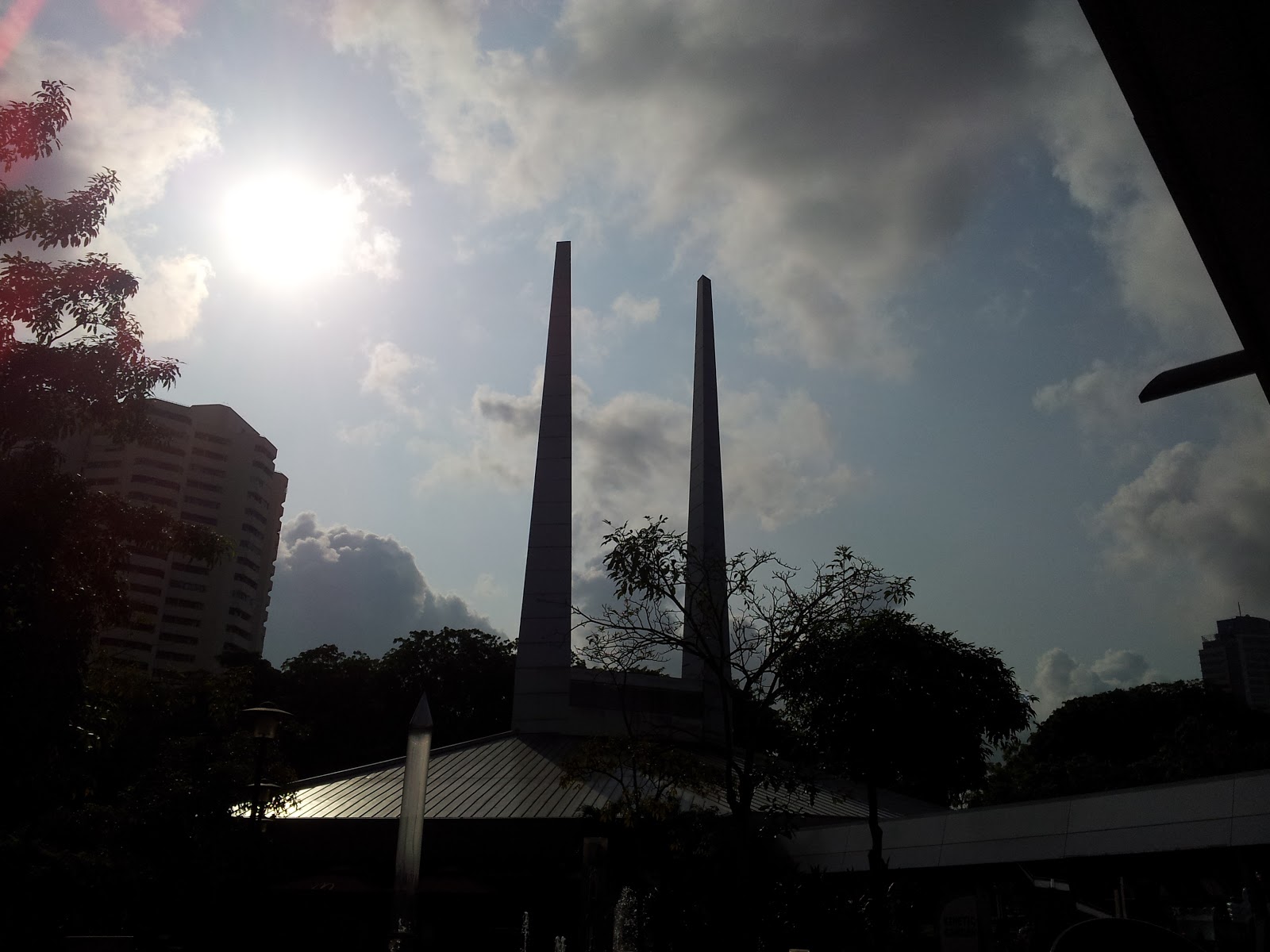
On 25th March 2014, Scobbers Alfred and Kin Guan brought starmaps (you can download them for free as well on SCS website) and a Celestron C8 telescope for the event. The venue was set at NTU’s School of Art, Design and Media (ADM) building. For those who have been there, the iconic curved rooftop is covered by grass patch completely. More importantly, the unobstructed view of the night sky was terrific. We were thrilled by the excellent choice of the stargazing spot.
Image Credit: NTU School of Art, Design and Media

At the start of the event, Kin Guan gave a short talk on the night sky to the audience who were enjoying pizzas at the same time. A tutorial on how to use the starmap was given as well as easy identification of stars and planets. After that, Alfred and Kin Guan manned the C8 telescope for viewing. We pointed out constellations using green laser pointers as well. At the end of the day, 50 student teachers enjoyed themselves and learnt one or two things about astronomy.

Scobber Alfred setting up the scope.

Alfred preparing the scope for viewing.

Scobber Kin Guan giving a brief introduction to the night sky.

Interested to have a sidewalk session for your club or school? Leave us a comment and we can arrange something together!


Wednesday, February 26, 2014

With Dr Neil deGrasse Tyson & Ann Druyan

On 13th and 14th February 2014, Scobbers Danny and Kin Guan were invited by National Geographic Channel to follow Dr Neil deGrasse Tyson around in Singapore.

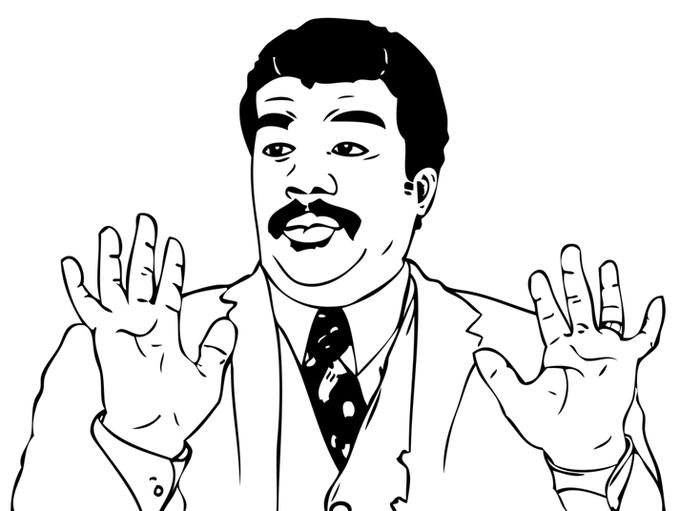
Yes, you heard it right. The sexiest astrophysicist in the world, the guy who made many kids cry by demoting Pluto to a dwarf planet, the frequent guest on The Daily Show and The Colbert Report, and the meme immortalized online.

Image Credit: knowyourmeme.com


He came to Singapore to promote his newest TV documentary series COSMOS: A Spacetime Odyssey. This 13-part series, combining drama, fantasy and stunning natural reality, is the follow-up of Carl Sagan’s classic COSMOS: A Personal Voyage produced thirty years ago. Covering a wide range of scientific topics such as the origin of life and the universe, Sagan did a terrific job in communicating science to a wide public audience. The programme has been broadcast in more than 60 countries and seen by over 500 million people.

Image Credit: Wikipedia
It was such a precious legacy left by Sagan to us. Since his death in 1996, his widow Ann Druyan has been trying to create a new version of the series. Together with Dr Tyson and Seth MacFarlane (yes, the Family Guy), she managed to secure funding and TV channel (Fox TV) for the show.

In Southeast Asia, the first episode “Standing Up In the Milky Way” will premiere on simulcast across National Geographic Channel (NGC), NGC HD, Nat Geo WILD, Nat Geo People, as well as FOX, FX, and FOXCRIME.  Danny and Kin Guan, along with other media representatives, had the privilege to watch it during the press conference and media preview on Thursday (13th February) held at ArtScience Museum.

Image Credit: National Geographic Channel

Image Credit: National Geographic Channel
Free from the shackles of time and space, Neil tells us the story of humankind and universe in his signature Ship of the Imagination. We were all amazed by the stunning visual effects and the splendorous views. The concept of compressing the whole history of the universe into one year opens up our eyes and mind – Human is so insignificant when placed in such a long scale of time. This is what Neil calls a “Cosmic Year”. For example, in the last second of the Cosmic Year (31 December, 23:59:59), human firstly observed the Moon in telescope and landed on it (which spans 400 years in real time)!

Image Credit: National Geographic Channel
Ann Druyan pointed out that the major differences between the old and new series are the cinematic experience and elements of skepticism. She mentioned that one 9-minute scene where the viewers are plunged into the heart of Titan, Saturn’s largest Moon. She believes that this new addition to the series will surely amaze the generations and beyond.

Image Credit: National Geographic Channel

Image Credit: National Geographic Channel
When asked how the rise of social media affects the science education for young generation, Neil was not worried over the phenomenon. Being an avid user of Twitter having 1.6 million followers, he found that the social media is not distraction at all. On the contrary, the power of visual splendour and storytelling bestowed by social media is staggeringly huge and provides an uplifting force to the society.

The last question asked was on his wrestling stint in Harvard: If he chose the road not taken and became a wrestler, what would be his ring name? The answer, of course, is related to astronomy. One very special property about the Moon is that it always faces the Earth with the same side. This effect, called “tidal locking”, can be true in the other way too! When the Earth faces the Moon with the same side, the phenomenon is called “double tidal lock”. VoilĂ , that’s Neil’s ring name and signature move.

What a menacing move from Neil the wrestler! "Double Tidal Lock"
Image Credit: National Geographic Channel
For a more detailed Q & A, please check out the blog post (link) on Science Centre website written by Danny!

Cosmos: A Spacetime Odyssey premieres on 15th March, 10pm (SG time), on the National Geographic Channel (SingTel mio TV Ch. 201 & StarHub TV Ch. 411). Don’t miss it!


Image Credit: National Geographic Channel

Thursday, February 13, 2014

Sidewalk Astronomy at Yew Tee


Last Friday (7th February 2014), Scobbers Alfred, Everlyne and Kin Guan showed the wonders of the night sky to the public in Yew Tee for the first time this year. This was a collaboration between Science Centre Singapore and Yew Tee RC Zone 10.

We brought our C8 Celestron telescope out and set the venue up with the help of RC volunteers. The venue was Yew Tee MRT Open Space (In between Yew Tee Square and Yew Tee Mall). (Google Street View)

Cloudy weather around 7pm on Friday. What could we see?

Scobbers having a briefing with RC volunteers.

Setting up the banner. 


We started the telescope viewing at 8pm and the queue was already forming:


Thanks to the clear sky (the clouds kindly made way for us), we were able to observe first quarter Moon (it's a half-lit moon from Earth's perspective) and Jupiter. Alfred manned the telescope and introduced some fun facts about Jupiter and Moon:


Everlyne interacted with the public in the queue and handed them Star Map. It is a handy tool to identify the objects in the night sky!


Tuesday, October 1, 2013

Happy Belated Mid Autumn Festival!

Scobbers were so busy that we forgot that Mid Autumn Festival has past! Other than filling ourselves with mooncakes and playing with sparklers, we found out some amazing facts about the Moon that you might not know.

1. The Moon was created in a huge impact event by a Mars-like object

Artist's Impression of Giant Impact event (Source: Wikipedia)

Termed as "Giant Impact Hypothesis", most scientists think that the Moon was formed after a great collision between the Earth and a Mars-sized object 4.5 billion years ago. It explains why the Earth and the Moon spin in similar ways. Scientists also did some calculations to show that if the post-impact Earth revolves in a 2-hour period, i.e. a day is 2 hours instead of 24 hours, we can explain some of the observations.

After the direct impact, the cores of the Mars-sized object and the young Earth fused. The collision made the post-impact Earth spin so fast that a significant portion of the Earth's mass was ejected to form the Moon. By the conservation of angular momentum (a quantity to describe an object's rotation), the Earth-Moon system has similar spin directions.

Also, if the Moon was created from the Earth's material we can explain the fact that the Earth and the Moon have similar chemical compositions. For example the isotopes of oxygen and titanium were found to have identical ratios in both lunar and terrestrial rocks.

The Mars-like object is commonly known as Theia. In Greek myth, Theia is a titan who gave birth to Selene the Moon, Helios the Sun and Eos the Dawn. That's why we use Selen- (or lunar) and Helio- to describe stuff related to the Moon and the Sun respectively.

2. We are always looking at the same side of the Moon

Near side of the Moon (Source: Wikipedia)
Far side of the Moon (Source: Wikipedia)
Readers may have known this fact a long time ago. The "dark" side of the Moon has also been depicted in movie as well. Of course, there are neither giant robots nor military bases located at the far side of the Moon, as shown in the NASA Astronomy Picture of the Day on 16 September 2013. (Direct YouTube link)

There is nothing hidden behind the Moon as shown in photos taken by lunar probes. There are only craters at the far side of the Moon (the side that is not facing us). On the other hand, the near side of the Moon (the side that is facing us) has more interesting features. Apart from the craters there are valleys, mountains and maria (meaning Sea in Latin). Maria appear dark as they mainly contain iron compounds that are less reflective. People in ancient times made up stories for the observed patterns, such as the Moon rabbit legend in Chinese culture. Do you see it in the following picture?

Did you see the Moon Rabbit? (Source: Wikipedia)
Regarding why the Moon always faces with the same side, we need to know how gravity works. Every massive object in the universe attracts each other with a force called gravity. For instance, an apple drops to the ground due to the Earth's gravity (the apple also attracts the Earth, but the effect is very negligible due to the Earth's much larger mass). The strength of the gravity depends on the distance between two objects, so in this case the near side is more attracted than the far side is, making the Moon face towards the Earth with only one side. This effect is called "Tidal Locking".

3. One day, we will lose the Moon

The Moon exerts a gravitational force on the Earth (and vice versa), pulling the water nearer to itself and causing high tide on the Earth. As the Earth rotates underneath the water (we can imagine Earth being a solid rocky ball covered by water), it tugs the tides and loses some of the rotational energy. As a result, the Moon picks up some of the energy and then speeds up, ascending from its orbit. On average, the distance between the Earth and the Moon increases by around 4 cm every year.

It has an interesting side effect: as the Earth loses rotational energy it will rotate slower and slower. The length of a day will increase as a result, amounting to 2 millisecond per century. Wish to have 48 hours per day? Perhaps if you're still around after 4 billion years!

Reference:
  1. Wikipedia. Moon. Retrieved 20 September 2013, from http://en.wikipedia.org/wiki/Moon
  2. Geology 5835 - The Moon - Fall 2006. University of Colorado Boulder. Retrieved 20 September 2013, from http://lasp.colorado.edu/life/GEOL5835/Moon_presentation_19Sept.pdf
  3. A New Model for the Origin of the Moon. Harvard University. Retrieved 24 September 2013, from http://www.fas.harvard.edu/~planets/sstewart/Moon.html
  4. M. Ä†uk, S.T. Stewart (2012). Making the Moon from a Fast-Spinning Earth: A Giant Impact Followed by Resonant Despinning. Science Vol. 338 no. 6110 pp. 1047-1052.

Friday, August 30, 2013

Venus: A Hostile Planet

It has been over one year since we witnessed Venus travelling in front of the Sun. We had an event last year to observe this rare phenomenon. Did you come?

Venus spotted in front of Science Centre's entrance.

Venus spotted in Johor Bahru, Malaysia.

In these few months we can observe Venus when we look towards the western sky. Often mistaken for a star, Venus appears as a very bright speck in the sky. It is so bright that it can actually cast shadows on Earth. 

Here are some short facts about Venus:
  • It is Earth's Twin Sister. It is the closest planet to Earth, and similar to Earth in terms of size and mass.
  • It is the only planet in the Solar System that is named after a female figure.
  • On Venus, a day is longer than a year. One Venusian day is 243 Earth days, and one Venusian year is 224.7 Earth days.
  • It is the hottest planet in the Solar System. The average surface temperature on Venus is 462 °C.
The last statement comes from the fact that Venus is shrouded by a thick atmosphere which consists of carbon dioxide and sulfuric acid. These gases form highly reflective clouds, preventing us from observing the Venus surface directly. In other words, the pictures we see are actually the Venusian atmosphere instead of the surface. Active volcanic activities happen on the surface of Venus, as evident in the radar image below. These make Venus an extremely hostile place for us to go!

Venus. The surface is obscured by thick clouds. (Wikipedia)

Craters on the surface of Venus. (Wikipedia)

Fortunately for us Earthlings, we can observe Venus from a safe distance (1.7 x 10^8 kilometres, or 17 followed by 7 zeros). Around 7pm to 9pm, we can observe Venus now until end of November. Look towards the Western sky and say hello to Venus! Science Centre Observatory opens every Friday from 7:45pm to 10pm, come and join us!


Thursday, December 20, 2012

Solstice on Doomsday!

December 21st is a significant date for a few reasons.
Every year around this date the Earth reaches a position around the Sun that causes the south pole to lean/tilt towards the Sun at its greatest extent. This is known as Solstice, which means "Sun-stationary".
This could mean its an ideal time to buy lots of nice pens, pencils and rulers illustrated with smiley-face suns for Christmas or.... that the Sun, having gradually shifted more toward the South each day for the past few months, has now reached its Southern-most point in the sky. Therefore with each new sunrise after 21st December, the Sun appears to reverse course and shift back towards the Northern half of the sky.


The effects of the Solstice are the related to the seasons, as the intensity of sunlight varies at different places on the Earth.
Commonly known as Winter Solstice, it also results in the shortest daylight hours and longest night of year in northern hemisphere countries. At the same time, southern hemisphere countries experience their Summer Solstice or longest daylight hours/shortest nights.

Naturally there are lots of cultural events and festivals around this time. In Singapore, some of those of Chinese ancestry celebrate with family and friends by eating a dessert known as tangyuan ćąŻĺś“


The region that receives the most intense sunlight at this time of year is known as the Tropic of Capricorn. This is because the Sun's position in the sky during this time (i.e. its southernmost point), used to be directly in front of the constellation Capricornus.
However, the Earth's tend to wobble as it rotates and over thousands of years this wobble (known as precession) resulted in the Sun's southern solstice position shifting into the neighbouring constellation of Sagittarius. I guess someone should go re-label all those globes and maps and replace the Tropic of Capricorn with "Tropic of Sagittarius". At the same time they should also change the northernmost position of the Sun as well (i.e. Tropic of Cancer Gemini).


Solstice in Singapore
As mentioned in my previous post during the June Solstice, the effects on equatorial regions, such as Singapore, are much more subtle.

Slightly north of the equator, Singapore also experiences its shortest daylight hours, roughly 12hrs 3mins 2secs from sunset to sunrise, but this does not coincide with the latest sunrise, which occurs during February in the tropics.
Solstice marks the time when Singapore sunrise becomes later than 7am (i.e.7:01am). From now until February, sunrise will gradually get later and later, so you can enjoy a few extra minutes of darkness in the morning.

Sun's position 9am June - Facing east, Sun rises from North-East (left)

Sun's position 9am December - Facing east, Sun rises from South-East (right)
At June/Northern Solstice the Sun rises from the North-East direction and sets North-West.
In December, sunrise is from South East and sunset South-West. Therefore, those with south-facing windows can expect more sunlight at this time of year, while north-facing window enjoy more shade. However, in December its raining most of the time, so it probably won't make much of a difference.


End of the year world
Finally, 21st December 2012 is now more well known for its association with the ending of an ancient Mayan calendar.
Mayan Pyramid of the Moon
These ancient Central Americans kept track of the days in the following way:
1 day is called a k’in.
20 days is referred to as 1 winal.
360 days is called 1 tun.
A period of 20 tuns is called 1 k’atun
20 k’atuns are grouped into 1 b’ak’tun, which is equal to 144,000 days.


This so called Mesoamerican Long Count Calendar ends after a cycle of 13 b'ak'tuns, which when translated to our modern Gregorian Calendar finishes on 21st December 2012. 
Many scholars and scientists  think that after this date the calendar simply repeats itself or starts again, similar to how we always start back at January every year.
However, there are many other ideas out there that have developed over time, referring to doomsday and the end of the world. Many are based on scientific findings and events like asteroid collisions, planetary alignments and solar storms but have been extremely exaggerated and highly unlikely.
I think its all just a great excuse to make tonnes of movies, documentaries, write books and articles.
I guess we will find out soon!

Thursday, October 25, 2012

Halloween in the tropics - an astronomical event

Next week is Halloween. This festival is normally associated with death and spook things but it also has an astronomical significance, just like alot of other seasonal holidays.

Halloween occurs on 31st October every year, which is in the middle of the season of Autumn or Fall in the Northern temperate regions of the Earth. During this time the leaves on many trees (so called "deciduous trees") start to turn brown and fall to the ground, in preparation for the approaching winter months.
I'd imagine that the disappearance of alot of the summer flora and fauna was one of the key influences for the "death" theme of Halloween, as at this time life simply seems to fade away, to be replaced by a cold, barren, frozen landscape.
A typical British street during winter - with leafless trees and frost or snow covering the ground.

These changes are mainly triggered by a reduction in the amount of sunlight, resulting in a lose of chlorophyll (the green stuff responsible for photosynthesis) in leaves.

Basically Halloween signifies the middle point between the Autumnal Equinox (22nd Sept - where night and day are equal in length) and the Northern Winter Solstice (21st Dec - the shortest daylight hours of the year).

Although we don't experience the same seasons here in tropical Singapore, there are a few  astronomical clues that can be observed around Halloween:

1) Early Sunrise/Sunset
If like me you wake up for work around 6:30am-6:45am, you may have noticed recently that the sky is already bright compared to a few months ago when at the same time it was still dark.
This is because on the day after Halloween (1st Nov) Singapore (and other tropical areas) experiences its earliest sunrise for the whole year. Sunrise on this day occurs at 6:46am compared to the latest sunrise of 7:17am on 10th Feb (incidentally close to Valentine's Day and Chinese New Year).
In the tropics, early sunrise also means early sunset. So if you get home around 7pm, over this next week, it should be almost dark as sunset on 1st Nov (and Halloween) is at 6:50pm.
All this is a result of the orientation of Earth's tilt relative to the Sun at this time of year.

9am Morning Sun during June  - Sun located towards North-east (on the left).
9am Morning Sun in October - Sun is slightly higher and more towards the South (right) than earlier in the year.

2) Southern Sun
During Equinox (22nd Sept) the Sun is directly level with the equator, which from Singapore, results in the Sun rising due East and setting due West, with the midday Sun directly overhead.
On December 21st (solstice) the Sun rises from its most southern point in the sky. Around Halloween the Sun will be halfway between these two positions. So the daytime sunlight will come from a slightly southern direction. Bad news for those with south-facing windows, as for the next few months you can expect more and more sunlight on that side of your house.

This effect can also be seen in the orientation of shadows on ground.
Back in June (close to northern solstice) the Sun was at its northern most point so shadows appear to point south.
12:30pm - Midday shadows in June (solstice) - shadow are long and point south (left).

During Equinox, shadows pointed more or less east and west as well as directly below our feet.
12:30pm - Midday shadows in September (Equinox)  -  shadows are short, gradually pointing west and east in the morning and afternoon.
Lunchtime shadows in September (Equinox) are directly  below our feet

Around Halloween shadows now point slightly north (i.e. opposite the Sun).
12pm - Midday Shadows in October (close to Halloween) - shadows point slight North (towards the right)
Of course Halloween has alot of other cultural and religious influences, but its timing is primarily astronomical in basis and represents one of the four so called "cross-quarter dates" that occur between solstice and equinox.


Being an astronomer in Singapore has its uses, sometimes to share these little tidbits of information with others whilst walking out for lunch, to pause for a few seconds in order to look around and observe the small occurrences of the Earth's daily wanderings through space before we ourselves resume going about our own daily life.