Sticky Post

We are currently not maintaining our blog here. Please go to our Facebook Page for latest updates!
Showing posts with label Satellites. Show all posts

Friday, February 1, 2013

February 2013

ISS
February starts with a bright International Space Station (ISS) pass over Singapore on Sun 3rd Feb 7:38pm-7:45pm.

During this time the ISS will pass almost directly overhead, from south-west to north-east between the bright stars of Orion and the planet Jupiter.
The only things that will interfere with its visibility will be clouds or the bright evening sky at this time of year.
Star map showing the path and timings of ISS pass on 3rd Feb in Singapore.

Sunrise-Sunset
You may have noticed that mornings remain darker for longer and early evening (ard 7pm) is brighter than usual.
Every year in February, Earth is halfway between its Solstice(21st Dec) and Equinox(21st Mar) position, resulting in the latest sunrise and sunset of the year in equatorial regions like Singapore.
Around 10th Feb the Sun rises at 7:17am and sets at 7:21pm.
Therefore the late sunset may impede ISS visibility.

Chinese New Year!
Its no coincidence that CNY also occurs on 10th Feb this year.
The date of Chinese Lunar New Year is also related to the position of the Sun at this time of year.
In China, the Sun's position around 3rd-4th Feb traditionally signifies the start of spring or Lichun 立春.
The New Moon closest to Lichun, is the start of the lunar new year.

Moon dates for Feb 2013


Obviously, during new moon, the moon is facing towards the Sun and is obscured from view. You can expect to see the Moon in the evening from 14th Feb to 26th Feb.
Position of the Moon in the early evening sky during Feb 2013


Jupiter's Moon
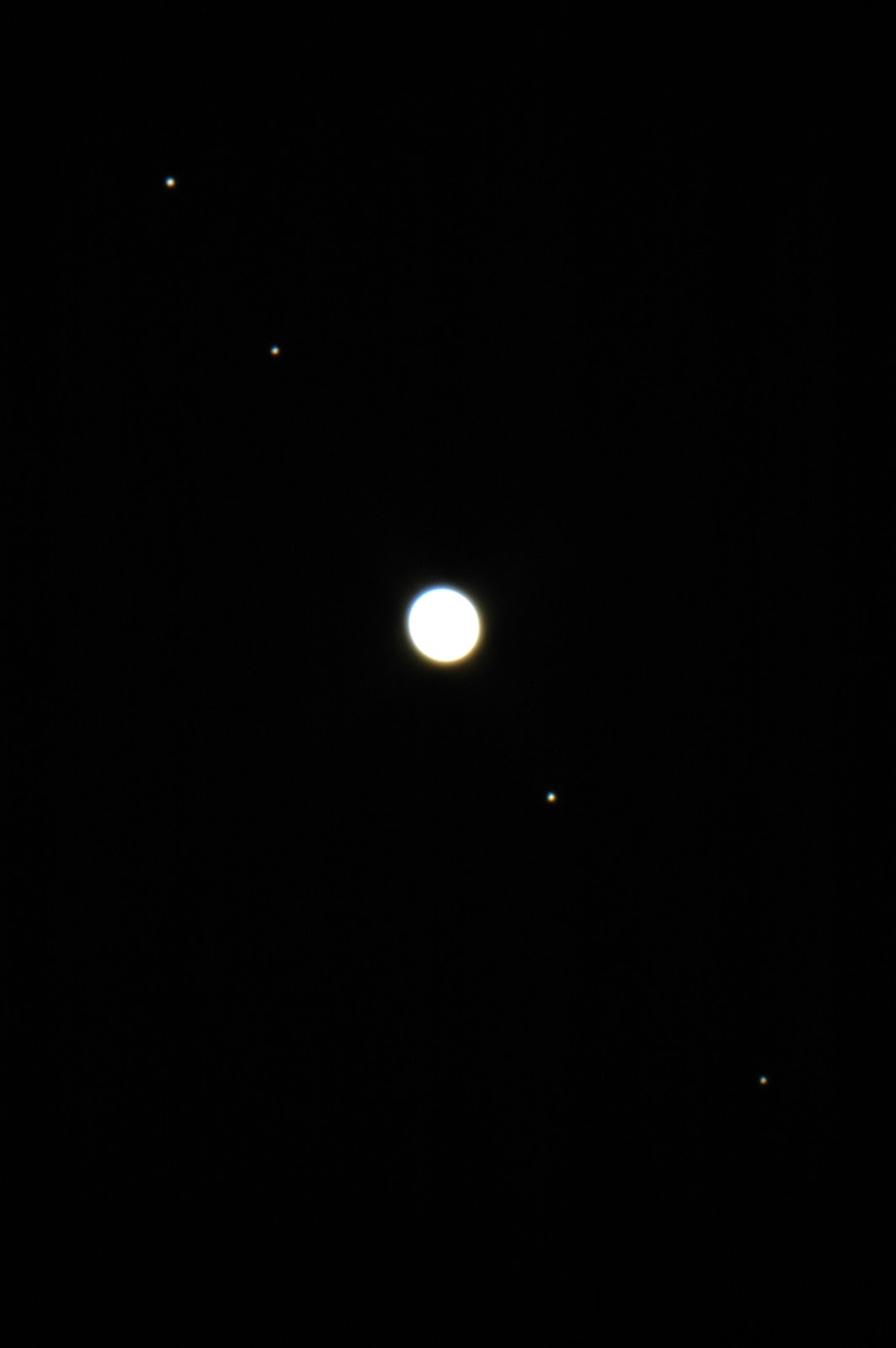
Jupiter remains the brightest planet in the night sky. During Friday's at SCOB we'll be able to see the following arrangement of its four biggest moons:

Mercury
The closest planet to the Sun, reaches its maximum elongation (18deg) east  of the Sun, meaning Mercury is at is highest position, towards the West direction shortly after sunset on 14th Feb (around 7:30pm). Ideal weather conditions (clear sky) are required to see it, but it is just visible to the naked eye.

Constellations
Finally, at least 8 of the brightest stars in the sky are visible in February. This includes Sirius, Canopus, Procyon.
One of our most common targets is of course Orion, reaching his highest point in the sky in the early evening this month, which should give us some pretty good views of the Orion Nebula.
Diagram of the brightest stars in the constellation Orion

Wednesday, November 14, 2012

1 night, 3 planets, 2 satellites, the Moon and stars!

Last weekend on the evening of  9th-10th Nov, there were lots of bright and interesting things up in the sky. Fortunately, the night was partially clear and I was ready with my camera to snap some photos.

First up was an Iridium Flare. These bright communication satellites only reflect sunlight for a few seconds at specific points in their low earth orbit (LEO). On Friday night 7:48pm we assembled the volunteers and visitors at our stargazing session together to witness the event.
Faint Iridium Flare - thin white line, centre, amidst the clouds - Friday 9th Nov 2012
This was my first attempt at photographing an Iridium flare. In my haste I didn't quite get the exposure and ISO setting correct, so it didn't turn out so bright but it was partially hidden by clouds also.


Next was Uranus. I've been trying to get a shot of this dim planet for more than a month now but the sky was always too bright and cloudy. Towards the end of last Friday's session, attempted to locate it in a clear patch of sky near the zenith. A bit of a challenge as our right ascension coordinates on our 1980's Pentax telescope controller are no longer working accurately. However, I was able to locate it in the finder with the aid starry night software and Google Sky Map.
Uranus - 9th Nov 2012 - Taken with Nikon D70s DSLR through 16" Cassegrain

Several visitors patiently waited until the the end of the session to catch a glimpse of Jupiter around 10pm.
Afterwards, I swapped the eyepiece for a T-Adapter and took a few shots. It was hard to get a sharp focus due to Jupiter's low altitude at the time (around 20degrees). It was nice to see the four Galilean Moons flanking Jupiter, with two on each side.
Jupiter - 9th Nov 2012 - taken using Nikon D70s DSLR through 6" refractor telescope.

Jupiter with Galilean Moons - from the top: Ganymede, Europa, Jupiter, Io, Callisto - 9th Nov 2012 - taken using Nikon D70s DSLR through 16" Cassegrain telescope.

Jupiter - 9th Nov - taken with Nikon D70s camera using 2x Barlow lens through 16" Cassegrain telescope.

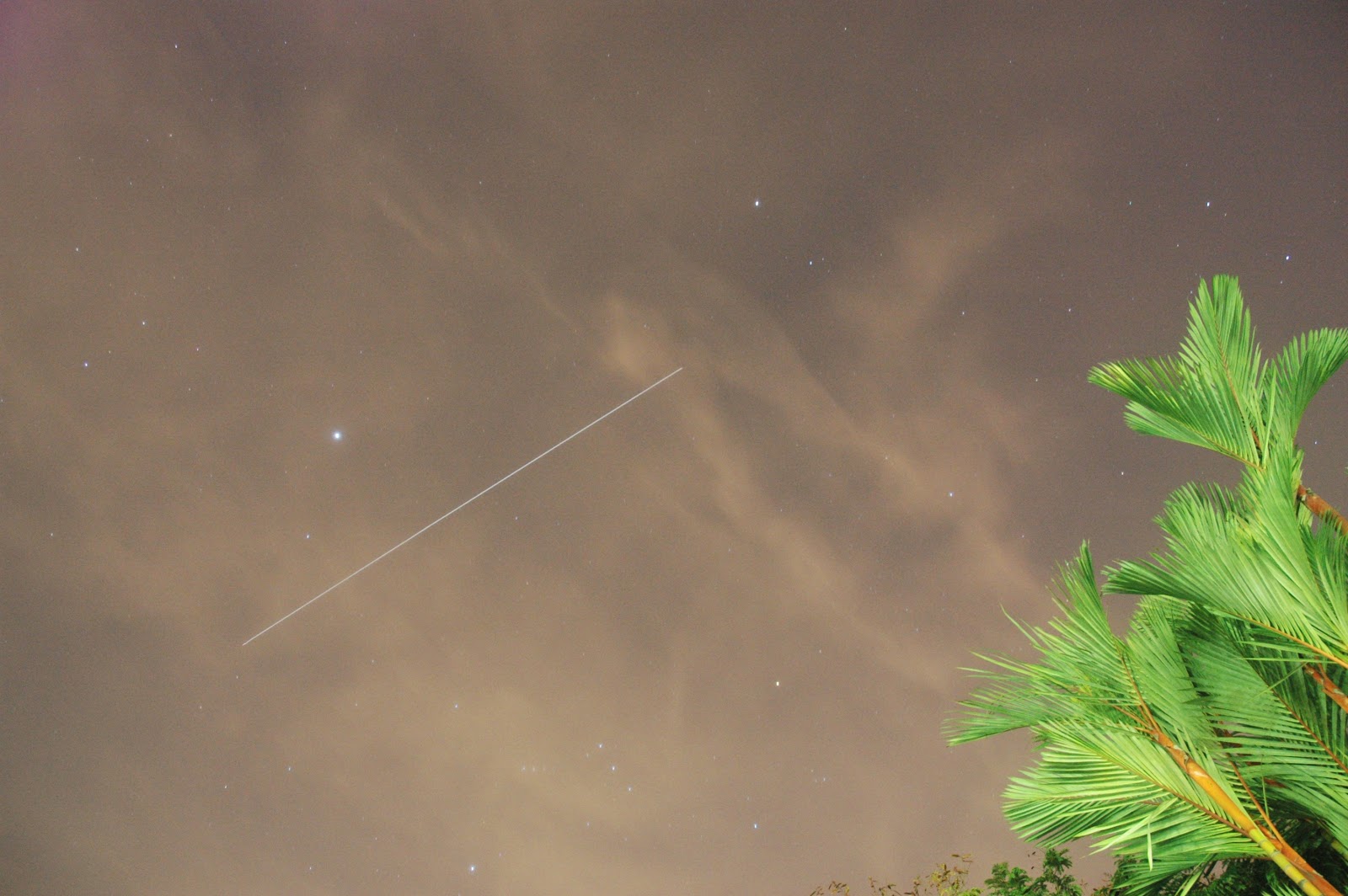
Reaching home around 11:30pm, I set my alarm for 5am to see a bright ISS flyby.
At 5:30am (Sat 10th Nov) I was ready outside with my camera, tripod and the mosquitoes.
It took about 4 mins for the space station to go from SW to NNE, however I kept my exposures to 30 seconds as I was worried the background sky would become too bright if I'd opened to shutter for longer.
ISS travelling between constellations Canis Major (above) & Orion (below), towards Canis Minor (top).


Fully awake with a bunch of bright objects in the sky, I continued to take more photos for the next few hours.
Jupiter (bright object at the bottom) with Orion (centre), Sirius (top left) and Procyon (Canis Minor, top right)

Moon (top) and Venus (below) - 6:20am Sat 10th November - Singapore

Waning Crescent Moon


Finally, sunrise came and as I leave near Changi Airport, I also got a shot of some planes before the sun came up.
Out of focus "Solar Pillar" phenomenon before sunrise 6:40am Sat 10th November

Plane landing at sunrise 6:50am


The Sun - shortly after sunrise - 7:20am Sat 10th Nov

Wednesday, June 27, 2012

Observing Satellites

Orbiting around our planet are thousands of electronic satellites that make great targets for urban astronomers like ourselves. And, there are a number of useful tools and apps that will help you locate them.

A common misconception is that the easiest satellites to spot are those in geosynchronous orbit (GSO) which  stay positioned above the same place on Earth. This is not true, as these satellites orbit at a distance of 35,786km, from which they cannot be seen as they have no light of their own.
The easiest satellittes to spot are those closest to us in low earth orbit (LEO), orbitting between 200km-2000km above the Earth. Such low orbits cause them to travel around the Earth 10 or 15 times every day, occassional travelling above Singapore.


A good website to find dates and timings of visible satellittes is Heavens-Above.
Once there, the first thing you must do is set your location. This is done under the "Configuration" menu: click "from database" and type in and select your city .i.e. Singapore.


You can be more precise by manually inputting your longitude and latitude or selecting from the map, however I often found these options give you the timings in UT (universal time/GMT) which is minus 8 hours from Singapore time,which is a be a bit confusing. Selecting your city from the database gives the local timings.

Once your location is set, just click on a satellite name. The brightest satellites are usually the International Space Station (ISS), Hubble Space Telescope (HST), Iridium Satellites (very bright communication satellites) or maybe China's Tiangong 1 space station.

After making a selection you will be presented with a table of information for all the visible passes for that particular time period.
This information includes the brightness or magnitude. The lower the number the brighter the object will be. Negative numbers indicates that the satellite will be brighter than most stars.
Satellites with magnitudes greater than 2 or 3 maybe difficult to spot in a light polluted environment.
The timings are given in 24hour format (HH:MM:SS) along with the altitude (height) and azimuth (direction) of the satellite at that particular time. Some satellites are visible for several minutes, so their start and end timings/positions are stated separately.
The highest possible altitude is 90 degree (directly overhead). Altitudes below 30 degrees may not be visible from some locations due to trees or tall buildings.

Iridium Satellites (http://en.wikipedia.org/wiki/Iridium_satellite_constellationare only visible for a few seconds so usually only one time period is stated. Because of the shape of their solar panels, they only reflect the sunlight for short period of time but the reflection is very intense and quickly fades from view, this is known as an Iridium Flare. 
Iridium satellite 
Apps for Satellite Tracking

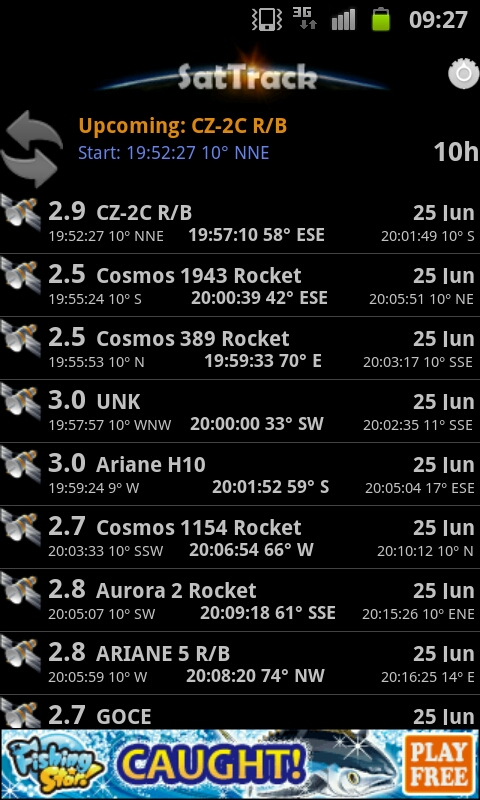
One of the most useful ways to find satellites is using a smartphone app. I've only tried one so far called SatTrack for Android phones from Goggle Play Store:
Again, the first thing is to set your location using your GPS, once that's done you'll get a list of all visible satellites passing over your location. This even includes various rockets and other space junk left behind in orbit. Its best to use the settings to filter the most visible ones. Basically, anything brighter (lower) than magnitude 2.5 and higher than 30 degrees in altitude should be easy to find.


Once you select a satellite, you'll be presented with the magnitude, timings, altitude and azimuth as well as a handy compass which indicates the location and direction in which the satellite will travel across the sky (the purple line).

The app sometimes sends you notifications, when a satellite pass is due to start but you can also select an extra alarm/vibrate setting for those satellites you do not want to miss.

SatTrack app is free and there's also a paid version (without ads) but there many other satellite apps on the android market. There are also some on iTunes for iPhone users, this include: GoSatWatch and Satellites although they're not free,

Look out for those bright Iridium Flares and ISS sightings over the coming week.

Monday, June 8, 2009

Viewing the International Space Station

Last Friday (5th June) was a nice night. Although the Moon was almost full and brighten the sky considerably, it was remarkable clear, giving us a great view of constellations such as Leo, Crux, Centaurus and Ursa Major.

The best highlight of the night had to be the appearance of the International Space Station (ISS) as it raced across the sky in its Low Earth Orbit. It was only visible for 2 or 3 minutes but it was an impressive sight watching this bright white dot suddenly appear moving from NNW to SW before disppearing into the Earth's shadow. With a good pair of binoculars I was able to make out its irregular shape, different from stars or planet which look like round dots.

The ISS is orbitting the Earth at an altitude of about 35okm above the ground. It can complete 1 orbit of the Earth in about 90 mins and 15 orbits in one day. As such, if you're in the right time or place its a nice object to try and spot.


Dates and times for ISS sightings can be found on the NASA human spaceflight website:
http://spaceflight.nasa.gov/realdata/sightings/

and also on a site called Heaven's Above:
http://www.heavens-above.com/?lat=1.29422&lng=103.85376&loc=Singapore&alt=0&tz=MALST

You need to select or find your viewing location (e.g. Singapore) before searching for the timings.

Here is a summary of the more visible sightings over next month (in Singapore):
Mon 8th June: 8:02pm to 8:04pm - moving from WSW to SSW direction - very low
(10-15 degree above horizon) - clear view of SW direction required.

Wed 10th June: 6:16am to 6:19am - moving from South to ESE direction - low in the sky
(10-20 degree above horizon) - clear view of SE direction required

Sat 13th June: 5:58am to 6:01am - from West to NNW (across Northern part of sky, staring 35 degrees above horizon)

Sun 5th July: 8:23pm to 8:27pm - moving from SW to NNE - passing almost directly overhead (85 degree from horizon)

Tues 7th July: 7:37pm to7:42pm - moving from SW to NNE - passing almost directly overhead (79 degree above horizon) - shortly after sunset.

Fri 10th July: 6:14am to 6:20am - moving from NNW to SE - fairly high in the sky (maximium of 51degrees above horizon)


The next time we can see the ISS at the observatory on our Friday night stargazing session is:

Friday 7th August: 7:40pm - for about 1 minute :( - traveling WSW to SSW, only 11 degrees above horizon.
Meaning just after sunset when we'll be setting up we might get another glimpse of ISS, hopefully.

The next "better" sighting on a Friday will be :
Fri 4th Sept - 7:36pm to 7:41pm - 5 minutes!!!! - SW to NNE
We look foward to it :)


The ISS taken from a NASA Space Shuttle (can't remember which shuttle tho) in orbit.