Sticky Post

We are currently not maintaining our blog here. Please go to our Facebook Page for latest updates!
Showing posts with label Meteors. Show all posts

Monday, August 13, 2012

Watching for Perseids...... and early morning planets

Was awake at 4am last night to watch the Perseid meteor shower. Backed out of my grand plan of staying up all night in favour of getting some sleep for the first half of the night. Unfortunately, as is often the case, the sky was too cloudy and bright. In the end I only saw two bright meteors, one about 4:45am, the other around 5:30am.

Our other meteor shower events in previous years didn't yield much results either. Of course, Singapore, like most cities, isn't a great place for watching meteor showers but it was worth a try. Every meteor shower I've watched here has turned out cloudy for most of the night. In fact the last meteor showers I watched whilst studying in the UK, also turned out cloudy, although I did see more meteors overall.


Anyway, as the clouds began to clear, towards dawn, I hung around to gaze upon the rather nice sight of the Crescent Moon, in-between Juipter (above) and Venus (below) together with several constellations like Taurus and Orion: 


The "M-shaped" constellation, Cassiopeia , faintly visible through clouds.


Friday, August 10, 2012

Highlights for August 2012

Its already the middle of August and so much is happening up in the heavens.

Planets in August
Last monday, NASA successfully landed  the largest robotic rover, Curiosity, on Mars.


In the sky, Mars is still visible low in the west, during the early evening, forming a neat little triangle with the bright star Spica and the planet Saturn. This triangle continues to get smaller every day, until about 14th August when the three objects appear in line with each other. After 14th August, Mars will gradually move upwards away from Saturn and Spica. They are best viewed before 9pm.
The reason for this alignment is that Earth, Saturn and Mars are roughly in line with each other in the Solar System. However, the three planets are not in line with the Sun, as Mars and Saturn are located towards one side of Earth, which is gradually speeding away towards the other side of the Sun.


There is also a similar alignment towards the morning side of the Earth, with Venus and Jupiter still visible in the early morning around 6am.

Meteor Showers
August is also a great time for meteor showers as the not so prominent Delta Aquarids comes to an end at the beginning of August and the much more obvious Perseids Meteor Showers peaks around 12th and 13th August. To view the Perseids its best to stay up all night and watch the sky between midnight and dawn on either 11th or 12th August to have the best chance of catching shooting stars. However, in an urban environment like Singapore, you're likely to see much less meteors than those in darker areas.

Early morning (6am) on 13th August, you'll also see the waning crescent Moon just above Venus and Jupiter. With four planets, the moon and a meteor shower visible in one night, I'm hoping to stay up all night on Sunday and take some photos.

Stars and Constellations
As in July, Scorpius and Sagittarius remain high and bright in the sky, towards the South. Here's a recent photo of Scorpius taken by one of our scobbers, Li Fei:

On 24th August there is a First Quarter Half Moon, this night is also known as Qi Xi 七夕, the 7th day of the 7th month of the Chinese Lunar Calendar. Associated with this night is the story of Niu Lang 牛郎 (cow herd) and Zhi nu 织女 (weaver girl), who become separated and meet again every year on Qi Xi.
The story is also represented by the constellations Cygnus, Lyra and Aquila. The brightest stars of these three constellations (Deneb, Vega, Altair) form the Summer Triangle which appears low in the east this month.

Tuesday, December 7, 2010

Rainy Days and Shooting Stars

Tis the season to be jolly fa la la la la, la la la la.
We're in the middle of the holidays and Christmas is approaching, there's a relaxed atmosphere in the office as most people are clearing leave, thinking of year end parties and planning secret santa gift exchanges, which remains me I must find a good day to pop out at lunch to buy my gift for D-day this Friday.
Of course this does not mean that we scobbers are just sat around the office surfing the internet feeling all merry, of course not no no no... half of us are on leave sat at home surfing the internet or even off on holiday somewhere feeling even merrier :)
For those of us still in the office, its all work work work, there's still shows to perform, visitors to entertains, events and programmes to prepare for, even surfing the internet and this blogpost is work related...-gives oneself pat on back for working so hard-... Although I probably would be on leave now if I hadn't used it up earlier in the year.

Anyways back to work.... at SCOB there's alot of planning to be done. We're currently working on developing a planetarium programme for our friday night stargazing using our new inflatable STARLAB planetarium, which requires further testing but will probably be ready early next year.

Stargazing on Fridays has been severely limited by the rain. December is actually great for stargazing as there are several bright constellations and interesting objects around, its just unfortunate that this period is one of the most cloudiest and rainiest in Singapore.

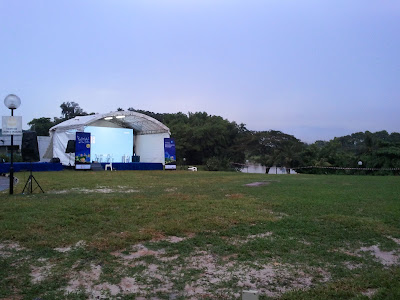
It was a similar story last month, especially during our big event "The Festival Of Stars" held on the eve of the Hari Raya Haji holiday on 16th Nov. A few thousand people turned up expecting a look at Jupiter through the many telescopes provided by TASOS and SCOB and hoping to stay overnight to witness the shooting stars of the Leonids Meteor Shower.
Instead, we were all witness to a tremendous rain shower:
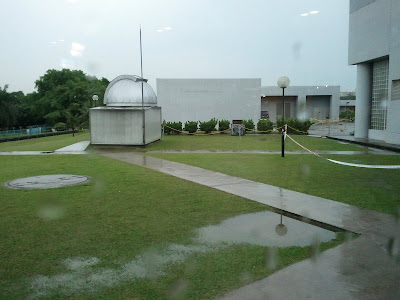

The observatory and stage area was literally flooded. No stars or meteors visible on this occasion. However, it was decided that the show must go on, as all the outdoor festivities, performances and movie screenings were moved to the indoor auditorium at the Annexe Hall 1, the Science Centre Exhibitions were also opened for all.


At the SCOB, things remained rather quiet, with just a handful of families remaining to participate in the arts and crafts activities. Only thing left for scobbers to do was to regrettably inform new arrivals of the wet weather and usher them to the galleries and annexe auditorium. We also put up a temporary sign to help guide visitors along and reduce the amount of times we had to repeat the information.


Now dare I say that there is another meteor shower coming this December, in fact its happening this very weekend. The Geminids Meteor Shower peaks around December 12th & 13th every year. This year is supposed to be a pretty good one as the Geminid Meteors are expected to be brigther and more numerous than meteor showers in previous months.

Having said that, its best not to get your hopes up. Remember, watching any meteor shower in an urban environment like Singapore will yield a relatively low number of shooting stars. Whereas the expected number of Geminids is supposed to be 40-60 meteors per hour, you are more likely to see one or two per hour, somemore its rainy season so expect more rain than meteors.

SCOB we will not be organising any event for the Geminids. For those who wish to view it from home, it is best seen on the evening of 12th December between 12am and 5am (which technically is early on 13th Dec). Meteors will originate from the North-East direction and can travel in any direction (up, left, right).

If you do manage to see any meteors let us know how many and where from. This Friday 10th Dec on Friday Night Stargazing we'll also be giving a talk at 8:15pm, giving more information on the Geminids and other meteor showers.

Merry Christmas Ho Ho Ho!!!

Monday, November 15, 2010

Festival of Stars - Shooting Stars, Jupiter and Movies!

Its that time of the year again for the Leonids Meteor Shower. The best time to see the shooting stars will be Tuesday 16th Nov and Wednesday 17th Nov (Hari Raya Haji), between the very late to very early hours of 12am and 5am.

Scanning through various astronomy-related sites, I see that the expected rate of meteors for this year's shower is about 20 meteors per hour. Now, as I'm sure many found out last year, watching a meteor shower in a light-polluted urban environment such as Singapore yields significantly less than the expected number of shooting stars. You will be considered extremely fortunate indeed if you manage to see just 20 meteors over the whole night.

To make matters worst, The Moon's brightness also reduces the number of meteors, meaning you're most likely to see the shower after 3am when the Moon sets.

All it not lost however, The Festival of Stars is here! Science Centre and TASOS (The Astronomical Society of Singapore) have teamed up to provide an evening of entertainment at the SCOB, Omni-Theatre and Snow City on 16th Nov.

Besides telescope viewing of Jupiter and the Moon, there's live stage shows, performances, talks and Movie screenings (Transformers 1 & 2.... i think) into the early hours of the morning, just in case you get bored of looking out for those elusive meteors. Events start at 7pm. Science Centre will also remain open until 10pm.


Festival of Stars - Star Maps and Jupiter's Moons

Over the past months, you may have seen a very bright star-like object high up in the night sky. That is actually the planet Jupiter.
During the Festival of Stars on 16th Nov, look straight up above your head to see Jupiter joined by a Gibbous (oval-shaped) Moon (see Star Map below):


After midnight, Jupiter and Moon will be low to the ground. In their place high above you'll find the stars of Taurus, Orion and Sirius (the brightest star in the sky). Its at this time that you start to see the occassional shooting star, which originate from in front of the stars of Leo, low to the eastern horizon (see Star Map below). Meteors can shoot out in any direction across constellations like Orion,Gemini and others above left and right of Leo.


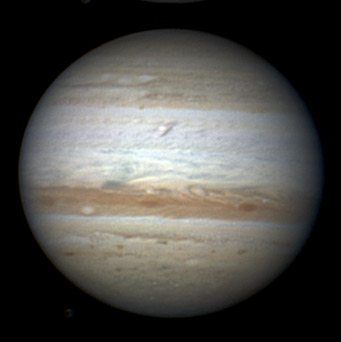
Although the meteor shower sets the theme of the Festival of Stars, the planet Jupiter will be the highlight of the telescope viewing. Being a Gas Giant, Juipter is covered by "bands" of clouds. For many years, two dark bands have been the most visible but this year one of the bands (The South Equatorial Belt or SEB) has disappeared, covered by whiter, higher clouds. When will it return? Nobody knows but this past week dark spots have begun to appear in the white clouds and if they continue to spread it could cause to SEB to reappear.
View some of the most recent images of Jupiter and its missing belt at astronomer Chrisopher Gu's website: http://jupiter.cstoneind.com/


Image Credit: Christopher Gu

Also visible around Jupiter will be its four biggest moons - Io, Europa, Ganymede and Callisto. As they are in constant motion around Jupiter, they are in different positions each night. Here are their approximate positions during Festival of Stars 16th Nov:

Monday, November 16, 2009

Leonids Meteor shower 17th & 18th Nov

Just some more info about the meteor shower happening this week.
These meteors (aka shooting stars) are tiny bits of debris (ice and rock dust)left by a comet called Tempel-Tuttle, which occassional crosses the Earth's orbit.

On Tuesday night/Wednesdau morning, Earth will move through this comet debris. As the debris enters our atmosphere it burns and creates a bright flash in the sky.

Each flash will last no longer than a second. Between the hours of 12am and 4am (wednesday) you might expect to see a small number of meteors (10 or less per hour).
Approaching 5am, this should increase to about 200 meteors per hour as the Earth enters the densest part of the comet's debirs field.

Remember that being in an urban environment, with brightly lit skies, we may not see the full glory of the shower but if the sky is clear it should still be quite a show.

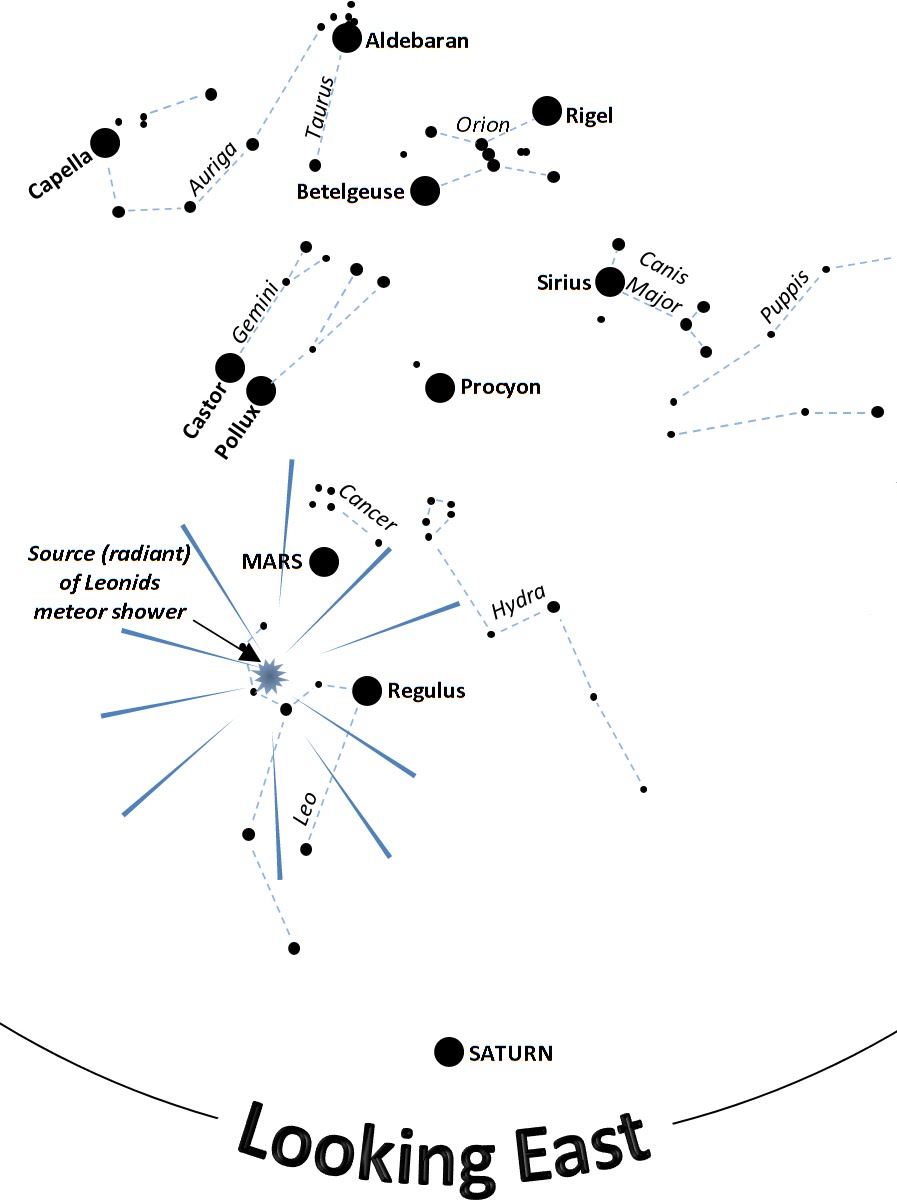
The shower is called the Leonids because the meteor appear to originate from in front of the constellation Leo (see diagram below). Leo will be visible above the horizon after about 2am towards the East direction.
To watch the meteor shower it is best to have a clear view of the Eastern part of the sky (i.e. where the Sun will rise in the morning). Although the meteors start from the East direction they travel out in all directions so position yourself facing Eastward but kept looking high up to catch the meteors as the streak across the sky.

A star map of the east direction, on Wed 18th Nov 2009 between 3am and 5am:
(Look out for the two planet, Mars and Starn as well)

Wednesday, August 12, 2009

Today's Google logo shows this:

And that means it is a special occasion, and you should be verrrrrrrry excited.

It is the 2009 Perseid meteor shower!

The name Perseid originates from the constellation Perseus which the meteoroids appear to come from. (The meteoroids do not actually come from Perseus. Perseus is made up of stars light years away, while these meteoroids are only miles away, passing through our atmosphere.) This meteor shower is an annual event which happens every year early August. The Earth passes through rock and dust fragments left behind by the comet Swift-Tuttle, and as these small particles collide with the Earth’s atmosphere, they burn-up, often creating a beautiful streak of light across the sky.


Can we see this meteor shower in Singapore? Andrew says yes☺. Face eastward tonight (slightly to the north) and look high up from 11pm to 5am, it is going to be a wonderous spectacle. But it would require a relatively clear sky and what you see may be affected by the brightness of the moon. As always, the darker the better. Depending on the sky conditions you may see about 10- 20 meteors per hour. The peak time for meteor showers is usually around 2am to 4am.

Note that you need just your naked eye to see the meteor shower, a pair of binos may come in useful if you have one. It is best to have a comfortable chair or mat that you can rest on and gaze at the sky for a few hours.


We wish you luck.

Check out NASA's article on Perseids here.
Source: IYA2009, Sky and Telescope

A short video of what you may see:


Tuesday, March 31, 2009

Space Rocks!

Space rocks comes in many shapes, sizes and can be constitute of many various substances! Scientists believed that Space rocks may be the remains of a planet that was destroyed billions of years ago or that it could be the debris left over from the formation of the solar system. No one really knows...Perhaps one day one day we will have confirmation on which one is more correct. The reason why scientists believed that space rocks may once be part of a planet is that some of them can be entirely made up of Iron and other heavy metals which are usually found in the core of planets!

Most of the space rocks are found in orbit around the sun. That orbital path is called the Asteroid Belt the other name for space rocks floating out in space is also Asteroids, smaller space rocks are called Meteoroids.

Any space rocks that has a diameter smaller than 1.6km is called a Meteoroid.


The picture above is drawn with artistic license, so please take it up with the proper authorities.

Sometimes the orbital path of a space rock would fall outside the Asteroid belt and come closer to earth than usual. Sometimes the gravitational pull from Earth may pull it even closer, and sometimes the gravitational pull of it may even cause the poor space rock to fall onto the surface of Earth at such great speed that the rock may create a streak of fire forming a long tail. We call this phenomenon "shooting stars" or meteors, we never call them asters. Occasioanlly if the space rock is large enough, or is made of denser substances like Iron, they may survive the journey all the way from space and smack right into Earth forming a crater. The left over space rock that survived is called meteorite.


This is the artist's childlike impression of a particularly large shooting star.