Sticky Post

We are currently not maintaining our blog here. Please go to our Facebook Page for latest updates!
Showing posts with label Stars/Constellations. Show all posts

Friday, April 25, 2014

Stargazing on the green rooftop

Never underestimate the captivating power of a clear night sky. Since the last Sidewalk Astronomy at Yew Tee MRT station (check out our post here) (which attracted over 300 people in 2 hours), Scobbers headed out for an outreach event again last month. NIE’s Bachelor of Science Club (BSC) invited SCOB on our Facebook Page (Do like it if you haven't done so!) to conduct a stargazing session for the student teachers.

On 25th March 2014, Scobbers Alfred and Kin Guan brought starmaps (you can download them for free as well on SCS website) and a Celestron C8 telescope for the event. The venue was set at NTU’s School of Art, Design and Media (ADM) building. For those who have been there, the iconic curved rooftop is covered by grass patch completely. More importantly, the unobstructed view of the night sky was terrific. We were thrilled by the excellent choice of the stargazing spot.
Image Credit: NTU School of Art, Design and Media

At the start of the event, Kin Guan gave a short talk on the night sky to the audience who were enjoying pizzas at the same time. A tutorial on how to use the starmap was given as well as easy identification of stars and planets. After that, Alfred and Kin Guan manned the C8 telescope for viewing. We pointed out constellations using green laser pointers as well. At the end of the day, 50 student teachers enjoyed themselves and learnt one or two things about astronomy.

Scobber Alfred setting up the scope.

Alfred preparing the scope for viewing.

Scobber Kin Guan giving a brief introduction to the night sky.

Interested to have a sidewalk session for your club or school? Leave us a comment and we can arrange something together!


Friday, April 5, 2013

What's up for April 2013

Stars and Constellations
For the past few months we've been focused on the bright stars and constellations of Orion, Taurus, Canis Major, Gemini, etc. During the early evenings of April, these stars are getting lower and lower  towards the West each day.
The bright reflected light of Jupiter is still visible in this part of the sky close to Taurus. By next month most of these stars will begin to disappear from view.

From April onwards, we start to shift our attention to the bright stars of the South, including the second brightest star in the night sky, Canopus, part of the constellation Carina. Canopus was also known in China as “Old Man of the South” for its southern location and sometimes red appearance in hazy or cloudy conditions.
The constellations Puppis, Vela and Carina form the ancient star pattern of the Argo Navis, representing the sailing ship from an Ancient Greek legend. 
The asterism (star pattern) the False Cross is sometimes confused for the Southern Cross (Crux), located nearby to the east.
Lying close to a dense part of our Galaxy, The Milky Way, several star clusters can be found when scanning the  area with binoculars.

1) & 2) M46, M47 – Two faint open clusters, east of bright star Sirius. M47 is the closer and brighter of the two. Small telescopes maybe required.
3) M93 – Faint wedge-shaped star cluster over 3000 light years away but visible in binoculars.
4) IC2391 – large open cluster of 50 stars surrounding the star Omicron Velorum. Best viewed using binoculars.
5), 6) ; 7) IC2581, NGC3293  NGC3114   Three fainter open star clusters located in front of the rich spiral arm of the Milky Way. Binoculars and small telescopes required.
8) Eta Carinae Nebula (NGC 3372) – a gas cloud surrounding the explosive variable star Eta Carinae. Several more stars are visible through binoculars and telescopes.
9) NGC3532 -  A large bright open cluster containing more than 100 stars forming an elliptical shape, 1300 lightyears away.
10) IC2602 (The Southern Pleiades)  Large open cluster of around 60 stars surround star Theta Carinae. Easy to spot with binoculars .


Saturn
Every year planet Saturn makes it appearance in the sky when it approaches opposition, i.e. when the Earth moves into alignment with both Saturn and the Sun. This period results in the closest distance between Saturn and Earth and the brightest and biggest view of Saturn in the sky.

Opposition occurs on 28th April 2013. So can we can expect to be observing Saturn at SCOB during the later part of the month.


Moon
Here are the dates for the main moon phases this month. We will be observing the Moon at our Friday night stargazing sessions on Friday 19th April and Friday 26th April.

Full Moon on 25th/26th April 2013 will result in a Partial Lunar Eclipse over Singapore, when the Moon enters the outer edge of Earth's shadow (the penumbra). However, this is only a very small eclipse, therefore the Moon will only darken slightly during 2am-6am on Friday 26th April, (Singapore time).
We will not be holding any eclipse viewing event at SCOB.
It may be difficult to notice any change in the moon's brightness.
Lyrids Meteor Shower
Finally, 21st/22nd April is the annual Lyrids Meteor Shower, one of the brightest showers of the year. We will not be organising any meteor shower events because most meteors cannot be seen in a bright urban environment like Singapore.
You can increase you chance of seeing a few meteors by going to a wide open area such as a sports field, beach or reservoir, but the frequency of meteors may only be about one or two per hour.

Meteor showers are best observed from midnight til dawn. Lyrid meteors originate from the north-east direction but can appear in any part of the sky.


Thursday, March 7, 2013

First week of March 2013

Last Friday 1st March, the sky cleared for our first stargazing session of the month.
At first it was mostly cloudy with lightning in the distance so we delayed our start time to allow the weather to improve. Whilst waiting we had time to watch the dramatic sunset.

Sunset 1st March 2013 - Science Centre Singapore Observatory.

After 8pm the sky was clear. As usual, Jupiter was the main target for most of the first hour. Just like the previous week, the Great Red Spot (a giant storm) was faintly visible amidst one of the equatorial cloud belts.
Jupiter - Taken on 22nd Feb 2013 - from Science centre Singapore, through a 16 inch Cassegrain using a Nikon D70s. The great red spot is just visble on the left, beside the southern equatorial belt (lower dark band).

Jupiter - taken on 22nd Feb 2013 - through a 6 inch refractor. Sidewise orientation due to position of Jupiter in the sky (towards the west) and the position of the camera.

Later in the evening we turned are attention to the bright stars and constellations of Taurus, Orion and Canis Major. The great Orion Nebula (M42) was particularly stunning in the main 16-inch telescope, especially as there was no moonlight around.

After closing time, a few of us stayed back to take some photos of constellations:
Orion (top) and Jupiter (brightest, below) next to bright star of Aldebaran (in Taurus) - taken facing west - 1st March 2013.

Rectangular constellation of Gemini - bright stars Pollux (on top) and Castor (below). Facing North.


Close up of Orion

Close up of Canis Major - brightest star Sirius (top right).

Canis Major & Sirius (top right) with Carina & Canopus (below) - facing South

Waning Gibbous Moon rising from the East - 1st Mar 2013 10:45pm

Back at home, on Sunday evening (3rd Mar) there was was a bright flyby of the International Space Station (ISS) over Singapore. It would have made a nice photo as the ISS passed  right next to Jupiter and through Orion. However, 10 minutes before the flyby, a big patch of cloud blocked that part of thesky. ISS was visible for a few seconds through gaps in the clouds but all I got on camera was a faint streak as it approached Jupiter:
Faint trail of ISS passing by Jupiter on a cloudy night - 3rd March 2013 - Singapore 


Finally, the Moon is currently going through its waning phases as it moves around the morning side of the Earth. I've seen it every morning this week as I walked to the MRT to get to work. Every day getting closer and closer to the Sun as it approaches New Moon, resulting in its phase changing from a Large bright Gibbous to a half and then just this morning a thin crescent Moon.
Waning Gibbous Moon - 28th Feb 2013 - 7:30am - Singapore

Last Quarter Half Moon - 4th March 2013 - 7:40am - Singapore


Waning Crescent Moon - 7th March 2013 - 7:45am - Singapore

New Moon occurs on Monday 11th of March, which means it will not be visible this weekend as it will be too close to the Sun to see. By the end of next week it will return to the evening sky as a crescent Moon around 13th-15th March.

To see the Moon at SCOB this month I would recommend either Friday 15th March or Friday 22nd March.
____
Also we've seen no sign of Comet PANSTARRS C/2011 L4, which is at its brightest this week. However, its extremely low in the sky between 7pm and 7:30pm, almost exactly west after sunset. So far, its been cloudy every day in that direction so it will be challenging to spot it.

Friday, February 1, 2013

February 2013

ISS
February starts with a bright International Space Station (ISS) pass over Singapore on Sun 3rd Feb 7:38pm-7:45pm.

During this time the ISS will pass almost directly overhead, from south-west to north-east between the bright stars of Orion and the planet Jupiter.
The only things that will interfere with its visibility will be clouds or the bright evening sky at this time of year.
Star map showing the path and timings of ISS pass on 3rd Feb in Singapore.

Sunrise-Sunset
You may have noticed that mornings remain darker for longer and early evening (ard 7pm) is brighter than usual.
Every year in February, Earth is halfway between its Solstice(21st Dec) and Equinox(21st Mar) position, resulting in the latest sunrise and sunset of the year in equatorial regions like Singapore.
Around 10th Feb the Sun rises at 7:17am and sets at 7:21pm.
Therefore the late sunset may impede ISS visibility.

Chinese New Year!
Its no coincidence that CNY also occurs on 10th Feb this year.
The date of Chinese Lunar New Year is also related to the position of the Sun at this time of year.
In China, the Sun's position around 3rd-4th Feb traditionally signifies the start of spring or Lichun ç«‹æ˜¥.
The New Moon closest to Lichun, is the start of the lunar new year.

Moon dates for Feb 2013


Obviously, during new moon, the moon is facing towards the Sun and is obscured from view. You can expect to see the Moon in the evening from 14th Feb to 26th Feb.
Position of the Moon in the early evening sky during Feb 2013


Jupiter's Moon
Jupiter remains the brightest planet in the night sky. During Friday's at SCOB we'll be able to see the following arrangement of its four biggest moons:

Mercury
The closest planet to the Sun, reaches its maximum elongation (18deg) east  of the Sun, meaning Mercury is at is highest position, towards the West direction shortly after sunset on 14th Feb (around 7:30pm). Ideal weather conditions (clear sky) are required to see it, but it is just visible to the naked eye.

Constellations
Finally, at least 8 of the brightest stars in the sky are visible in February. This includes Sirius, Canopus, Procyon.
One of our most common targets is of course Orion, reaching his highest point in the sky in the early evening this month, which should give us some pretty good views of the Orion Nebula.
Diagram of the brightest stars in the constellation Orion

Tuesday, January 8, 2013

January 2013 - Happy New Perihelion!

Our first stargazing session of the new year turned out to be very cloudy indeed, not a single thing to see. The same was also true during our attempts to see ISS fly over Singapore on 2nd & 3rd Jan.
However, as the weather is much clearer and hotter this week, I put a solar filter on our 6-inch refractor attached to the main telescope and took a look at our parent star, the Sun.
Photo of Sun ans sunspot 7th Jan 2013 4:15pm - taken through 6 inch refractor with Samsung SII phone camera. Image is rotated 90deg counter-clockwise, north is on the left, south on the right.
Image of the Sun from NASA satellite SDO (Solar Dynamic Observatory) showing the numbers/names of the sunspots on 6th Jan. The highlight area produce a M-class Solar flare on 5th Jan. This image is in the correct orientation with north at the top.

January is the month when the Earth reaches its closest position to the Sun, (perihelion), which was actually on 2nd Jan.  The difference between Earth's perihelion (closest) and aphelion (furthest) distance is only 3% so it doesn't look any different than usual. There were several sunspots visible on the Sun's surface, areas of magnetic instability and high activity, usually associated with solar flares. 2013 is expected to be the year in which the Sun reaches its solar maximum, the peak of its  11 year natural activity cycle.

For the remainder of January here's what we can expect to see:

Constellations
Most of the brightest stars in the sky are visible during the first part of the year. This includes Orion, Taurus and Canis Major, with the brightest star in the night sky Sirius, lower towards the south-east.

Planets
We've been observing Jupiter for over a month now and its still shining brighter than all the stars. This month its alot higher in the sky, so we should get some nice clear views of its bands of clouds and its 4 Galilean Moons.  64 moons have been discovered around Jupiter, but only its four biggest moons, Io, Europa Ganymede and Callisto are visible through most telescopes.
Position of Jupiter's four biggest moons during Friday night stargazing at SCOB (8pm-10pm).

As a planet orbiting around the Sun, Jupiter appears to move in front of the constellations. Currently, its making its way through Taurus. Since October 2012, Jupiter has been in apparent retrograde motion, meaning its moving backwards in the opposite direction of its original path (prograde)
This apparent retrograde is due to the position of the Earth.

As Earth is closer to the Sun, it travels faster than Jupiter. Both planets are travelling in the same direction but as Earth comes closer to Jupiter and eventually overtakes it, the giant planet appears to move backwards. This current retrograde will last from Oct 2012 until 30th January 2013.

Moon
The Moon moves close to Jupiter on 21st Jan and 22nd Jan. Look out for the bright planet next to the Gibbous moon on these two evenings.
On Friday nights at SCOB, we'll be observing the Moon on 18th Jan (crescent/half moon) and 25th Jan (gibbous moon).
The other significant Moon dates are as follows:

 Happy skywatching!


Wednesday, December 19, 2012

December Updates - Part 2

It was a fascinating night last Friday, with one of the clearest skies we had at SCOB in several weeks. A large patch of cloud drifted by in the early evening but towards the end of the session, things cleared up again and, with no Moon around, many of the familiar December stars were free to shine as best they could in our light polluted sky.
Photo of the constellations Orion (top), Canis Major with Sirius (right), Canis Minor and Procyon (below in cloud) and parts of Gemini (lower left).
Initially, most of our attention was focused on Jupiter. During the most crowded period we were watching as Jupiter's moon Io gradually appeared out from the giant planet's shadow.
Didn't have a camera handy at that point but after closing time I took a few snaps of the Jupiter and the surrounding area of Taurus, including the Pleiades (M45) star cluster.
Long exposure photo of Taurus (v-shaped) with Jupiter (brightest object) and Pleiades Star Cluster (centre).

To finish the evening we had a last look at the great Orion Nebula (M42). I attached the camera to our main 16 inch telescope but didn't manage to reach the correct focal point, so switched to the 6 inch refractor for a "quick" 30 second exposure before the battery went flat. Next time, must remember to be more prepared and get all this photograph stuff ready early. I'm still new to astrophotography and with all the other things going on it tend to be last on my mind.
Orion Nebula M42 through 6 inch refractor telescope using a Nikon D70s camera.  The central collection of stars is known as the Trapezium, because of the four brightest stars but if you look closely there are actually 6 stars. 

The central collection of stars is known as the Trapezium, because of the four brightest stars but if you look closely there are actually 6 stars. Many visitors often confuse the three stars at the bottom with Orion's Belt. I guess its easy to form a connection between the two as the telescope is roughly pointing in the same direction as the belt, which makes it harder to grasp the concept that what we're looking at only occupies a tiny speck of sky and cannot be fully observed by the eye alone.

At one point that night we tried pointing our telescope at the Andromeda Galaxy M31, with an experienced eye I could make out the faint glow of its core but to many of our visitors it was almost invisible, I recall seeing a few blank expressions as I tried to explain about using averted vision :/

That's all for now!

Wednesday, December 12, 2012

December update

Its's 12-12-12, and I haven't done any update yet for December.
As expected the weather is still very cloudy and rainy. There were a few clear nights last week so once again I was out with my camera to take a few shots of this month's bright celestial highlights.
In particular Jupiter, Taurus and Orion. The Bull and Hunter always appear in the East during the early evening in December. This year, they are accompanied by the largest  (and second brightest) planet, Jupiter.


Over the next few weeks,  Jupiter will slower move away from Taurus's bright star Aldebaran (the follower). Later in the evening and toward the end of the month, Sirius, the brightest star in the sky will also appear, shining brightly south-east of Orion.

December is usually a good month for watching meteors/shooting star, with the Geminids meteor shower peaking around 13th-14th December (this week in fact!).
With an expected high rate of meteors and no Moon in the night sky, its bound to be the best shower of 2012.
However, in a bright city like Singapore, in the middle of the rainy season, the chances of seeing any shooting stars are significantly reduced, oh well. If we get a clear night sky of the next few days and you stare at the sky for a few hours after midnight it will increase your chances.


Other things happening this month include, Venus and Saturn still there in the early morning around 6am-7am towards the East. Mercury is there too but low altitude makes it very difficult to spot in the usual morning hazy.

21st December is southern solstice, which makes the southern most position of the Sun in the sky. Southern hemisphere countries will also experience their longest daylight hours, while the north has the shortest daylight hours. More on this in a future post.

Moon Dates for December:
We'll be observing the Moon at SCOB on Friday 21st Dec & Friday 28th Dec.


Finally, our school holiday activities are still available and going strong at SCOB every Friday evening this month.

During the past few weeks the planetarium has been the most popular activity, with light painting a close second. We also have a few items, such as astronomical 3D postcards, for sale. Surprisingly, the astronaut ice cream as been an unexpected hit.

Occasionally, we have a few visitors pop by, who appeared to have lost their way. For instance, this guy, who kept asking about some rebel base?????????


Wednesday, November 14, 2012

1 night, 3 planets, 2 satellites, the Moon and stars!

Last weekend on the evening of  9th-10th Nov, there were lots of bright and interesting things up in the sky. Fortunately, the night was partially clear and I was ready with my camera to snap some photos.

First up was an Iridium Flare. These bright communication satellites only reflect sunlight for a few seconds at specific points in their low earth orbit (LEO). On Friday night 7:48pm we assembled the volunteers and visitors at our stargazing session together to witness the event.
Faint Iridium Flare - thin white line, centre, amidst the clouds - Friday 9th Nov 2012
This was my first attempt at photographing an Iridium flare. In my haste I didn't quite get the exposure and ISO setting correct, so it didn't turn out so bright but it was partially hidden by clouds also.


Next was Uranus. I've been trying to get a shot of this dim planet for more than a month now but the sky was always too bright and cloudy. Towards the end of last Friday's session, attempted to locate it in a clear patch of sky near the zenith. A bit of a challenge as our right ascension coordinates on our 1980's Pentax telescope controller are no longer working accurately. However, I was able to locate it in the finder with the aid starry night software and Google Sky Map.
Uranus - 9th Nov 2012 - Taken with Nikon D70s DSLR through 16" Cassegrain

Several visitors patiently waited until the the end of the session to catch a glimpse of Jupiter around 10pm.
Afterwards, I swapped the eyepiece for a T-Adapter and took a few shots. It was hard to get a sharp focus due to Jupiter's low altitude at the time (around 20degrees). It was nice to see the four Galilean Moons flanking Jupiter, with two on each side.
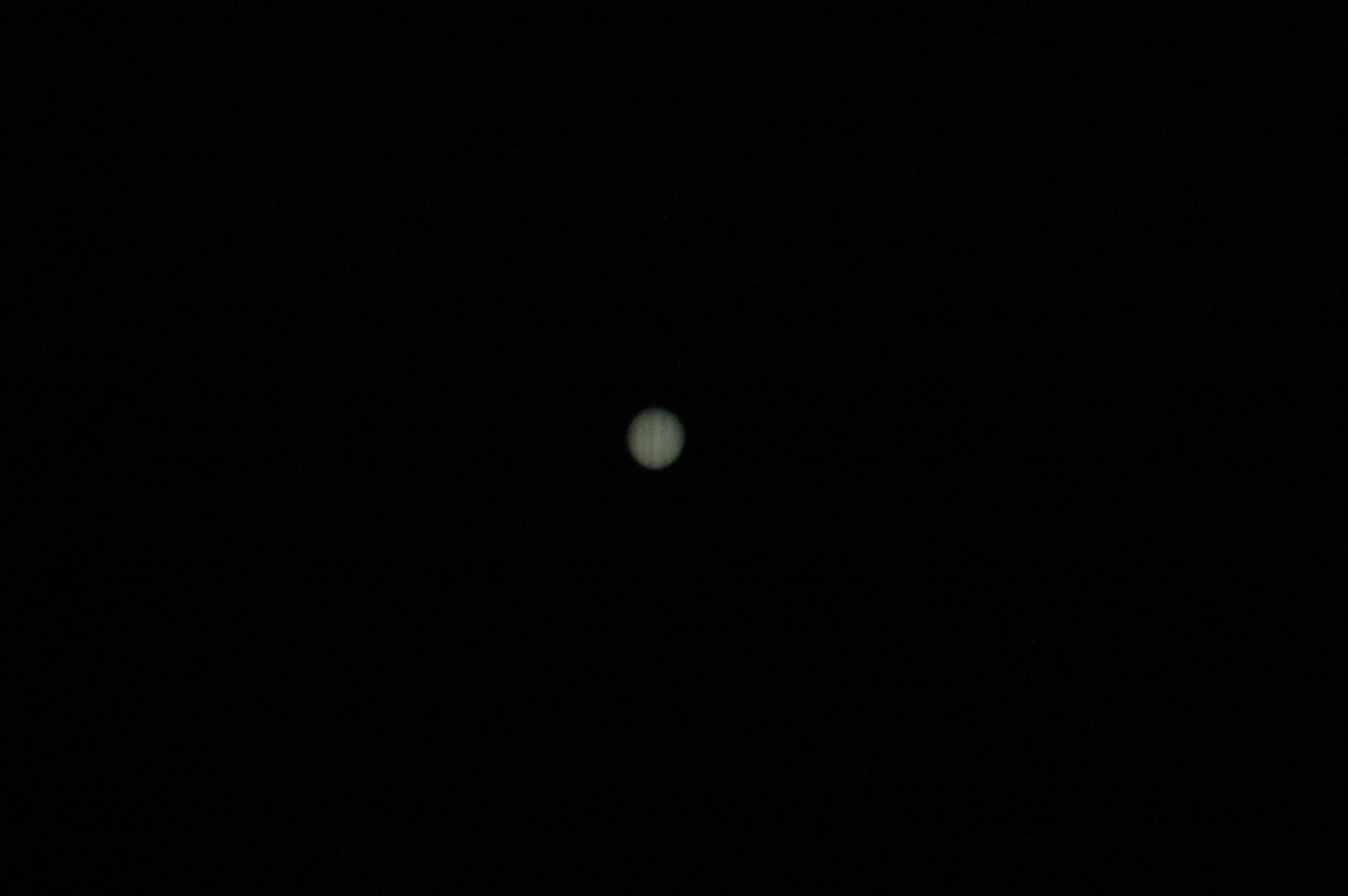
Jupiter - 9th Nov 2012 - taken using Nikon D70s DSLR through 6" refractor telescope.

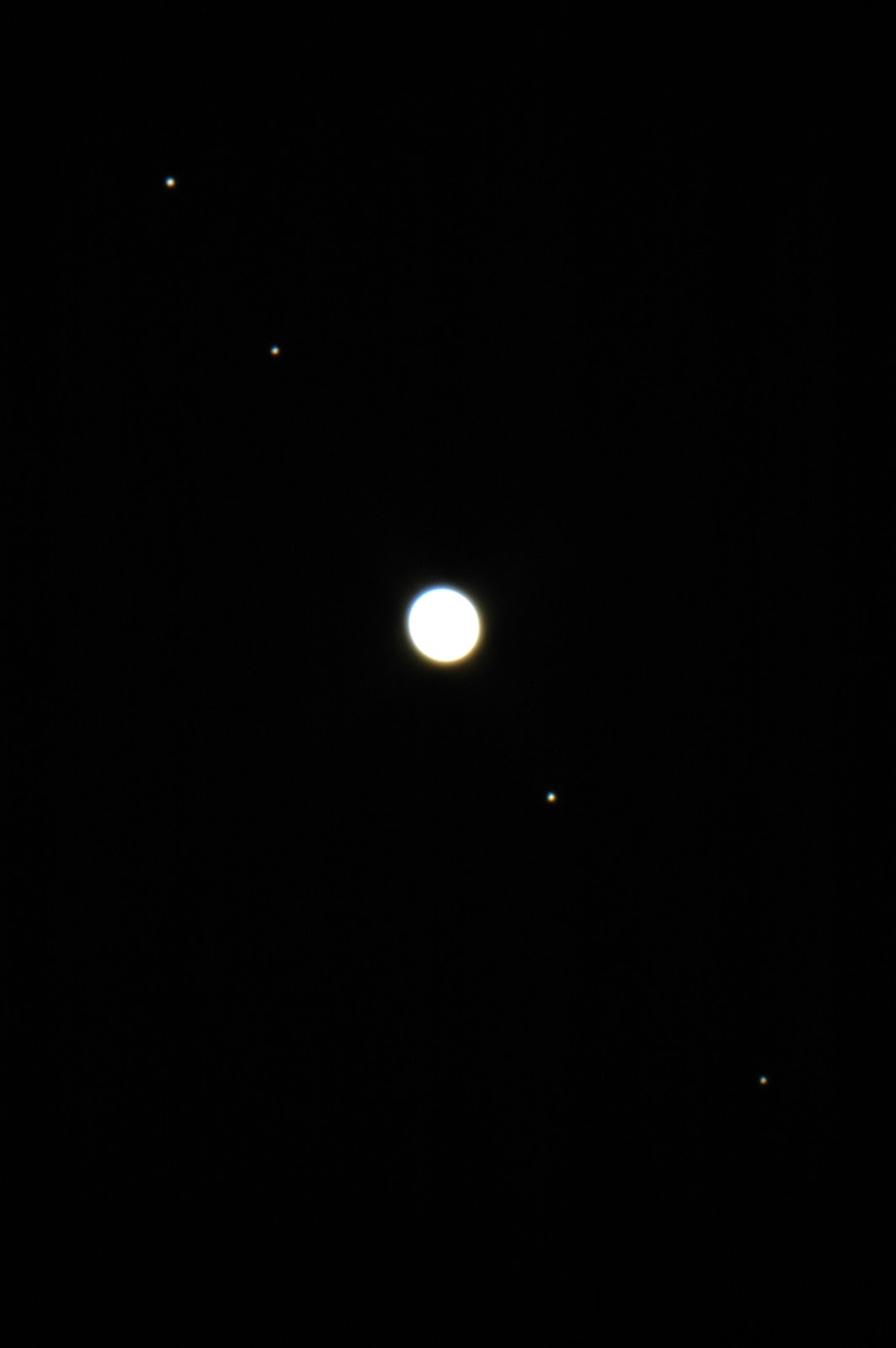
Jupiter with Galilean Moons - from the top: Ganymede, Europa, Jupiter, Io, Callisto - 9th Nov 2012 - taken using Nikon D70s DSLR through 16" Cassegrain telescope.

Jupiter - 9th Nov - taken with Nikon D70s camera using 2x Barlow lens through 16" Cassegrain telescope.

Reaching home around 11:30pm, I set my alarm for 5am to see a bright ISS flyby.
At 5:30am (Sat 10th Nov) I was ready outside with my camera, tripod and the mosquitoes.
It took about 4 mins for the space station to go from SW to NNE, however I kept my exposures to 30 seconds as I was worried the background sky would become too bright if I'd opened to shutter for longer.
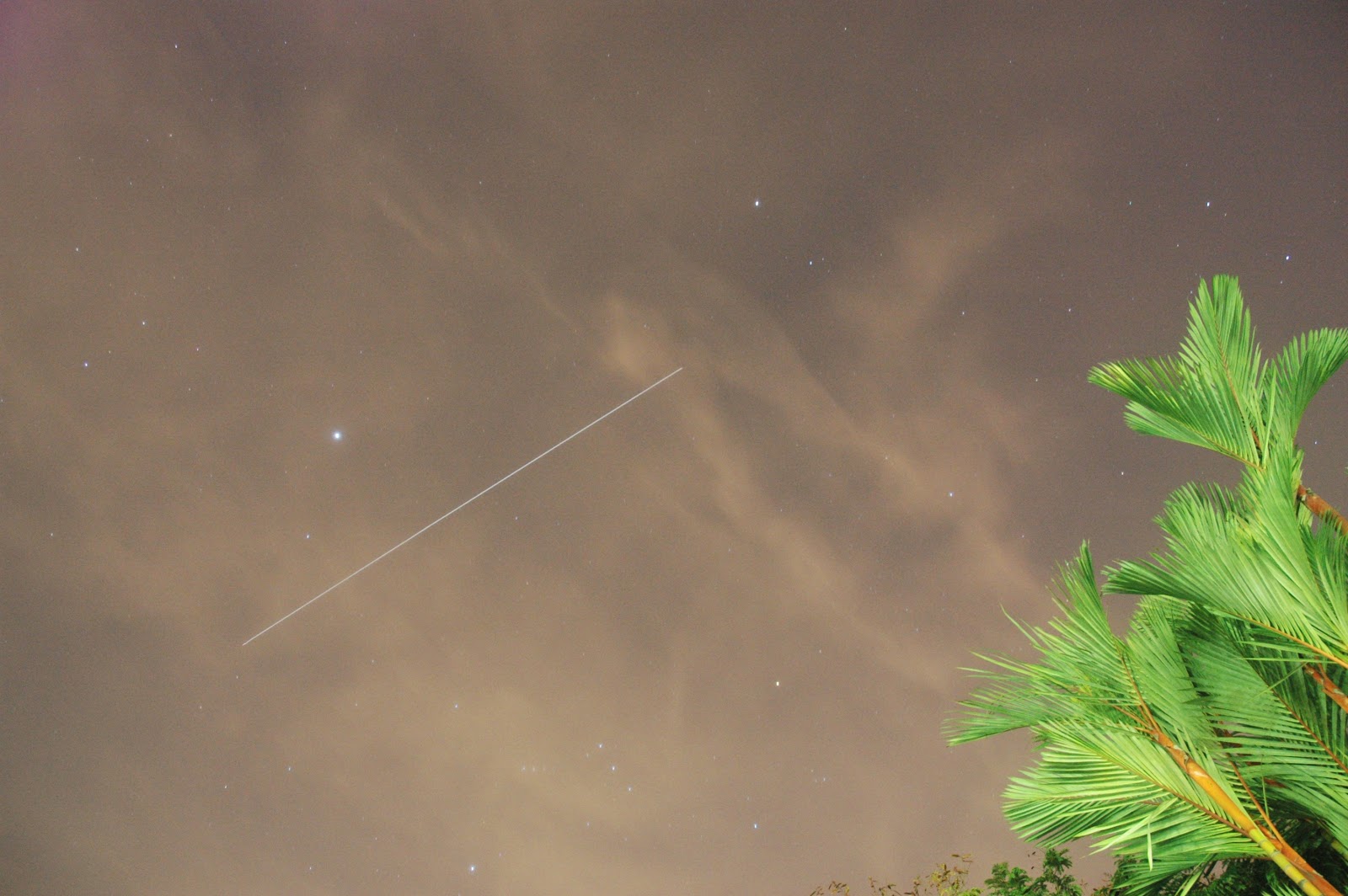
ISS travelling between constellations Canis Major (above) & Orion (below), towards Canis Minor (top).


Fully awake with a bunch of bright objects in the sky, I continued to take more photos for the next few hours.
Jupiter (bright object at the bottom) with Orion (centre), Sirius (top left) and Procyon (Canis Minor, top right)

Moon (top) and Venus (below) - 6:20am Sat 10th November - Singapore

Waning Crescent Moon


Finally, sunrise came and as I leave near Changi Airport, I also got a shot of some planes before the sun came up.
Out of focus "Solar Pillar" phenomenon before sunrise 6:40am Sat 10th November

Plane landing at sunrise 6:50am


The Sun - shortly after sunrise - 7:20am Sat 10th Nov