Sticky Post

We are currently not maintaining our blog here. Please go to our Facebook Page for latest updates!
Showing posts with label Scobbers go to.... Show all posts

Friday, April 25, 2014

Stargazing on the green rooftop

Never underestimate the captivating power of a clear night sky. Since the last Sidewalk Astronomy at Yew Tee MRT station (check out our post here) (which attracted over 300 people in 2 hours), Scobbers headed out for an outreach event again last month. NIE’s Bachelor of Science Club (BSC) invited SCOB on our Facebook Page (Do like it if you haven't done so!) to conduct a stargazing session for the student teachers.

On 25th March 2014, Scobbers Alfred and Kin Guan brought starmaps (you can download them for free as well on SCS website) and a Celestron C8 telescope for the event. The venue was set at NTU’s School of Art, Design and Media (ADM) building. For those who have been there, the iconic curved rooftop is covered by grass patch completely. More importantly, the unobstructed view of the night sky was terrific. We were thrilled by the excellent choice of the stargazing spot.
Image Credit: NTU School of Art, Design and Media

At the start of the event, Kin Guan gave a short talk on the night sky to the audience who were enjoying pizzas at the same time. A tutorial on how to use the starmap was given as well as easy identification of stars and planets. After that, Alfred and Kin Guan manned the C8 telescope for viewing. We pointed out constellations using green laser pointers as well. At the end of the day, 50 student teachers enjoyed themselves and learnt one or two things about astronomy.

Scobber Alfred setting up the scope.

Alfred preparing the scope for viewing.

Scobber Kin Guan giving a brief introduction to the night sky.

Interested to have a sidewalk session for your club or school? Leave us a comment and we can arrange something together!


Wednesday, February 26, 2014

With Dr Neil deGrasse Tyson & Ann Druyan

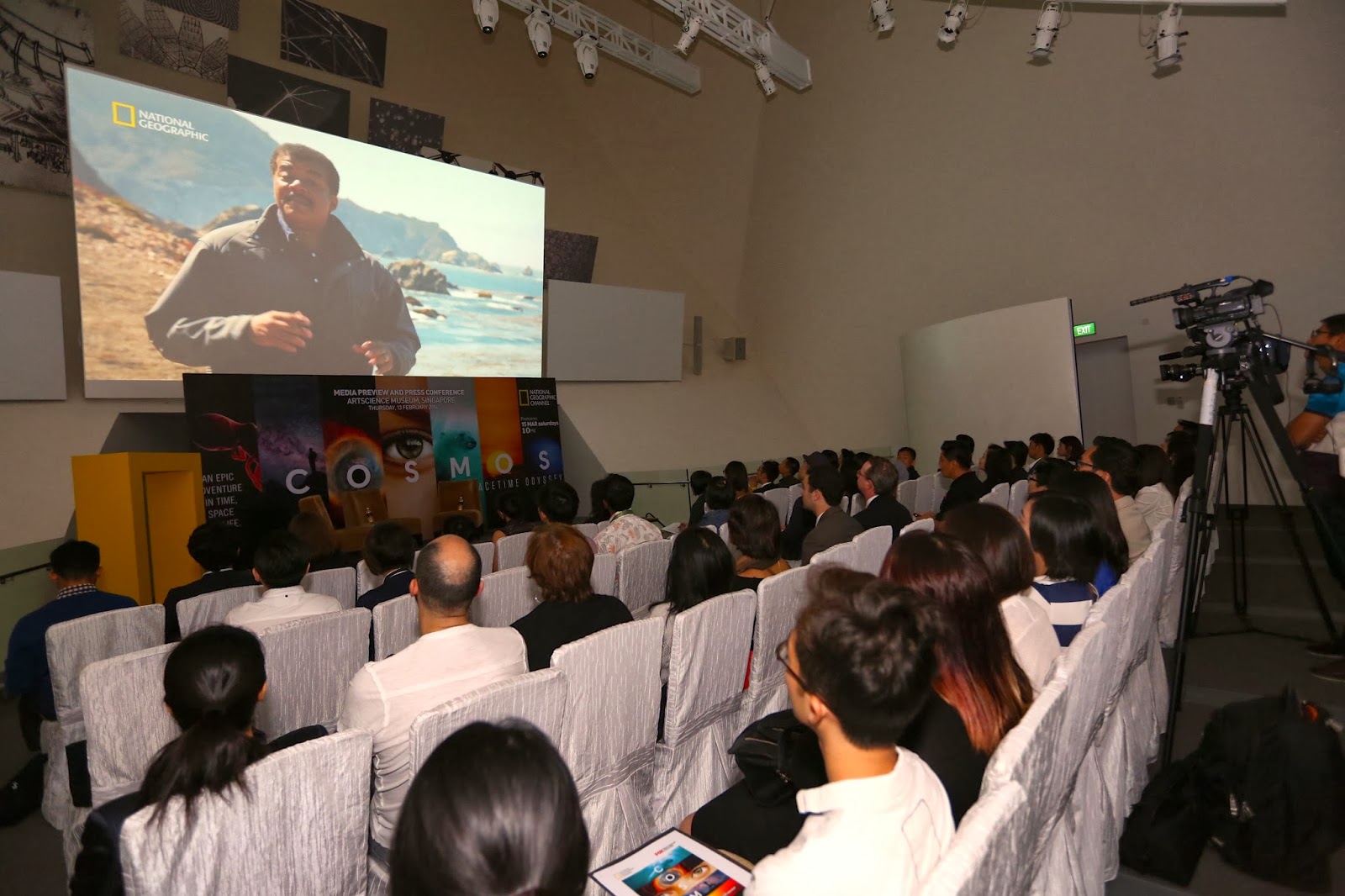
On 13th and 14th February 2014, Scobbers Danny and Kin Guan were invited by National Geographic Channel to follow Dr Neil deGrasse Tyson around in Singapore.

Yes, you heard it right. The sexiest astrophysicist in the world, the guy who made many kids cry by demoting Pluto to a dwarf planet, the frequent guest on The Daily Show and The Colbert Report, and the meme immortalized online.

Image Credit: knowyourmeme.com


He came to Singapore to promote his newest TV documentary series COSMOS: A Spacetime Odyssey. This 13-part series, combining drama, fantasy and stunning natural reality, is the follow-up of Carl Sagan’s classic COSMOS: A Personal Voyage produced thirty years ago. Covering a wide range of scientific topics such as the origin of life and the universe, Sagan did a terrific job in communicating science to a wide public audience. The programme has been broadcast in more than 60 countries and seen by over 500 million people.

Image Credit: Wikipedia
It was such a precious legacy left by Sagan to us. Since his death in 1996, his widow Ann Druyan has been trying to create a new version of the series. Together with Dr Tyson and Seth MacFarlane (yes, the Family Guy), she managed to secure funding and TV channel (Fox TV) for the show.

In Southeast Asia, the first episode “Standing Up In the Milky Way” will premiere on simulcast across National Geographic Channel (NGC), NGC HD, Nat Geo WILD, Nat Geo People, as well as FOX, FX, and FOXCRIME.  Danny and Kin Guan, along with other media representatives, had the privilege to watch it during the press conference and media preview on Thursday (13th February) held at ArtScience Museum.

Image Credit: National Geographic Channel

Image Credit: National Geographic Channel
Free from the shackles of time and space, Neil tells us the story of humankind and universe in his signature Ship of the Imagination. We were all amazed by the stunning visual effects and the splendorous views. The concept of compressing the whole history of the universe into one year opens up our eyes and mind – Human is so insignificant when placed in such a long scale of time. This is what Neil calls a “Cosmic Year”. For example, in the last second of the Cosmic Year (31 December, 23:59:59), human firstly observed the Moon in telescope and landed on it (which spans 400 years in real time)!

Image Credit: National Geographic Channel
Ann Druyan pointed out that the major differences between the old and new series are the cinematic experience and elements of skepticism. She mentioned that one 9-minute scene where the viewers are plunged into the heart of Titan, Saturn’s largest Moon. She believes that this new addition to the series will surely amaze the generations and beyond.

Image Credit: National Geographic Channel

Image Credit: National Geographic Channel
When asked how the rise of social media affects the science education for young generation, Neil was not worried over the phenomenon. Being an avid user of Twitter having 1.6 million followers, he found that the social media is not distraction at all. On the contrary, the power of visual splendour and storytelling bestowed by social media is staggeringly huge and provides an uplifting force to the society.

The last question asked was on his wrestling stint in Harvard: If he chose the road not taken and became a wrestler, what would be his ring name? The answer, of course, is related to astronomy. One very special property about the Moon is that it always faces the Earth with the same side. This effect, called “tidal locking”, can be true in the other way too! When the Earth faces the Moon with the same side, the phenomenon is called “double tidal lock”. VoilĂ , that’s Neil’s ring name and signature move.

What a menacing move from Neil the wrestler! "Double Tidal Lock"
Image Credit: National Geographic Channel
For a more detailed Q & A, please check out the blog post (link) on Science Centre website written by Danny!

Cosmos: A Spacetime Odyssey premieres on 15th March, 10pm (SG time), on the National Geographic Channel (SingTel mio TV Ch. 201 & StarHub TV Ch. 411). Don’t miss it!


Image Credit: National Geographic Channel

Thursday, February 13, 2014

Sidewalk Astronomy at Yew Tee


Last Friday (7th February 2014), Scobbers Alfred, Everlyne and Kin Guan showed the wonders of the night sky to the public in Yew Tee for the first time this year. This was a collaboration between Science Centre Singapore and Yew Tee RC Zone 10.

We brought our C8 Celestron telescope out and set the venue up with the help of RC volunteers. The venue was Yew Tee MRT Open Space (In between Yew Tee Square and Yew Tee Mall). (Google Street View)

Cloudy weather around 7pm on Friday. What could we see?

Scobbers having a briefing with RC volunteers.

Setting up the banner. 


We started the telescope viewing at 8pm and the queue was already forming:


Thanks to the clear sky (the clouds kindly made way for us), we were able to observe first quarter Moon (it's a half-lit moon from Earth's perspective) and Jupiter. Alfred manned the telescope and introduced some fun facts about Jupiter and Moon:


Everlyne interacted with the public in the queue and handed them Star Map. It is a handy tool to identify the objects in the night sky!


Tuesday, September 18, 2012

Scobbers go to Jakarta - Kalbe Junior Science Fair

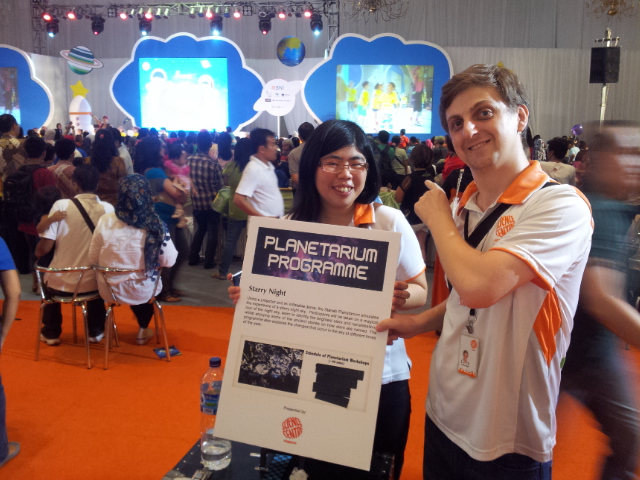
Last week, from 7th-10th Sept, scobbers Murni and Andrew (i.e. myself) journeyed to Jakarta, Indonesia to conduct our first overseas planetarium shows with our trusty STARLAB inflatable planetarium.
It was all part of the annual Kalbe Junior Science Fair, held at Jakarta Convention Center (JCC). Actually, we were more of a small part, as the fair was huge! Occupying the about two large convention halls, with a mixture of sponsor's booths, activities stations, playgrounds, workshops and stage performances. The atmosphere was an amazing bustle of activity and excitement, more popular than the large IT fairs we get here in Singapore.

Here are some highlights:
Checking in for the flight, just within baggage allowance.


Entrance banners


Setting up the dome

In anticipation of the large crowd, we made a temporary barrier of chairs and rope.

Which was further enhanced by a human barrier.

Here they come! Over 30,000 visitors on day one.

Our large dome of stars was very attractive. Was challenging to manage the crowd sometimes but people were always friendly and patient. We increased the number of sessions from 6 to 13 sessions on the first day.

First time someone brought a dog inside the planetarium.

We were right next to the main stage, sometimes it was so loud we couldn't hear ourselves talk, visitors still enjoyed seeing the stars and constellations though. On the stage, there were performances by Indonesian singers and student dance groups as well as talks by Japanese scientist and astronaut Dr Mamoru Mohri.

We issued out stickers/tickets for each session (30 pax per session) by midday, we were out of tickets, all sessions full.
End of day two, all packed up after 2pm session, to make way for the closing ceremony performances.


Other exhibits and attractions:


Monday, August 6, 2012

Recent Planetarium Shows at Science Festivals

Trying to catch up on some observatory updates after all the education programmes and events that have been going on since the start of the new school term at the end of June.

We've just finished a week of Kids Science Fest, as part of the Singapore Science Festival, where amongst activities such as light painting and marble machines, we also conducted six planetarium shows a day inside our STARLAB portable planetarium.

 These planetarium sessions are normally available for bookings by school and kindergarten groups but this is the second time we've used the STARLAB at this event, in addition to a two week period during the December holidays last year.


The system uses a popular astronomical software called Starry Night, which displays a virtual image of the sky via a projector on the inside of the inflatable dome. The projector is equipped with a fisheye lens to create a 360 degree view of the entire sky.


We actually have another planetarium that we take out of Science Centre to schools as part of our outreach programme. Last month, we visited Anderson Secondary School and Victoria Junior College.
This older more basic system, uses a halogen light bulb and series of projecting cylinders, each of which has a fixed number for images, for examples e.g constellations.


Here we are set up on a sheltered basketball court at Anderson Secondary, as part of their local cluster science day event, which involves a number of other schools from the around the same area.

Ideally, these portable domes should be placed in a indoor, air conditioned venue. However, due to limited space at the school, we opted for this semi-outdoor area, which although sheltered from Sun, was still very warm and stuffy inside the dome as warm outside air is continually blown in to the dome to keep it inflated.

A few days later we were at VJC, for a similar Science day event for east zone schools. We've attended this event for the past few years and set up in our regular venue, the AVA Lecture Theatre. There's just enough room on the small stage to squeeze in the fully inflated dome ad there's air-con too!!!

It has crossed my mind to set up an inflatable planetarium at the observatory, on several occasions during Friday night stargazing, however, we're a bit short on space as well as manpower. A more permanent planetarium may be the answer, but that may take sometime to become a reality, we'll see what we can do.