Sticky Post

We are currently not maintaining our blog here. Please go to our Facebook Page for latest updates!
Showing posts with label What's on at SCOB. Show all posts

Wednesday, February 26, 2014

With Dr Neil deGrasse Tyson & Ann Druyan

On 13th and 14th February 2014, Scobbers Danny and Kin Guan were invited by National Geographic Channel to follow Dr Neil deGrasse Tyson around in Singapore.

Yes, you heard it right. The sexiest astrophysicist in the world, the guy who made many kids cry by demoting Pluto to a dwarf planet, the frequent guest on The Daily Show and The Colbert Report, and the meme immortalized online.

Image Credit: knowyourmeme.com


He came to Singapore to promote his newest TV documentary series COSMOS: A Spacetime Odyssey. This 13-part series, combining drama, fantasy and stunning natural reality, is the follow-up of Carl Sagan’s classic COSMOS: A Personal Voyage produced thirty years ago. Covering a wide range of scientific topics such as the origin of life and the universe, Sagan did a terrific job in communicating science to a wide public audience. The programme has been broadcast in more than 60 countries and seen by over 500 million people.

Image Credit: Wikipedia
It was such a precious legacy left by Sagan to us. Since his death in 1996, his widow Ann Druyan has been trying to create a new version of the series. Together with Dr Tyson and Seth MacFarlane (yes, the Family Guy), she managed to secure funding and TV channel (Fox TV) for the show.

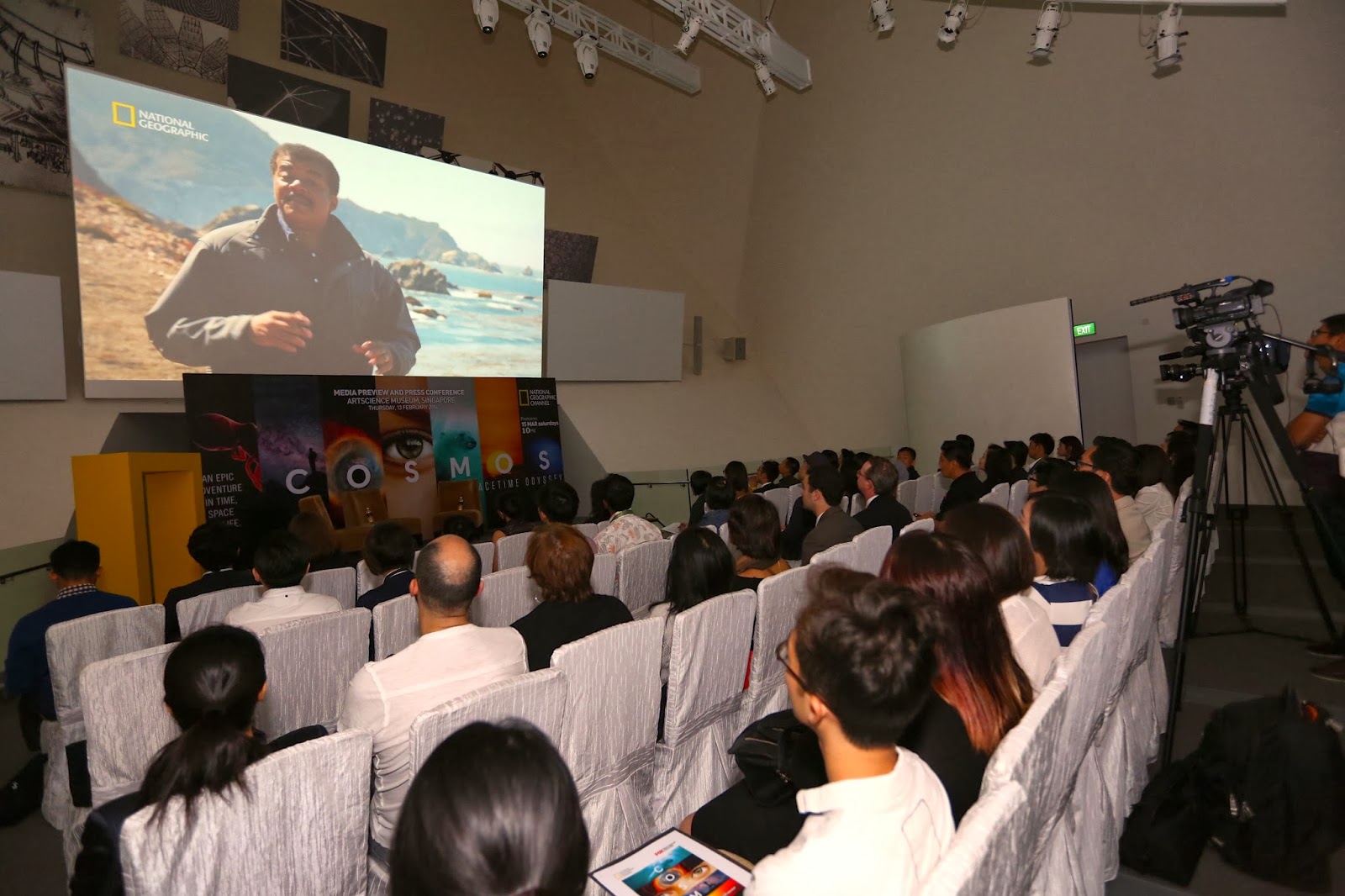
In Southeast Asia, the first episode “Standing Up In the Milky Way” will premiere on simulcast across National Geographic Channel (NGC), NGC HD, Nat Geo WILD, Nat Geo People, as well as FOX, FX, and FOXCRIME.  Danny and Kin Guan, along with other media representatives, had the privilege to watch it during the press conference and media preview on Thursday (13th February) held at ArtScience Museum.

Image Credit: National Geographic Channel

Image Credit: National Geographic Channel
Free from the shackles of time and space, Neil tells us the story of humankind and universe in his signature Ship of the Imagination. We were all amazed by the stunning visual effects and the splendorous views. The concept of compressing the whole history of the universe into one year opens up our eyes and mind – Human is so insignificant when placed in such a long scale of time. This is what Neil calls a “Cosmic Year”. For example, in the last second of the Cosmic Year (31 December, 23:59:59), human firstly observed the Moon in telescope and landed on it (which spans 400 years in real time)!

Image Credit: National Geographic Channel
Ann Druyan pointed out that the major differences between the old and new series are the cinematic experience and elements of skepticism. She mentioned that one 9-minute scene where the viewers are plunged into the heart of Titan, Saturn’s largest Moon. She believes that this new addition to the series will surely amaze the generations and beyond.

Image Credit: National Geographic Channel

Image Credit: National Geographic Channel
When asked how the rise of social media affects the science education for young generation, Neil was not worried over the phenomenon. Being an avid user of Twitter having 1.6 million followers, he found that the social media is not distraction at all. On the contrary, the power of visual splendour and storytelling bestowed by social media is staggeringly huge and provides an uplifting force to the society.

The last question asked was on his wrestling stint in Harvard: If he chose the road not taken and became a wrestler, what would be his ring name? The answer, of course, is related to astronomy. One very special property about the Moon is that it always faces the Earth with the same side. This effect, called “tidal locking”, can be true in the other way too! When the Earth faces the Moon with the same side, the phenomenon is called “double tidal lock”. Voilà, that’s Neil’s ring name and signature move.

What a menacing move from Neil the wrestler! "Double Tidal Lock"
Image Credit: National Geographic Channel
For a more detailed Q & A, please check out the blog post (link) on Science Centre website written by Danny!

Cosmos: A Spacetime Odyssey premieres on 15th March, 10pm (SG time), on the National Geographic Channel (SingTel mio TV Ch. 201 & StarHub TV Ch. 411). Don’t miss it!


Image Credit: National Geographic Channel

Friday, September 13, 2013

A small upgrade at SCOB


We have recently upgraded our observatory step by step! (pun intended) We have placed anti-slip strips on every step of the stairway to the Observatory. Scobbers Chua, Li Fei and Joanna have been busy under the hot weather :)


Now the steps will not become as slippery as before when it rains. Still, please go up the stairway one step at a time carefully :)

Friday, April 5, 2013

What's up for April 2013

Stars and Constellations
For the past few months we've been focused on the bright stars and constellations of Orion, Taurus, Canis Major, Gemini, etc. During the early evenings of April, these stars are getting lower and lower  towards the West each day.
The bright reflected light of Jupiter is still visible in this part of the sky close to Taurus. By next month most of these stars will begin to disappear from view.

From April onwards, we start to shift our attention to the bright stars of the South, including the second brightest star in the night sky, Canopus, part of the constellation Carina. Canopus was also known in China as “Old Man of the South” for its southern location and sometimes red appearance in hazy or cloudy conditions.
The constellations Puppis, Vela and Carina form the ancient star pattern of the Argo Navis, representing the sailing ship from an Ancient Greek legend. 
The asterism (star pattern) the False Cross is sometimes confused for the Southern Cross (Crux), located nearby to the east.
Lying close to a dense part of our Galaxy, The Milky Way, several star clusters can be found when scanning the  area with binoculars.

1) & 2) M46, M47 – Two faint open clusters, east of bright star Sirius. M47 is the closer and brighter of the two. Small telescopes maybe required.
3) M93 – Faint wedge-shaped star cluster over 3000 light years away but visible in binoculars.
4) IC2391 – large open cluster of 50 stars surrounding the star Omicron Velorum. Best viewed using binoculars.
5), 6) ; 7) IC2581, NGC3293  NGC3114   Three fainter open star clusters located in front of the rich spiral arm of the Milky Way. Binoculars and small telescopes required.
8) Eta Carinae Nebula (NGC 3372) – a gas cloud surrounding the explosive variable star Eta Carinae. Several more stars are visible through binoculars and telescopes.
9) NGC3532 -  A large bright open cluster containing more than 100 stars forming an elliptical shape, 1300 lightyears away.
10) IC2602 (The Southern Pleiades)  Large open cluster of around 60 stars surround star Theta Carinae. Easy to spot with binoculars .


Saturn
Every year planet Saturn makes it appearance in the sky when it approaches opposition, i.e. when the Earth moves into alignment with both Saturn and the Sun. This period results in the closest distance between Saturn and Earth and the brightest and biggest view of Saturn in the sky.

Opposition occurs on 28th April 2013. So can we can expect to be observing Saturn at SCOB during the later part of the month.


Moon
Here are the dates for the main moon phases this month. We will be observing the Moon at our Friday night stargazing sessions on Friday 19th April and Friday 26th April.

Full Moon on 25th/26th April 2013 will result in a Partial Lunar Eclipse over Singapore, when the Moon enters the outer edge of Earth's shadow (the penumbra). However, this is only a very small eclipse, therefore the Moon will only darken slightly during 2am-6am on Friday 26th April, (Singapore time).
We will not be holding any eclipse viewing event at SCOB.
It may be difficult to notice any change in the moon's brightness.
Lyrids Meteor Shower
Finally, 21st/22nd April is the annual Lyrids Meteor Shower, one of the brightest showers of the year. We will not be organising any meteor shower events because most meteors cannot be seen in a bright urban environment like Singapore.
You can increase you chance of seeing a few meteors by going to a wide open area such as a sports field, beach or reservoir, but the frequency of meteors may only be about one or two per hour.

Meteor showers are best observed from midnight til dawn. Lyrid meteors originate from the north-east direction but can appear in any part of the sky.


Thursday, March 7, 2013

First week of March 2013

Last Friday 1st March, the sky cleared for our first stargazing session of the month.
At first it was mostly cloudy with lightning in the distance so we delayed our start time to allow the weather to improve. Whilst waiting we had time to watch the dramatic sunset.

Sunset 1st March 2013 - Science Centre Singapore Observatory.

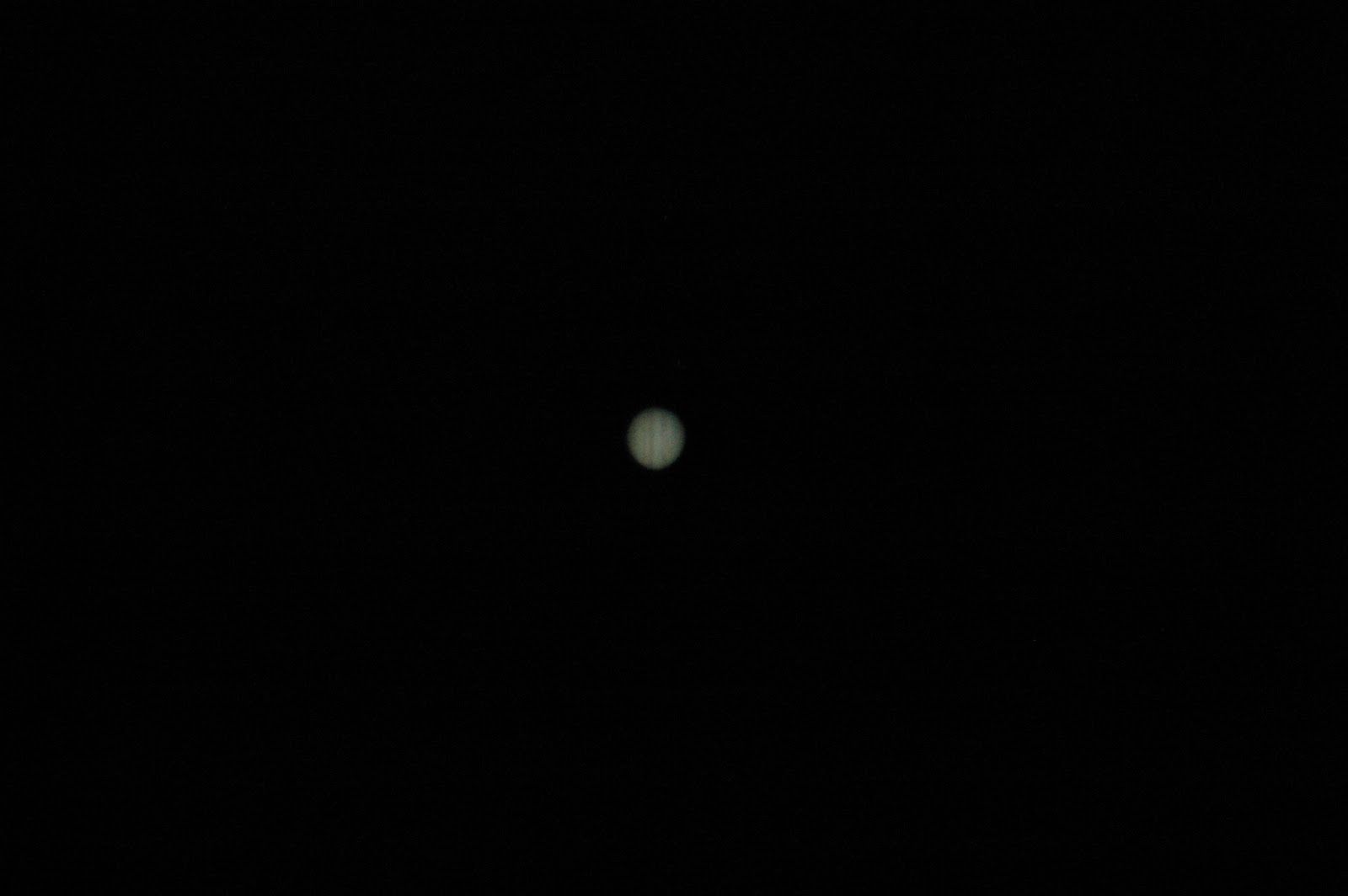
After 8pm the sky was clear. As usual, Jupiter was the main target for most of the first hour. Just like the previous week, the Great Red Spot (a giant storm) was faintly visible amidst one of the equatorial cloud belts.
Jupiter - Taken on 22nd Feb 2013 - from Science centre Singapore, through a 16 inch Cassegrain using a Nikon D70s. The great red spot is just visble on the left, beside the southern equatorial belt (lower dark band).

Jupiter - taken on 22nd Feb 2013 - through a 6 inch refractor. Sidewise orientation due to position of Jupiter in the sky (towards the west) and the position of the camera.

Later in the evening we turned are attention to the bright stars and constellations of Taurus, Orion and Canis Major. The great Orion Nebula (M42) was particularly stunning in the main 16-inch telescope, especially as there was no moonlight around.

After closing time, a few of us stayed back to take some photos of constellations:
Orion (top) and Jupiter (brightest, below) next to bright star of Aldebaran (in Taurus) - taken facing west - 1st March 2013.

Rectangular constellation of Gemini - bright stars Pollux (on top) and Castor (below). Facing North.


Close up of Orion

Close up of Canis Major - brightest star Sirius (top right).

Canis Major & Sirius (top right) with Carina & Canopus (below) - facing South

Waning Gibbous Moon rising from the East - 1st Mar 2013 10:45pm

Back at home, on Sunday evening (3rd Mar) there was was a bright flyby of the International Space Station (ISS) over Singapore. It would have made a nice photo as the ISS passed  right next to Jupiter and through Orion. However, 10 minutes before the flyby, a big patch of cloud blocked that part of thesky. ISS was visible for a few seconds through gaps in the clouds but all I got on camera was a faint streak as it approached Jupiter:
Faint trail of ISS passing by Jupiter on a cloudy night - 3rd March 2013 - Singapore 


Finally, the Moon is currently going through its waning phases as it moves around the morning side of the Earth. I've seen it every morning this week as I walked to the MRT to get to work. Every day getting closer and closer to the Sun as it approaches New Moon, resulting in its phase changing from a Large bright Gibbous to a half and then just this morning a thin crescent Moon.
Waning Gibbous Moon - 28th Feb 2013 - 7:30am - Singapore

Last Quarter Half Moon - 4th March 2013 - 7:40am - Singapore


Waning Crescent Moon - 7th March 2013 - 7:45am - Singapore

New Moon occurs on Monday 11th of March, which means it will not be visible this weekend as it will be too close to the Sun to see. By the end of next week it will return to the evening sky as a crescent Moon around 13th-15th March.

To see the Moon at SCOB this month I would recommend either Friday 15th March or Friday 22nd March.
____
Also we've seen no sign of Comet PANSTARRS C/2011 L4, which is at its brightest this week. However, its extremely low in the sky between 7pm and 7:30pm, almost exactly west after sunset. So far, its been cloudy every day in that direction so it will be challenging to spot it.

Thursday, February 28, 2013

Galaxy Forum 2013 - 9th March


On Saturday 9th March, Science Centre Singapore is hosting the first Galaxy Forum in South East Asia.

Organised by the International Lunar Observatory Association (ILOA) the forum features a series of space-related presentations and discussions on the theme of Galaxy Education, Exploration and Enterprise.

More details here: http://galaxyforum.org/future-galaxy-forums/#sea13
Register via:http://www.science.edu.sg/events/Pages/GalaxyForum.aspx
Enquiries: enquiries-tnc@science.edu.sg

Friday, February 1, 2013

February 2013

ISS
February starts with a bright International Space Station (ISS) pass over Singapore on Sun 3rd Feb 7:38pm-7:45pm.

During this time the ISS will pass almost directly overhead, from south-west to north-east between the bright stars of Orion and the planet Jupiter.
The only things that will interfere with its visibility will be clouds or the bright evening sky at this time of year.
Star map showing the path and timings of ISS pass on 3rd Feb in Singapore.

Sunrise-Sunset
You may have noticed that mornings remain darker for longer and early evening (ard 7pm) is brighter than usual.
Every year in February, Earth is halfway between its Solstice(21st Dec) and Equinox(21st Mar) position, resulting in the latest sunrise and sunset of the year in equatorial regions like Singapore.
Around 10th Feb the Sun rises at 7:17am and sets at 7:21pm.
Therefore the late sunset may impede ISS visibility.

Chinese New Year!
Its no coincidence that CNY also occurs on 10th Feb this year.
The date of Chinese Lunar New Year is also related to the position of the Sun at this time of year.
In China, the Sun's position around 3rd-4th Feb traditionally signifies the start of spring or Lichun 立春.
The New Moon closest to Lichun, is the start of the lunar new year.

Moon dates for Feb 2013


Obviously, during new moon, the moon is facing towards the Sun and is obscured from view. You can expect to see the Moon in the evening from 14th Feb to 26th Feb.
Position of the Moon in the early evening sky during Feb 2013


Jupiter's Moon
Jupiter remains the brightest planet in the night sky. During Friday's at SCOB we'll be able to see the following arrangement of its four biggest moons:

Mercury
The closest planet to the Sun, reaches its maximum elongation (18deg) east  of the Sun, meaning Mercury is at is highest position, towards the West direction shortly after sunset on 14th Feb (around 7:30pm). Ideal weather conditions (clear sky) are required to see it, but it is just visible to the naked eye.

Constellations
Finally, at least 8 of the brightest stars in the sky are visible in February. This includes Sirius, Canopus, Procyon.
One of our most common targets is of course Orion, reaching his highest point in the sky in the early evening this month, which should give us some pretty good views of the Orion Nebula.
Diagram of the brightest stars in the constellation Orion

Thursday, January 17, 2013

Astronomy talk 25th January

UPDATE! - **VENUE CHANGE** -  THIS TALK WILL NOW BE HELD AT MAXWELL AUDITORIUM IN SCIENCE CENTRE'S MAIN BUILDING.
Due to larger than expected response. Same time: 8pm-9pm
Thanks for your support!!

----------------------------

Next week (25th Jan) we are hosting a free talk by A*STAR scholar and Harvard PhD student in astronomy, Mr Eddie Chua:

25th Jan 8pm-9pm at SCOB, in addition to our regular Friday night Stargazing.

Seats are limited, pre-register via upstream@science.edu.sg

Programme:
7:45pm – Registration
8:00pm – Talk: “What is the universe made of?...” by Eddie Chua
8:45pm – Q&A and interaction with the speaker
9:00pm – Friday night stargazing – Jupiter and the Moon (weather permitting)
10:00pm – Observatory closed

“What is the universe made of? .... a walk through the dark side of the universe”
The talk  “What is the universe made of? .... a walk through the dark side of the universe” gives  an overview of the origins of the universe (big bang), the discovery of the accelerating expansion of the universe (Nobel Prize in Physics 2011),  constituents of the universe (dark energy, dark matter + ordinary matter),  large scale structure of the universe (cosmic web) as well as a simulation of the evolution of the universe and the formation of galaxies such as our Milky Way. These are not ordinarily encountered in school classes but serve as a stepping stone to get more interested in the science which aids in our understanding of the universe.

Eddie Chua
...is a second year PhD student in Astronomy at Harvard. He works with Professor Lars Hernquist, using computer simulations to understand the formation of large-scale structure in the universe as well as the properties of galaxies such as the Milky Way.

Tuesday, January 8, 2013

January 2013 - Happy New Perihelion!

Our first stargazing session of the new year turned out to be very cloudy indeed, not a single thing to see. The same was also true during our attempts to see ISS fly over Singapore on 2nd & 3rd Jan.
However, as the weather is much clearer and hotter this week, I put a solar filter on our 6-inch refractor attached to the main telescope and took a look at our parent star, the Sun.
Photo of Sun ans sunspot 7th Jan 2013 4:15pm - taken through 6 inch refractor with Samsung SII phone camera. Image is rotated 90deg counter-clockwise, north is on the left, south on the right.
Image of the Sun from NASA satellite SDO (Solar Dynamic Observatory) showing the numbers/names of the sunspots on 6th Jan. The highlight area produce a M-class Solar flare on 5th Jan. This image is in the correct orientation with north at the top.

January is the month when the Earth reaches its closest position to the Sun, (perihelion), which was actually on 2nd Jan.  The difference between Earth's perihelion (closest) and aphelion (furthest) distance is only 3% so it doesn't look any different than usual. There were several sunspots visible on the Sun's surface, areas of magnetic instability and high activity, usually associated with solar flares. 2013 is expected to be the year in which the Sun reaches its solar maximum, the peak of its  11 year natural activity cycle.

For the remainder of January here's what we can expect to see:

Constellations
Most of the brightest stars in the sky are visible during the first part of the year. This includes Orion, Taurus and Canis Major, with the brightest star in the night sky Sirius, lower towards the south-east.

Planets
We've been observing Jupiter for over a month now and its still shining brighter than all the stars. This month its alot higher in the sky, so we should get some nice clear views of its bands of clouds and its 4 Galilean Moons.  64 moons have been discovered around Jupiter, but only its four biggest moons, Io, Europa Ganymede and Callisto are visible through most telescopes.
Position of Jupiter's four biggest moons during Friday night stargazing at SCOB (8pm-10pm).

As a planet orbiting around the Sun, Jupiter appears to move in front of the constellations. Currently, its making its way through Taurus. Since October 2012, Jupiter has been in apparent retrograde motion, meaning its moving backwards in the opposite direction of its original path (prograde)
This apparent retrograde is due to the position of the Earth.

As Earth is closer to the Sun, it travels faster than Jupiter. Both planets are travelling in the same direction but as Earth comes closer to Jupiter and eventually overtakes it, the giant planet appears to move backwards. This current retrograde will last from Oct 2012 until 30th January 2013.

Moon
The Moon moves close to Jupiter on 21st Jan and 22nd Jan. Look out for the bright planet next to the Gibbous moon on these two evenings.
On Friday nights at SCOB, we'll be observing the Moon on 18th Jan (crescent/half moon) and 25th Jan (gibbous moon).
The other significant Moon dates are as follows:

 Happy skywatching!


Wednesday, December 19, 2012

December Updates - Part 2

It was a fascinating night last Friday, with one of the clearest skies we had at SCOB in several weeks. A large patch of cloud drifted by in the early evening but towards the end of the session, things cleared up again and, with no Moon around, many of the familiar December stars were free to shine as best they could in our light polluted sky.
Photo of the constellations Orion (top), Canis Major with Sirius (right), Canis Minor and Procyon (below in cloud) and parts of Gemini (lower left).
Initially, most of our attention was focused on Jupiter. During the most crowded period we were watching as Jupiter's moon Io gradually appeared out from the giant planet's shadow.
Didn't have a camera handy at that point but after closing time I took a few snaps of the Jupiter and the surrounding area of Taurus, including the Pleiades (M45) star cluster.
Long exposure photo of Taurus (v-shaped) with Jupiter (brightest object) and Pleiades Star Cluster (centre).

To finish the evening we had a last look at the great Orion Nebula (M42). I attached the camera to our main 16 inch telescope but didn't manage to reach the correct focal point, so switched to the 6 inch refractor for a "quick" 30 second exposure before the battery went flat. Next time, must remember to be more prepared and get all this photograph stuff ready early. I'm still new to astrophotography and with all the other things going on it tend to be last on my mind.
Orion Nebula M42 through 6 inch refractor telescope using a Nikon D70s camera.  The central collection of stars is known as the Trapezium, because of the four brightest stars but if you look closely there are actually 6 stars. 

The central collection of stars is known as the Trapezium, because of the four brightest stars but if you look closely there are actually 6 stars. Many visitors often confuse the three stars at the bottom with Orion's Belt. I guess its easy to form a connection between the two as the telescope is roughly pointing in the same direction as the belt, which makes it harder to grasp the concept that what we're looking at only occupies a tiny speck of sky and cannot be fully observed by the eye alone.

At one point that night we tried pointing our telescope at the Andromeda Galaxy M31, with an experienced eye I could make out the faint glow of its core but to many of our visitors it was almost invisible, I recall seeing a few blank expressions as I tried to explain about using averted vision :/

That's all for now!

Wednesday, December 12, 2012

December update

Its's 12-12-12, and I haven't done any update yet for December.
As expected the weather is still very cloudy and rainy. There were a few clear nights last week so once again I was out with my camera to take a few shots of this month's bright celestial highlights.
In particular Jupiter, Taurus and Orion. The Bull and Hunter always appear in the East during the early evening in December. This year, they are accompanied by the largest  (and second brightest) planet, Jupiter.


Over the next few weeks,  Jupiter will slower move away from Taurus's bright star Aldebaran (the follower). Later in the evening and toward the end of the month, Sirius, the brightest star in the sky will also appear, shining brightly south-east of Orion.

December is usually a good month for watching meteors/shooting star, with the Geminids meteor shower peaking around 13th-14th December (this week in fact!).
With an expected high rate of meteors and no Moon in the night sky, its bound to be the best shower of 2012.
However, in a bright city like Singapore, in the middle of the rainy season, the chances of seeing any shooting stars are significantly reduced, oh well. If we get a clear night sky of the next few days and you stare at the sky for a few hours after midnight it will increase your chances.


Other things happening this month include, Venus and Saturn still there in the early morning around 6am-7am towards the East. Mercury is there too but low altitude makes it very difficult to spot in the usual morning hazy.

21st December is southern solstice, which makes the southern most position of the Sun in the sky. Southern hemisphere countries will also experience their longest daylight hours, while the north has the shortest daylight hours. More on this in a future post.

Moon Dates for December:
We'll be observing the Moon at SCOB on Friday 21st Dec & Friday 28th Dec.


Finally, our school holiday activities are still available and going strong at SCOB every Friday evening this month.

During the past few weeks the planetarium has been the most popular activity, with light painting a close second. We also have a few items, such as astronomical 3D postcards, for sale. Surprisingly, the astronaut ice cream as been an unexpected hit.

Occasionally, we have a few visitors pop by, who appeared to have lost their way. For instance, this guy, who kept asking about some rebel base?????????