Sticky Post

We are currently not maintaining our blog here. Please go to our Facebook Page for latest updates!
Showing posts with label Planets. Show all posts

Friday, August 30, 2013

Venus: A Hostile Planet

It has been over one year since we witnessed Venus travelling in front of the Sun. We had an event last year to observe this rare phenomenon. Did you come?

Venus spotted in front of Science Centre's entrance.

Venus spotted in Johor Bahru, Malaysia.

In these few months we can observe Venus when we look towards the western sky. Often mistaken for a star, Venus appears as a very bright speck in the sky. It is so bright that it can actually cast shadows on Earth. 

Here are some short facts about Venus:
  • It is Earth's Twin Sister. It is the closest planet to Earth, and similar to Earth in terms of size and mass.
  • It is the only planet in the Solar System that is named after a female figure.
  • On Venus, a day is longer than a year. One Venusian day is 243 Earth days, and one Venusian year is 224.7 Earth days.
  • It is the hottest planet in the Solar System. The average surface temperature on Venus is 462 °C.
The last statement comes from the fact that Venus is shrouded by a thick atmosphere which consists of carbon dioxide and sulfuric acid. These gases form highly reflective clouds, preventing us from observing the Venus surface directly. In other words, the pictures we see are actually the Venusian atmosphere instead of the surface. Active volcanic activities happen on the surface of Venus, as evident in the radar image below. These make Venus an extremely hostile place for us to go!

Venus. The surface is obscured by thick clouds. (Wikipedia)

Craters on the surface of Venus. (Wikipedia)

Fortunately for us Earthlings, we can observe Venus from a safe distance (1.7 x 10^8 kilometres, or 17 followed by 7 zeros). Around 7pm to 9pm, we can observe Venus now until end of November. Look towards the Western sky and say hello to Venus! Science Centre Observatory opens every Friday from 7:45pm to 10pm, come and join us!


Thursday, June 20, 2013

June 2013 - Venus, Mercury, Solstice, Supermoon and HAZE!!!

June got off to a pretty good start with clear nights and some great views of Saturn.

Planets Venus and Mercury also made an appearance shortly after sunset. Mercury was at its highest on 12th June, about 24 degrees high at sunset. Its gradually getting lower each day before disappearing by end June.

I took this picture on 10th June, when a thin waxing crescent Moon was near Venus. Mercury is the dimmer object above Venus near the top edge of the photo.

Venus will get higher each day from now until November as it makes its way closer to Earth.

Mercury-Venus Conjunction
On 20th and 21st June, Venus and Mercury will appear close together (about 2deg apart). Due to their low position in the western part of the sky, they will only be visible from 7:30pm-8pm.
Screenshot from Stellarium planetarium programme - posted on Singapore-Sky Facebook page by Dr KK Cheong.
Sadly, the haze that has currently enveloped the island will make these planets almost impossible to see.

Northern Solstice
June 21st is the time when the Sun reaches its northernmost point in the sky due to the tilt of the Earth. This also causes warmer temperatures and longer daylight hours in the Northern parts of the world.

In Singapore, expect the Sun to rise from the north east and set in the north west. Daytime will also be slightly longer than usual, 12 hours 11 mins 43 secs to be more exact. Sunrise: 7:00am, Sunset: 7:12pm.
For more info on Solstice see last year's post: Solstice in Singapore

Supermoon Returns
23rd June 2013 is Full Moon in Singapore. Its also the Moon's closest perigee (the Moon's closest point to Earth), resulting in a  larger than normal Full Moon, known as a Supermoon.
Even at its closest point the Moon is still 356989km away, therefore the difference in size is hard to notice.
Size difference of Full Moons at closest position to Earth (perigee) and furtherest distance (apogee)
Usually the Moon looks bigger when its lower in the sky due to an illusion where are brain perceives objects near the ground closer than those high in the sky.
The June Supermoon is actually closer than other supermoons that occur in the year but once again it will be difficult to notice unless you compare photos of other full moons.
More on supermoon: Earth and Sky - Most "Super" Supermoon

Haze
These three astronomical events are quite subtle and can be missed if you don't know what you're looking for. Visibility is made worse by the haze blowing over Singapore from Sumatra.
The air quality/Pollutant Standards Index is currently in the unhealthy-hazardous range, so its not the best time to be going outside looking at the sky.
Took a picture of the hazy Sun setting behind Science Centre on the way home last night.


Someone commented that it looked a bit like Lord of the Rings, i.e. the eye of Sauron above the Dark Tower Barad-dur. A few minutes later I saw a post from SGAG with the exact same idea:

Original picture submitted by Jonathan Chong. Posted on SGAG facebook and www.sgag.sg

Friday, May 3, 2013

Return of Saturn

Saturn at Opposition
Every year as Earth makes it way around the Sun, it reaches a point where it is in line with an outer planet like Saturn. This is called opposition.


This year Saturn was at opposition on Sunday 28th April 2013. This means that Saturn has now started to appear in the eastern part of the sky during the early evening and appears at its brightest and biggest over the next few weeks.
Here's a photo of Saturn, which I snapped through our main telescope at the end of last Friday's stargazing session:

Saturn on 26th April 2013 at 10:20pm. - Taken with a HTC One X+ phone camera through a 16 inch cassegrain telescope with a 13mm Nagler eyepiece.

I was quite impressed at how this photo turned out, considering it was take with a phone camera held in front of the eyepiece. The fact that I was using an expensive, high power eyepiece lens (13mm Nagler) also helped.

Each year Saturn's opposition occurs about two weeks later than the previous year's. By the time Earth's returns to its previous position after its 365 day orbital journey, Saturn has also moved about 1/29th of the way around its own orbit.

As a result we see Saturn slowly drift in font of the the more distant star and constellations. Currently Saturn is making its way through the constellation Virgo. At next year's opposition it will be closer to Libra.


Saturn's tilt
Observing Saturn each year, you may begin to notice a change in the appearance of its rings. That is, some year you see more of them than others.
Like the Earth, Saturn is tilted. Its poles are tilted by about 26.7 degree. Depending on Saturn's position along its orbit we sometimes see Saturn tilted towards us or tilted away from us.

Back in 2009, Saturn was not tilted towards us at all, resulting in an edge-on view of the rings, making them appear very thin.
Saturn in 2009 - a thin edge on view of the rings, as seen from Singapore on 20th March 2009, looking East through our main telescope (16 inch cassegrain), with a Nikon D70 DSLR camera.

A brief sidetrack
Note that the vertical orientation of the rings in this photo has nothing to do with Saturn. It's because of our position on Earth. Here in Singapore, we are standing almost 90 degree from the north pole, thus we are standing sidewise relative to Saturn.


Late last year I was informed of a video (on youtube) that was using this very photo (amongst others) to falsely claim that Saturn has been knocked completely off its axis, signalling the end of the world. The video has since been removed and the world is still here.
Due to the curved surface of the Earth, observers in different locations and time periods will see Saturn at different angles.
Of course, I could have just rotated the camera or the photo to match Saturn's actual orientation.

Back to Saturn's tilt
Over the last few years, Saturn's "natural tilt" has resulted in its north pole facing more towards the Earth, resulting in the rings appearing wider and wider each year.
Saturn in May 2011 - taken through our 16 inch cassegrain reflector using a Nikon D70 DSLR camera.

Saturn in 2012 - taken through our 16 inch cassegrain reflector with a Nikon D70 DLSR camera. Rings look slightly wider than in the photos from 2009 and 2011.

By 2017 we will have the widest possible view of the Saturn's rings. After 2017 the rings start to appear smaller again as Saturn's north pole begins to turn away from us.
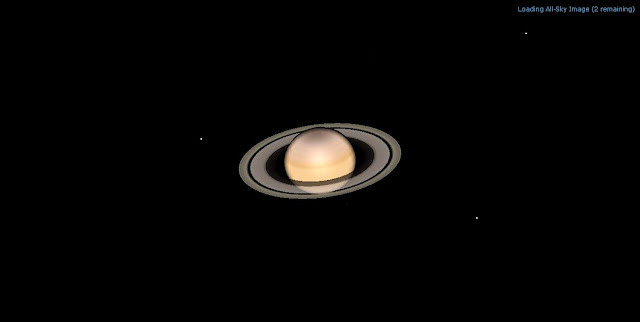
Saturn Rings in 2017 - Screen capture from astronomy software Starry Night Pro Plus.

Finally, Saturn is bright enough to see without the aid of the telescope as a bright yellowish dot in the sky, just slight east of the a bright whitest star in called Spica (part of Virgo). Each night over the next few months, its will gradually shift more towards the western part of the sky before disappearing from view around September/October time.
Each month the Moon will pass by Saturn in the sky. Look out for Saturn beside the Moon on 23rd May and 19th June.

Friday, April 5, 2013

What's up for April 2013

Stars and Constellations
For the past few months we've been focused on the bright stars and constellations of Orion, Taurus, Canis Major, Gemini, etc. During the early evenings of April, these stars are getting lower and lower  towards the West each day.
The bright reflected light of Jupiter is still visible in this part of the sky close to Taurus. By next month most of these stars will begin to disappear from view.

From April onwards, we start to shift our attention to the bright stars of the South, including the second brightest star in the night sky, Canopus, part of the constellation Carina. Canopus was also known in China as “Old Man of the South” for its southern location and sometimes red appearance in hazy or cloudy conditions.
The constellations Puppis, Vela and Carina form the ancient star pattern of the Argo Navis, representing the sailing ship from an Ancient Greek legend. 
The asterism (star pattern) the False Cross is sometimes confused for the Southern Cross (Crux), located nearby to the east.
Lying close to a dense part of our Galaxy, The Milky Way, several star clusters can be found when scanning the  area with binoculars.

1) & 2) M46, M47 – Two faint open clusters, east of bright star Sirius. M47 is the closer and brighter of the two. Small telescopes maybe required.
3) M93 – Faint wedge-shaped star cluster over 3000 light years away but visible in binoculars.
4) IC2391 – large open cluster of 50 stars surrounding the star Omicron Velorum. Best viewed using binoculars.
5), 6) ; 7) IC2581, NGC3293  NGC3114   Three fainter open star clusters located in front of the rich spiral arm of the Milky Way. Binoculars and small telescopes required.
8) Eta Carinae Nebula (NGC 3372) – a gas cloud surrounding the explosive variable star Eta Carinae. Several more stars are visible through binoculars and telescopes.
9) NGC3532 -  A large bright open cluster containing more than 100 stars forming an elliptical shape, 1300 lightyears away.
10) IC2602 (The Southern Pleiades)  Large open cluster of around 60 stars surround star Theta Carinae. Easy to spot with binoculars .


Saturn
Every year planet Saturn makes it appearance in the sky when it approaches opposition, i.e. when the Earth moves into alignment with both Saturn and the Sun. This period results in the closest distance between Saturn and Earth and the brightest and biggest view of Saturn in the sky.

Opposition occurs on 28th April 2013. So can we can expect to be observing Saturn at SCOB during the later part of the month.


Moon
Here are the dates for the main moon phases this month. We will be observing the Moon at our Friday night stargazing sessions on Friday 19th April and Friday 26th April.

Full Moon on 25th/26th April 2013 will result in a Partial Lunar Eclipse over Singapore, when the Moon enters the outer edge of Earth's shadow (the penumbra). However, this is only a very small eclipse, therefore the Moon will only darken slightly during 2am-6am on Friday 26th April, (Singapore time).
We will not be holding any eclipse viewing event at SCOB.
It may be difficult to notice any change in the moon's brightness.
Lyrids Meteor Shower
Finally, 21st/22nd April is the annual Lyrids Meteor Shower, one of the brightest showers of the year. We will not be organising any meteor shower events because most meteors cannot be seen in a bright urban environment like Singapore.
You can increase you chance of seeing a few meteors by going to a wide open area such as a sports field, beach or reservoir, but the frequency of meteors may only be about one or two per hour.

Meteor showers are best observed from midnight til dawn. Lyrid meteors originate from the north-east direction but can appear in any part of the sky.


Thursday, March 7, 2013

First week of March 2013

Last Friday 1st March, the sky cleared for our first stargazing session of the month.
At first it was mostly cloudy with lightning in the distance so we delayed our start time to allow the weather to improve. Whilst waiting we had time to watch the dramatic sunset.

Sunset 1st March 2013 - Science Centre Singapore Observatory.

After 8pm the sky was clear. As usual, Jupiter was the main target for most of the first hour. Just like the previous week, the Great Red Spot (a giant storm) was faintly visible amidst one of the equatorial cloud belts.
Jupiter - Taken on 22nd Feb 2013 - from Science centre Singapore, through a 16 inch Cassegrain using a Nikon D70s. The great red spot is just visble on the left, beside the southern equatorial belt (lower dark band).

Jupiter - taken on 22nd Feb 2013 - through a 6 inch refractor. Sidewise orientation due to position of Jupiter in the sky (towards the west) and the position of the camera.

Later in the evening we turned are attention to the bright stars and constellations of Taurus, Orion and Canis Major. The great Orion Nebula (M42) was particularly stunning in the main 16-inch telescope, especially as there was no moonlight around.

After closing time, a few of us stayed back to take some photos of constellations:
Orion (top) and Jupiter (brightest, below) next to bright star of Aldebaran (in Taurus) - taken facing west - 1st March 2013.

Rectangular constellation of Gemini - bright stars Pollux (on top) and Castor (below). Facing North.


Close up of Orion

Close up of Canis Major - brightest star Sirius (top right).

Canis Major & Sirius (top right) with Carina & Canopus (below) - facing South

Waning Gibbous Moon rising from the East - 1st Mar 2013 10:45pm

Back at home, on Sunday evening (3rd Mar) there was was a bright flyby of the International Space Station (ISS) over Singapore. It would have made a nice photo as the ISS passed  right next to Jupiter and through Orion. However, 10 minutes before the flyby, a big patch of cloud blocked that part of thesky. ISS was visible for a few seconds through gaps in the clouds but all I got on camera was a faint streak as it approached Jupiter:
Faint trail of ISS passing by Jupiter on a cloudy night - 3rd March 2013 - Singapore 


Finally, the Moon is currently going through its waning phases as it moves around the morning side of the Earth. I've seen it every morning this week as I walked to the MRT to get to work. Every day getting closer and closer to the Sun as it approaches New Moon, resulting in its phase changing from a Large bright Gibbous to a half and then just this morning a thin crescent Moon.
Waning Gibbous Moon - 28th Feb 2013 - 7:30am - Singapore

Last Quarter Half Moon - 4th March 2013 - 7:40am - Singapore


Waning Crescent Moon - 7th March 2013 - 7:45am - Singapore

New Moon occurs on Monday 11th of March, which means it will not be visible this weekend as it will be too close to the Sun to see. By the end of next week it will return to the evening sky as a crescent Moon around 13th-15th March.

To see the Moon at SCOB this month I would recommend either Friday 15th March or Friday 22nd March.
____
Also we've seen no sign of Comet PANSTARRS C/2011 L4, which is at its brightest this week. However, its extremely low in the sky between 7pm and 7:30pm, almost exactly west after sunset. So far, its been cloudy every day in that direction so it will be challenging to spot it.

Friday, February 1, 2013

February 2013

ISS
February starts with a bright International Space Station (ISS) pass over Singapore on Sun 3rd Feb 7:38pm-7:45pm.

During this time the ISS will pass almost directly overhead, from south-west to north-east between the bright stars of Orion and the planet Jupiter.
The only things that will interfere with its visibility will be clouds or the bright evening sky at this time of year.
Star map showing the path and timings of ISS pass on 3rd Feb in Singapore.

Sunrise-Sunset
You may have noticed that mornings remain darker for longer and early evening (ard 7pm) is brighter than usual.
Every year in February, Earth is halfway between its Solstice(21st Dec) and Equinox(21st Mar) position, resulting in the latest sunrise and sunset of the year in equatorial regions like Singapore.
Around 10th Feb the Sun rises at 7:17am and sets at 7:21pm.
Therefore the late sunset may impede ISS visibility.

Chinese New Year!
Its no coincidence that CNY also occurs on 10th Feb this year.
The date of Chinese Lunar New Year is also related to the position of the Sun at this time of year.
In China, the Sun's position around 3rd-4th Feb traditionally signifies the start of spring or Lichun ç«‹æ˜¥.
The New Moon closest to Lichun, is the start of the lunar new year.

Moon dates for Feb 2013


Obviously, during new moon, the moon is facing towards the Sun and is obscured from view. You can expect to see the Moon in the evening from 14th Feb to 26th Feb.
Position of the Moon in the early evening sky during Feb 2013


Jupiter's Moon
Jupiter remains the brightest planet in the night sky. During Friday's at SCOB we'll be able to see the following arrangement of its four biggest moons:

Mercury
The closest planet to the Sun, reaches its maximum elongation (18deg) east  of the Sun, meaning Mercury is at is highest position, towards the West direction shortly after sunset on 14th Feb (around 7:30pm). Ideal weather conditions (clear sky) are required to see it, but it is just visible to the naked eye.

Constellations
Finally, at least 8 of the brightest stars in the sky are visible in February. This includes Sirius, Canopus, Procyon.
One of our most common targets is of course Orion, reaching his highest point in the sky in the early evening this month, which should give us some pretty good views of the Orion Nebula.
Diagram of the brightest stars in the constellation Orion

Tuesday, January 8, 2013

January 2013 - Happy New Perihelion!

Our first stargazing session of the new year turned out to be very cloudy indeed, not a single thing to see. The same was also true during our attempts to see ISS fly over Singapore on 2nd & 3rd Jan.
However, as the weather is much clearer and hotter this week, I put a solar filter on our 6-inch refractor attached to the main telescope and took a look at our parent star, the Sun.
Photo of Sun ans sunspot 7th Jan 2013 4:15pm - taken through 6 inch refractor with Samsung SII phone camera. Image is rotated 90deg counter-clockwise, north is on the left, south on the right.
Image of the Sun from NASA satellite SDO (Solar Dynamic Observatory) showing the numbers/names of the sunspots on 6th Jan. The highlight area produce a M-class Solar flare on 5th Jan. This image is in the correct orientation with north at the top.

January is the month when the Earth reaches its closest position to the Sun, (perihelion), which was actually on 2nd Jan.  The difference between Earth's perihelion (closest) and aphelion (furthest) distance is only 3% so it doesn't look any different than usual. There were several sunspots visible on the Sun's surface, areas of magnetic instability and high activity, usually associated with solar flares. 2013 is expected to be the year in which the Sun reaches its solar maximum, the peak of its  11 year natural activity cycle.

For the remainder of January here's what we can expect to see:

Constellations
Most of the brightest stars in the sky are visible during the first part of the year. This includes Orion, Taurus and Canis Major, with the brightest star in the night sky Sirius, lower towards the south-east.

Planets
We've been observing Jupiter for over a month now and its still shining brighter than all the stars. This month its alot higher in the sky, so we should get some nice clear views of its bands of clouds and its 4 Galilean Moons.  64 moons have been discovered around Jupiter, but only its four biggest moons, Io, Europa Ganymede and Callisto are visible through most telescopes.
Position of Jupiter's four biggest moons during Friday night stargazing at SCOB (8pm-10pm).

As a planet orbiting around the Sun, Jupiter appears to move in front of the constellations. Currently, its making its way through Taurus. Since October 2012, Jupiter has been in apparent retrograde motion, meaning its moving backwards in the opposite direction of its original path (prograde)
This apparent retrograde is due to the position of the Earth.

As Earth is closer to the Sun, it travels faster than Jupiter. Both planets are travelling in the same direction but as Earth comes closer to Jupiter and eventually overtakes it, the giant planet appears to move backwards. This current retrograde will last from Oct 2012 until 30th January 2013.

Moon
The Moon moves close to Jupiter on 21st Jan and 22nd Jan. Look out for the bright planet next to the Gibbous moon on these two evenings.
On Friday nights at SCOB, we'll be observing the Moon on 18th Jan (crescent/half moon) and 25th Jan (gibbous moon).
The other significant Moon dates are as follows:

 Happy skywatching!


Wednesday, December 12, 2012

December update

Its's 12-12-12, and I haven't done any update yet for December.
As expected the weather is still very cloudy and rainy. There were a few clear nights last week so once again I was out with my camera to take a few shots of this month's bright celestial highlights.
In particular Jupiter, Taurus and Orion. The Bull and Hunter always appear in the East during the early evening in December. This year, they are accompanied by the largest  (and second brightest) planet, Jupiter.


Over the next few weeks,  Jupiter will slower move away from Taurus's bright star Aldebaran (the follower). Later in the evening and toward the end of the month, Sirius, the brightest star in the sky will also appear, shining brightly south-east of Orion.

December is usually a good month for watching meteors/shooting star, with the Geminids meteor shower peaking around 13th-14th December (this week in fact!).
With an expected high rate of meteors and no Moon in the night sky, its bound to be the best shower of 2012.
However, in a bright city like Singapore, in the middle of the rainy season, the chances of seeing any shooting stars are significantly reduced, oh well. If we get a clear night sky of the next few days and you stare at the sky for a few hours after midnight it will increase your chances.


Other things happening this month include, Venus and Saturn still there in the early morning around 6am-7am towards the East. Mercury is there too but low altitude makes it very difficult to spot in the usual morning hazy.

21st December is southern solstice, which makes the southern most position of the Sun in the sky. Southern hemisphere countries will also experience their longest daylight hours, while the north has the shortest daylight hours. More on this in a future post.

Moon Dates for December:
We'll be observing the Moon at SCOB on Friday 21st Dec & Friday 28th Dec.


Finally, our school holiday activities are still available and going strong at SCOB every Friday evening this month.

During the past few weeks the planetarium has been the most popular activity, with light painting a close second. We also have a few items, such as astronomical 3D postcards, for sale. Surprisingly, the astronaut ice cream as been an unexpected hit.

Occasionally, we have a few visitors pop by, who appeared to have lost their way. For instance, this guy, who kept asking about some rebel base?????????