Sticky Post

We are currently not maintaining our blog here. Please go to our Facebook Page for latest updates!
Showing posts with label Sun. Show all posts

Thursday, June 20, 2013

June 2013 - Venus, Mercury, Solstice, Supermoon and HAZE!!!

June got off to a pretty good start with clear nights and some great views of Saturn.

Planets Venus and Mercury also made an appearance shortly after sunset. Mercury was at its highest on 12th June, about 24 degrees high at sunset. Its gradually getting lower each day before disappearing by end June.

I took this picture on 10th June, when a thin waxing crescent Moon was near Venus. Mercury is the dimmer object above Venus near the top edge of the photo.

Venus will get higher each day from now until November as it makes its way closer to Earth.

Mercury-Venus Conjunction
On 20th and 21st June, Venus and Mercury will appear close together (about 2deg apart). Due to their low position in the western part of the sky, they will only be visible from 7:30pm-8pm.
Screenshot from Stellarium planetarium programme - posted on Singapore-Sky Facebook page by Dr KK Cheong.
Sadly, the haze that has currently enveloped the island will make these planets almost impossible to see.

Northern Solstice
June 21st is the time when the Sun reaches its northernmost point in the sky due to the tilt of the Earth. This also causes warmer temperatures and longer daylight hours in the Northern parts of the world.

In Singapore, expect the Sun to rise from the north east and set in the north west. Daytime will also be slightly longer than usual, 12 hours 11 mins 43 secs to be more exact. Sunrise: 7:00am, Sunset: 7:12pm.
For more info on Solstice see last year's post: Solstice in Singapore

Supermoon Returns
23rd June 2013 is Full Moon in Singapore. Its also the Moon's closest perigee (the Moon's closest point to Earth), resulting in a  larger than normal Full Moon, known as a Supermoon.
Even at its closest point the Moon is still 356989km away, therefore the difference in size is hard to notice.
Size difference of Full Moons at closest position to Earth (perigee) and furtherest distance (apogee)
Usually the Moon looks bigger when its lower in the sky due to an illusion where are brain perceives objects near the ground closer than those high in the sky.
The June Supermoon is actually closer than other supermoons that occur in the year but once again it will be difficult to notice unless you compare photos of other full moons.
More on supermoon: Earth and Sky - Most "Super" Supermoon

Haze
These three astronomical events are quite subtle and can be missed if you don't know what you're looking for. Visibility is made worse by the haze blowing over Singapore from Sumatra.
The air quality/Pollutant Standards Index is currently in the unhealthy-hazardous range, so its not the best time to be going outside looking at the sky.
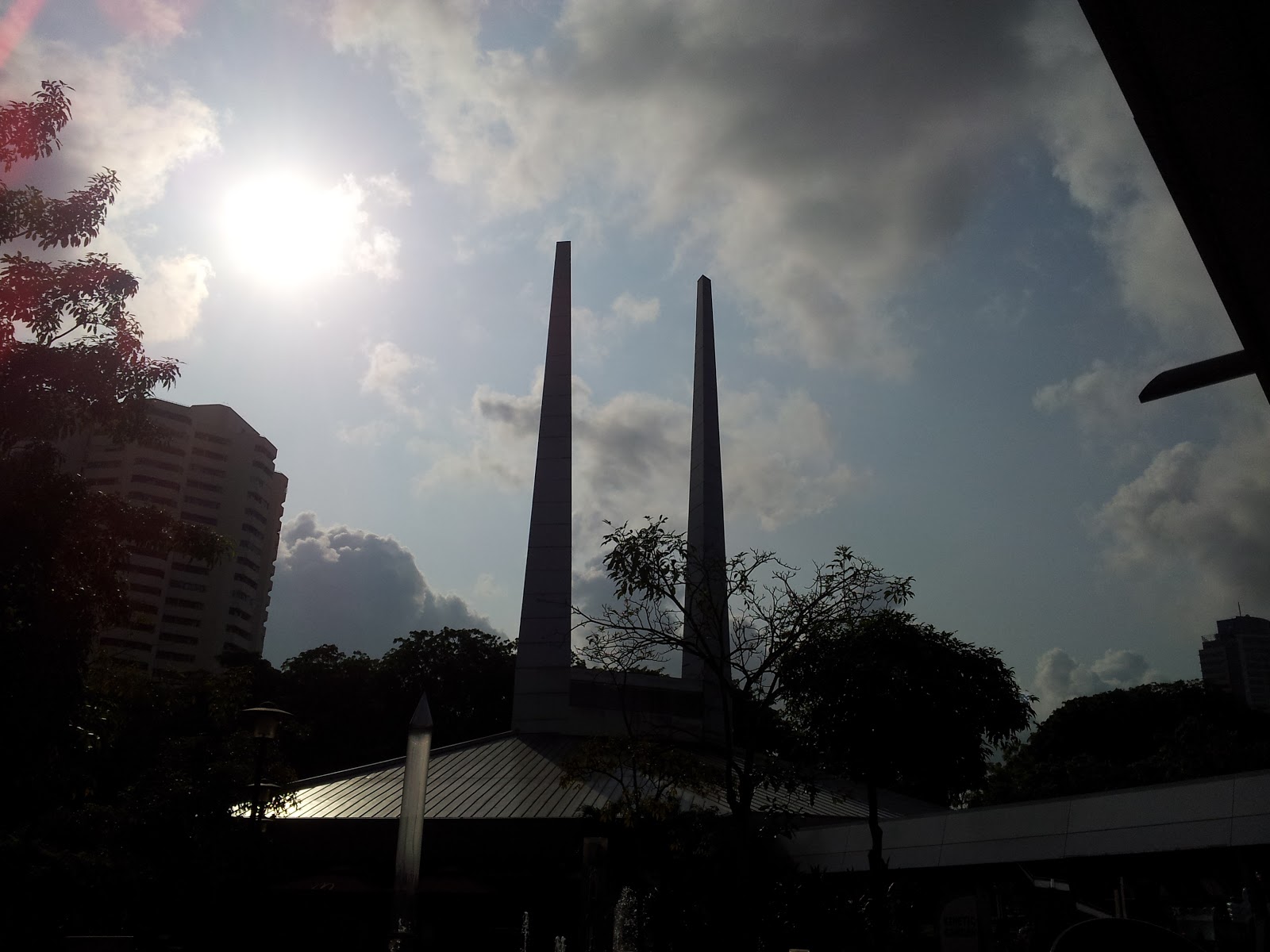
Took a picture of the hazy Sun setting behind Science Centre on the way home last night.


Someone commented that it looked a bit like Lord of the Rings, i.e. the eye of Sauron above the Dark Tower Barad-dur. A few minutes later I saw a post from SGAG with the exact same idea:

Original picture submitted by Jonathan Chong. Posted on SGAG facebook and www.sgag.sg

Thursday, March 7, 2013

First week of March 2013

Last Friday 1st March, the sky cleared for our first stargazing session of the month.
At first it was mostly cloudy with lightning in the distance so we delayed our start time to allow the weather to improve. Whilst waiting we had time to watch the dramatic sunset.

Sunset 1st March 2013 - Science Centre Singapore Observatory.

After 8pm the sky was clear. As usual, Jupiter was the main target for most of the first hour. Just like the previous week, the Great Red Spot (a giant storm) was faintly visible amidst one of the equatorial cloud belts.
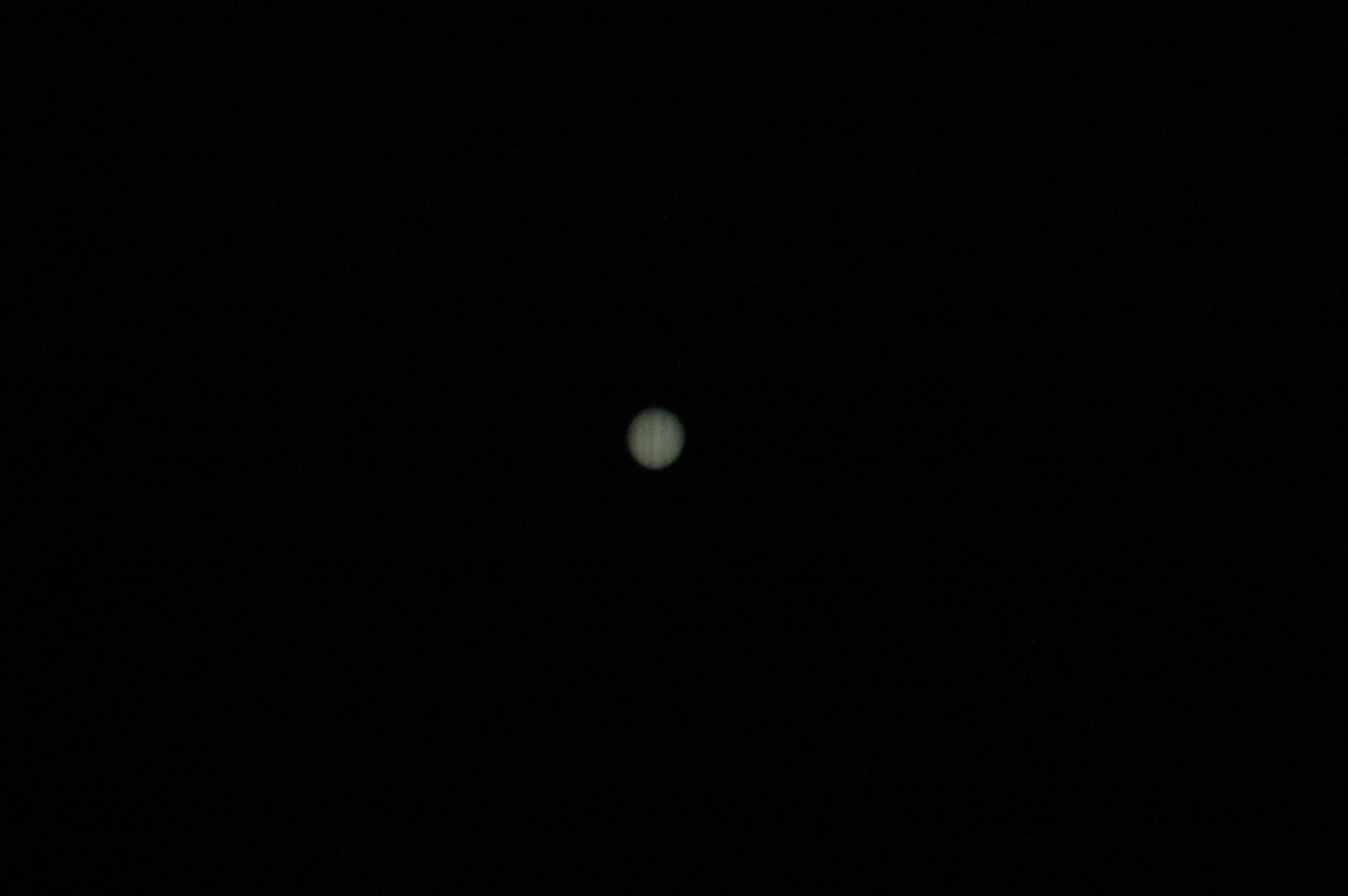
Jupiter - Taken on 22nd Feb 2013 - from Science centre Singapore, through a 16 inch Cassegrain using a Nikon D70s. The great red spot is just visble on the left, beside the southern equatorial belt (lower dark band).

Jupiter - taken on 22nd Feb 2013 - through a 6 inch refractor. Sidewise orientation due to position of Jupiter in the sky (towards the west) and the position of the camera.

Later in the evening we turned are attention to the bright stars and constellations of Taurus, Orion and Canis Major. The great Orion Nebula (M42) was particularly stunning in the main 16-inch telescope, especially as there was no moonlight around.

After closing time, a few of us stayed back to take some photos of constellations:
Orion (top) and Jupiter (brightest, below) next to bright star of Aldebaran (in Taurus) - taken facing west - 1st March 2013.

Rectangular constellation of Gemini - bright stars Pollux (on top) and Castor (below). Facing North.


Close up of Orion

Close up of Canis Major - brightest star Sirius (top right).

Canis Major & Sirius (top right) with Carina & Canopus (below) - facing South

Waning Gibbous Moon rising from the East - 1st Mar 2013 10:45pm

Back at home, on Sunday evening (3rd Mar) there was was a bright flyby of the International Space Station (ISS) over Singapore. It would have made a nice photo as the ISS passed  right next to Jupiter and through Orion. However, 10 minutes before the flyby, a big patch of cloud blocked that part of thesky. ISS was visible for a few seconds through gaps in the clouds but all I got on camera was a faint streak as it approached Jupiter:
Faint trail of ISS passing by Jupiter on a cloudy night - 3rd March 2013 - Singapore 


Finally, the Moon is currently going through its waning phases as it moves around the morning side of the Earth. I've seen it every morning this week as I walked to the MRT to get to work. Every day getting closer and closer to the Sun as it approaches New Moon, resulting in its phase changing from a Large bright Gibbous to a half and then just this morning a thin crescent Moon.
Waning Gibbous Moon - 28th Feb 2013 - 7:30am - Singapore

Last Quarter Half Moon - 4th March 2013 - 7:40am - Singapore


Waning Crescent Moon - 7th March 2013 - 7:45am - Singapore

New Moon occurs on Monday 11th of March, which means it will not be visible this weekend as it will be too close to the Sun to see. By the end of next week it will return to the evening sky as a crescent Moon around 13th-15th March.

To see the Moon at SCOB this month I would recommend either Friday 15th March or Friday 22nd March.
____
Also we've seen no sign of Comet PANSTARRS C/2011 L4, which is at its brightest this week. However, its extremely low in the sky between 7pm and 7:30pm, almost exactly west after sunset. So far, its been cloudy every day in that direction so it will be challenging to spot it.

Tuesday, January 8, 2013

January 2013 - Happy New Perihelion!

Our first stargazing session of the new year turned out to be very cloudy indeed, not a single thing to see. The same was also true during our attempts to see ISS fly over Singapore on 2nd & 3rd Jan.
However, as the weather is much clearer and hotter this week, I put a solar filter on our 6-inch refractor attached to the main telescope and took a look at our parent star, the Sun.
Photo of Sun ans sunspot 7th Jan 2013 4:15pm - taken through 6 inch refractor with Samsung SII phone camera. Image is rotated 90deg counter-clockwise, north is on the left, south on the right.
Image of the Sun from NASA satellite SDO (Solar Dynamic Observatory) showing the numbers/names of the sunspots on 6th Jan. The highlight area produce a M-class Solar flare on 5th Jan. This image is in the correct orientation with north at the top.

January is the month when the Earth reaches its closest position to the Sun, (perihelion), which was actually on 2nd Jan.  The difference between Earth's perihelion (closest) and aphelion (furthest) distance is only 3% so it doesn't look any different than usual. There were several sunspots visible on the Sun's surface, areas of magnetic instability and high activity, usually associated with solar flares. 2013 is expected to be the year in which the Sun reaches its solar maximum, the peak of its  11 year natural activity cycle.

For the remainder of January here's what we can expect to see:

Constellations
Most of the brightest stars in the sky are visible during the first part of the year. This includes Orion, Taurus and Canis Major, with the brightest star in the night sky Sirius, lower towards the south-east.

Planets
We've been observing Jupiter for over a month now and its still shining brighter than all the stars. This month its alot higher in the sky, so we should get some nice clear views of its bands of clouds and its 4 Galilean Moons.  64 moons have been discovered around Jupiter, but only its four biggest moons, Io, Europa Ganymede and Callisto are visible through most telescopes.
Position of Jupiter's four biggest moons during Friday night stargazing at SCOB (8pm-10pm).

As a planet orbiting around the Sun, Jupiter appears to move in front of the constellations. Currently, its making its way through Taurus. Since October 2012, Jupiter has been in apparent retrograde motion, meaning its moving backwards in the opposite direction of its original path (prograde)
This apparent retrograde is due to the position of the Earth.

As Earth is closer to the Sun, it travels faster than Jupiter. Both planets are travelling in the same direction but as Earth comes closer to Jupiter and eventually overtakes it, the giant planet appears to move backwards. This current retrograde will last from Oct 2012 until 30th January 2013.

Moon
The Moon moves close to Jupiter on 21st Jan and 22nd Jan. Look out for the bright planet next to the Gibbous moon on these two evenings.
On Friday nights at SCOB, we'll be observing the Moon on 18th Jan (crescent/half moon) and 25th Jan (gibbous moon).
The other significant Moon dates are as follows:

 Happy skywatching!


Thursday, December 20, 2012

Solstice on Doomsday!

December 21st is a significant date for a few reasons.
Every year around this date the Earth reaches a position around the Sun that causes the south pole to lean/tilt towards the Sun at its greatest extent. This is known as Solstice, which means "Sun-stationary".
This could mean its an ideal time to buy lots of nice pens, pencils and rulers illustrated with smiley-face suns for Christmas or.... that the Sun, having gradually shifted more toward the South each day for the past few months, has now reached its Southern-most point in the sky. Therefore with each new sunrise after 21st December, the Sun appears to reverse course and shift back towards the Northern half of the sky.


The effects of the Solstice are the related to the seasons, as the intensity of sunlight varies at different places on the Earth.
Commonly known as Winter Solstice, it also results in the shortest daylight hours and longest night of year in northern hemisphere countries. At the same time, southern hemisphere countries experience their Summer Solstice or longest daylight hours/shortest nights.

Naturally there are lots of cultural events and festivals around this time. In Singapore, some of those of Chinese ancestry celebrate with family and friends by eating a dessert known as tangyuan 湯圓


The region that receives the most intense sunlight at this time of year is known as the Tropic of Capricorn. This is because the Sun's position in the sky during this time (i.e. its southernmost point), used to be directly in front of the constellation Capricornus.
However, the Earth's tend to wobble as it rotates and over thousands of years this wobble (known as precession) resulted in the Sun's southern solstice position shifting into the neighbouring constellation of Sagittarius. I guess someone should go re-label all those globes and maps and replace the Tropic of Capricorn with "Tropic of Sagittarius". At the same time they should also change the northernmost position of the Sun as well (i.e. Tropic of Cancer Gemini).


Solstice in Singapore
As mentioned in my previous post during the June Solstice, the effects on equatorial regions, such as Singapore, are much more subtle.

Slightly north of the equator, Singapore also experiences its shortest daylight hours, roughly 12hrs 3mins 2secs from sunset to sunrise, but this does not coincide with the latest sunrise, which occurs during February in the tropics.
Solstice marks the time when Singapore sunrise becomes later than 7am (i.e.7:01am). From now until February, sunrise will gradually get later and later, so you can enjoy a few extra minutes of darkness in the morning.

Sun's position 9am June - Facing east, Sun rises from North-East (left)

Sun's position 9am December - Facing east, Sun rises from South-East (right)
At June/Northern Solstice the Sun rises from the North-East direction and sets North-West.
In December, sunrise is from South East and sunset South-West. Therefore, those with south-facing windows can expect more sunlight at this time of year, while north-facing window enjoy more shade. However, in December its raining most of the time, so it probably won't make much of a difference.


End of the year world
Finally, 21st December 2012 is now more well known for its association with the ending of an ancient Mayan calendar.
Mayan Pyramid of the Moon
These ancient Central Americans kept track of the days in the following way:
1 day is called a k’in.
20 days is referred to as 1 winal.
360 days is called 1 tun.
A period of 20 tuns is called 1 k’atun
20 k’atuns are grouped into 1 b’ak’tun, which is equal to 144,000 days.


This so called Mesoamerican Long Count Calendar ends after a cycle of 13 b'ak'tuns, which when translated to our modern Gregorian Calendar finishes on 21st December 2012. 
Many scholars and scientists  think that after this date the calendar simply repeats itself or starts again, similar to how we always start back at January every year.
However, there are many other ideas out there that have developed over time, referring to doomsday and the end of the world. Many are based on scientific findings and events like asteroid collisions, planetary alignments and solar storms but have been extremely exaggerated and highly unlikely.
I think its all just a great excuse to make tonnes of movies, documentaries, write books and articles.
I guess we will find out soon!

Thursday, November 1, 2012

November Night Sky

Halloween is over and November is here. As mentioned in my previous post, this is the time of year that Singapore experiences its earliest sunrise and sunset.

For the first half of November the Sun will rise at about 6:46am and set at 6:50pm. From now on, sunrise and sunset will gradually get later and later until around February 10th, where they reach their latest times of 7:17am and 7:21pm (in Singapore and other equatorial regions). Only half an hour different but it is noticeable  so enjoy those brighter morning this month.

Weather-wise, its still very rainy as we head further into the end of year rainy season. Although there are still some hot and sunny days here and there.
Here's a number of things can be seen on those occasional clear night.

The Moon

The best nights to observe the Moon at SCOB will be Friday 16th Nov (crescent Moon) & Friday 23rd Nov (Gibbous Moon).

Wednesday 28th November 2012, is the smallest Full Moon of the year, as this month's Full Moon coincides with the Moon's apogee or furthest distance from the Earth (roughly 406,364 km away).

However, the effect will be hard to notice as the size difference in the sky compared to other Full Moons will only be very slight. Although, I'm sure many photographic illusions will appear at this time to make the moon appear teeny-tiny.


Stars and constellations
Constellations in the early evenings of November are pretty dim. The brightest are located towards the North, the most obvious being the square shape of Pegasus and three bright stars forming the backbone of Andromeda (the Princess).

Located within this area are a few interesting objects:
1) Andromeda galaxy (M31) - one of the brightest and closest galaxies to our own Milky Way. Not such a great sight from Singapore, due to light pollution, but on a really clear night with no Moon, I've seen it as a  dim glow in our main 16inch telescope. (9th Nov and 30th Nov will probably the best Fridays to try this).
2) Gamma Andromedae - a bright double with a distinctive gold and blue colour pair of stars (when seen through telescopes).
3) The Triangulum - small constellation of three stars easily visible in binoculars and the naked eye.

Later in the evening towards midnight the bright constellations of Taurus and Orion begin to appear.

Planets
Uranus and Neptune are still around, high up in the sky, but they only appear as tiny faint dots.
Jupiter, one of the brightest planets in the sky, is visible just before 10pm. So we'll be aiming our telescopes towards Jupiter at the end of our Friday night stargazing sessions.


Thursday, October 25, 2012

Halloween in the tropics - an astronomical event

Next week is Halloween. This festival is normally associated with death and spook things but it also has an astronomical significance, just like alot of other seasonal holidays.

Halloween occurs on 31st October every year, which is in the middle of the season of Autumn or Fall in the Northern temperate regions of the Earth. During this time the leaves on many trees (so called "deciduous trees") start to turn brown and fall to the ground, in preparation for the approaching winter months.
I'd imagine that the disappearance of alot of the summer flora and fauna was one of the key influences for the "death" theme of Halloween, as at this time life simply seems to fade away, to be replaced by a cold, barren, frozen landscape.
A typical British street during winter - with leafless trees and frost or snow covering the ground.

These changes are mainly triggered by a reduction in the amount of sunlight, resulting in a lose of chlorophyll (the green stuff responsible for photosynthesis) in leaves.

Basically Halloween signifies the middle point between the Autumnal Equinox (22nd Sept - where night and day are equal in length) and the Northern Winter Solstice (21st Dec - the shortest daylight hours of the year).

Although we don't experience the same seasons here in tropical Singapore, there are a few  astronomical clues that can be observed around Halloween:

1) Early Sunrise/Sunset
If like me you wake up for work around 6:30am-6:45am, you may have noticed recently that the sky is already bright compared to a few months ago when at the same time it was still dark.
This is because on the day after Halloween (1st Nov) Singapore (and other tropical areas) experiences its earliest sunrise for the whole year. Sunrise on this day occurs at 6:46am compared to the latest sunrise of 7:17am on 10th Feb (incidentally close to Valentine's Day and Chinese New Year).
In the tropics, early sunrise also means early sunset. So if you get home around 7pm, over this next week, it should be almost dark as sunset on 1st Nov (and Halloween) is at 6:50pm.
All this is a result of the orientation of Earth's tilt relative to the Sun at this time of year.

9am Morning Sun during June  - Sun located towards North-east (on the left).
9am Morning Sun in October - Sun is slightly higher and more towards the South (right) than earlier in the year.

2) Southern Sun
During Equinox (22nd Sept) the Sun is directly level with the equator, which from Singapore, results in the Sun rising due East and setting due West, with the midday Sun directly overhead.
On December 21st (solstice) the Sun rises from its most southern point in the sky. Around Halloween the Sun will be halfway between these two positions. So the daytime sunlight will come from a slightly southern direction. Bad news for those with south-facing windows, as for the next few months you can expect more and more sunlight on that side of your house.

This effect can also be seen in the orientation of shadows on ground.
Back in June (close to northern solstice) the Sun was at its northern most point so shadows appear to point south.
12:30pm - Midday shadows in June (solstice) - shadow are long and point south (left).

During Equinox, shadows pointed more or less east and west as well as directly below our feet.
12:30pm - Midday shadows in September (Equinox)  -  shadows are short, gradually pointing west and east in the morning and afternoon.
Lunchtime shadows in September (Equinox) are directly  below our feet

Around Halloween shadows now point slightly north (i.e. opposite the Sun).
12pm - Midday Shadows in October (close to Halloween) - shadows point slight North (towards the right)
Of course Halloween has alot of other cultural and religious influences, but its timing is primarily astronomical in basis and represents one of the four so called "cross-quarter dates" that occur between solstice and equinox.


Being an astronomer in Singapore has its uses, sometimes to share these little tidbits of information with others whilst walking out for lunch, to pause for a few seconds in order to look around and observe the small occurrences of the Earth's daily wanderings through space before we ourselves resume going about our own daily life.

Friday, August 31, 2012

Not so Blue Moon!

I recently encountered a number of questions about this month's double full moon. The first full moon occurred on 2nd August (2012) and the second is tonight (Friday 31st August).
Its a common misconception that the second full moon in a month is called a "blue moon". I also made this assumption previously, however this is not the case. Having two full moons in one month does not result in a Blue Moon.
Throughout several conversations this week, I have attempted to explain why and this is the best explanation I can come up with:

The rather long background information
Our 12 month Gregorian Calendar is partially based on the 12 Lunar Cycle that often (but not always) occur in one year but individual calendars months (like August) are no longer in sync with the (approximately) 29-day lunar month (i.e. the time between two New Moons).
This results in some months (e.g those with 31 days) having two Full Moons or two New Moons.

The term "once in a Blue Moon" is not related to the number of Full Moons in one month but instead, the number of Full Moons or lunar cycles between two seasons.

Most calendars around the world have significant dates that represent the start of seasons. These dates are based on the Sun's position in the sky.

For example, in European calendars, the "Start of Spring" was usually celebrated on the 20th Mar (or 21st Mar), when the Sun is exactly level with the Earth's equator. This is referred to as Vernal Equinox where day and night are equal in length (Equi -"equal"; Nox -"night").
Likewise, the "start of summer" is usually 21st Jun or Solstice, when the Sun reaches its highest position in the sky, resulting in the longest daylight hours.


In Asian calendars, the "start of spring" (Lichun, 立春) is actually marked by the halfway point between the December Solstice and Vernal Equinox, i.e. when the Sun is 45 degrees behind (or 315 degrees in front of) its Vernal Equinox position.

The actual answer
How does the Blue Moon fit in to all of this?
Most of the time, there are three Full Moons between Equinox and Solstice (i.e. between seasons). But occasionally when a Full Moon occurs on or near the Equinox or Solstice, there will four Full Moons between the seasons. The third moon of a four moon season is called the "Blue Moon" (It will take another essay to explain why).


Consequences and Complications
Having an extra Full (Blue) Moon between seasons makes things a little bit messy, because cultural and religious festivals like Easter and Chinese New Year are based on lunar and seasonal dates.
For example, Chinese New Year is always celebrated on the New Moon closest to Lichun (the start of spring based on the Sun's position).
When there is a Blue Moon between seasons (like in 2013) it can result in the date of next Chinese New Year moving back (e.g from February to January) by almost half a month. Over several years, this gradual shift can result in Chinese New Year moving into winter months like December or November.

To accommodate this, extra/double months have to be added into the Chinese Lunar Calendar during certain years in order to push forward significant festivals, e.g. so that Chinese New Year stays close to spring/LiChun.

Phew ... that explanation was a little bit more complicated and longer than I thought!

Wednesday, June 20, 2012

June Solstice in Singapore

This week is June Solstice week, where the Sun reaches its most northerly point in the sky. Of course, this event is not due to the Sun's actual movement but instead the movement and tilt of Earth. Every year around 21st June, Earth's north pole points more towards the Sun than at any other time of year. This causes a number of significant effects here on Earth.

June Solstice signifies the start of summer in the northern parts of the Earth as well as the longest daylight hours for the whole year. At the same time, it also marks the start of winter and the shortest daylight hours in the southern hemisphere.
There's often a great deal of excitement and sometimes celebelation associated with solstice particularly in places like stonehenge in the UK, where crowds gather from sunrise (around 5am) to sunset (around 9:30pm). The stones themselves also mark the Sun's position at solstice.
Stonehenge - Credit: Pete Strasser - NASA.gov
In Singapore, the effects of solstice are a little harder to spot as near the equator the Sun's position varies only slightly throughout the year.
However, here are some of the signs to look out for in order to notice the solstice from 1 degree north of the equator:

1. Longest daylight hours and shortest night. As Singapore is technically in the northern hemisphere by 1 degree, we also experience the longest number of daylight hours for the year. How long? Exactly 12hours 11minutes 48seconds, from sunrise to sunset. Compare this to the shortest daylight hours of 12hours 3minutes 2seconds in December, the difference is only 8 minutes. Not much to celebrate about, but it is noticeable particularly if, like me, you find yourself reaching home around 7pm. Whilst walking home from the MRT station, bus stop or waiting for a ride, look up at the sky and see if it looks any brighter than usual. A slightly later sunset at 7:16pm should make the sky look brighter than at other times of the year.
Sunset/dusk in June - Longer daytime, later sunset, slightly brighter sky.

Sunset/dusk in April - slightly darker than in June.
2. Sunrise, Sunset and Northern Sun
If you're heading out to work or school around 7:30am or 8am, you may notice that the morning Sun is positioned slightly more to the left (i.e. North) than usual.

June morning Sun to the left (north) of the Science Centre entrance - After June 21st the morning Sun will gradually make its way south (towards the right)
After 21st June, take a look at the Sun every now and then over the next few months around 8am. You should find the Sun gradually moving more towards the right (i.e. south) every week, until it reaches the December solstice position on 21st December.
Similarly at sunset, the afternoon/evening Sun should be located more towards the right than usual. This can be a bit annoying if you happen to own a house, flat or condo with north-facing windows, thinking that you'll escape the brightness and heat of the afternoon/western Sun. Around June Solstice, you'll start to find what was once a nice shady spot is now lit by bright sunlight, as that north facing window is now tilted slightly towards the Sun for most of the day. Those with south-facing windows will experience the same thing in December.

3. Noontime Shadows
Between 12:30pm and 1:30pm, the Sun is at its highest point in the sky but as the June Sun is at its most northern point, midday shadows on the ground will be at their longest as compared to other times of year.
June Solstice Shadows - Longest noontime shadows. Shadows point South

Morning Shadows in June - Sun rises from north-east, shadows point south-west 
If you compare your shadow at midday over the next few months you should find it becoming gradually shorter and shorter until finally its directly below your feet around late September, when the Sun is directly overhead (Autumnal Equinox). Also, as the Sun is located towards the North, all the June shadows should point in the opposite direction towards the South.


All parts of the world, will experience the effects of solstice in one way or another, the most obvious being  in those parts furthest from the equator.In Singapore, the changes may be small, but the clues to spot them are all around us, we need only stop for a while and look around at the environment we live in.


There are a number of other times in year in which the Earth's tilt causes other seasonal effects, such as the the position of the Sun, daylight hours, sunrise, sunset, planet growth, animal migration and seasonal weather patterns. Some of these changes have even influenced the dates of well know holidays and celebrations such as May Day, Halloween, Mid-Autumn Festival, Christmas and Chinese New Year as the movement of objects like the Sun and Moon, have formed the basis of many calenders for thousands of years.
The world may be full of different cultures, but we all share the same sky.
Happy Solstice everyone!