Sticky Post

We are currently not maintaining our blog here. Please go to our Facebook Page for latest updates!

Friday, May 11, 2012

Reflections on a Supermoon

Last weekend there was a so called "supermoon", where this month's Full Moon coincided with the Moon's closest approach (perigee) to the Earth. This made the already large Full Moon, bigger and brighter than normal. This created quite alot of interest, especially with the help of news headlines and social media posts stating clearly, that this would be the biggest and brightest Full Moon of the Year, an event not to be missed!!
I myself also posted an announcement on our Observatory Facebook page. I was momentarily surprised when a similar post on Science Centre main Facebook, gained more than 100 likes in a matter of minutes. Immediately I began to compose another post to include more specific details about the event, only to realise that I was describing this event as relatively inconspicuous, basically saying that "yes it will be bigger, but not THAT much bigger".
Alas, in the end I deleted this information and instead posted some basic facts about the size difference and how to observe the Full Moon. The thought occurred to me that despite all the excitement and hype, this might be one of those times to sit back and let others decide for themselves whether they thought the moon looked bigger or not.
Admittedly, from my experience this particular Full Moon did look marginally larger than average and I have heard many other people also observe a slightly larger and brighter appearance. In reality the difference between the Moon's closest distance (perigee) and furthest distance (apogee) is only very small (around 42000km) compared the average distance of the Moon from Earth (388,000 km).
However, observing the Full Moon is sometimes open to individual interpretation, especially when it only occurs once a month and because of an illusion a normal moon looks bigger when its lower in the sky and smaller when its higher.
This is sometimes caused by comparing the moon to objects on the ground like trees and building or statues, which may vary size due to their distance from the observer. Basically, the further away an object is, the smaller it looks. So when the moon is low these distant objects it looks much bigger by comparison thus creating a supermoon illusion.
When the Moon is higher up in the sky there are less objects to compare it to, therefore the size difference is only very slight when comparing to previous Full Moons. As you can see, as an educator I have a habit of dispelling misconceptions and providing the most accurate information I can, however this event made me think about encouraging others to explore ideas for themselves. I also thought about how helpful words like "BIGGEST", "BRIGHTEST", "FIRST" "LAST" and "MOST SPECTACULAR EVER" can be, as they seem to be very helpful in getting "likes" to posts, heeheehee.
Picture comparing Perigee Moon (Supermoon) to Apogee Moon (Smallest Moon):
 Video explaining more about the supermoon:

Thursday, May 10, 2012

Recently at SCOB

Its been sometime since we posted any updates on this blog. Since the last post many changes and events have took place. In particular our dear friend and one of the original members of scobbers, SK (ruijie) moved on to other career opportunities. However, several new colleagues have joined the team and allowing scobbers to grow and expand. I have therefore finally got around to continuing what SK started and once again chronicle the events and happenings at SCOB, in addition to our other online updates (facebook, twitter etc.). To begin with let me share some photos of one of our most recent event, the ASPAC Science Centre Conference. Hosting this international event, took considerable planning and preparation. So much so that we closed the observatory for three weeks last month, as many of our scobbers were needed for other duties, in particular facilitating some of the sessions and providing the all important entertainment. The opening ceremony took alot of coordination and practice, mainly due to the number of people involved. This included a spectacular multicultural dance routine.
A musical sound and light show, mostly performed without speaking, which featured many new ideas and demos. Some of which didn't make it in to the final show. It was quite a challenge to incorporate all the different elements. Hopefully we will develop these ideas further to make new shows for visitors.
We also saw a number of other awesome sharing sessions and shows by presenters and educators from overseas science centres.
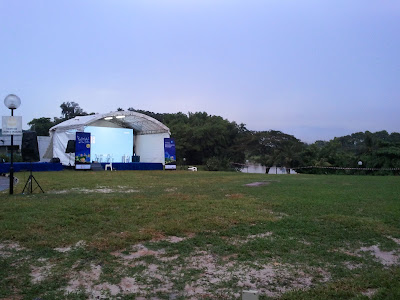
On one of the last evenings, there was a garden party, which extended from the kinetic garden to the observatory. Apart from opening the telescopes for delegates to view planets and such, many scobbers were busy facilitating the evenings entertainment and decorating the area. Working tirelessly throughout the afternoon blowing and tying balloons inside the observatory classroom.
Overall, the ASPAC conference was a great experience, sharing ideas and our passion for science education with many other from around the world and from far far away.

Thursday, June 9, 2011

Total Lunar Eclipse on 15th/16th June


A Lunar eclipse occurs during an alignment of the Sun, Earth and Full Moon, resulting in the Full Moon gradually darkening as it moves into the Earth’s shadow.

In Singapore, this eclipse occurs in the early morning hours of Thursday 16th June. It is the longest lunar eclipse since July 16th 2000.

Timings
1:22am – Penumbral phase – The Moon enters the outer edge of Earth’s Shadow (penumbra). This shadow maybe light and not very obvious.
2:22am – Umbral Phase – The Moon enters the darker, inner part of Earth’s shadow (umbra). Over the course of an hour, the dark grey shadow gradually moves across the face of the Moon.
3:22am-5:02am – Totality – The Moon is completely covered by the Umbra and turns red/orange in colour.
5:02 – 2nd Umbral phase – The Moon reaches the opposite edge of Earth’s umbral shadow. It begins to reappear as the shadow gradually recedes across its surface.
6:02 – 2nd Penumbral phase – The Moon is completely visible again, although not at full brightness as it is still inside the lighter, penumbral shadow.
7:00am – Eclipse ends – The Moon exits the penumbral shadow of the Earth’s and returns to full brightness. At this point the Moon may be too low to see.


How to observe the lunar eclipse:
Lunar eclipses do not require any special equipment to be seen.
They are easily visible to the naked eye, due to the Moon’s large apparent size and brightness.
Choice of location is important. As this eclipse occurs in the early hours of the morning, observers must have a clear view of the west direction, unobstructed by trees or tall buildings.
Open parks, fields and reservoirs often make good locations.
Avoid brightly lit areas.

Join us at the Red Moon Spectacle Event, at The Lakeside @ Omni-Theatre (Jurong Town Hall Road, besides Snow City).
Bring a mat and observe the eclipse overlooking Jurong Lake, as well as outdoor movie screenings starting from 11pm.

WEATHER WARNING:
In the event of thick clouds and/or rain, the lunar eclipse will not be visible.

Saturday, January 15, 2011

SPAstro

We had a cloudy sky during this evening's Observatory session. But occasionally little pockets of the sky peeped through the gaps in the clouds, exposing the glittering objects behind.

We saw Jupiter, Archernar (star) and the Moon through the telescopes set up.

We had a surprise visit from SPAstro, a bunch of vibrant and lively young people keen on Astronomy. Thanks for bringing your youth and exuberance to the Observatory, and thanks for promoting the love of Astronomy! The Observatory is also so much more colorful now with your help in putting up the color cards.


Presenting: SPAstro!

Hope you have enjoyed your visit. Come often ok?

Tuesday, December 7, 2010

Rainy Days and Shooting Stars

Tis the season to be jolly fa la la la la, la la la la.
We're in the middle of the holidays and Christmas is approaching, there's a relaxed atmosphere in the office as most people are clearing leave, thinking of year end parties and planning secret santa gift exchanges, which remains me I must find a good day to pop out at lunch to buy my gift for D-day this Friday.
Of course this does not mean that we scobbers are just sat around the office surfing the internet feeling all merry, of course not no no no... half of us are on leave sat at home surfing the internet or even off on holiday somewhere feeling even merrier :)
For those of us still in the office, its all work work work, there's still shows to perform, visitors to entertains, events and programmes to prepare for, even surfing the internet and this blogpost is work related...-gives oneself pat on back for working so hard-... Although I probably would be on leave now if I hadn't used it up earlier in the year.

Anyways back to work.... at SCOB there's alot of planning to be done. We're currently working on developing a planetarium programme for our friday night stargazing using our new inflatable STARLAB planetarium, which requires further testing but will probably be ready early next year.

Stargazing on Fridays has been severely limited by the rain. December is actually great for stargazing as there are several bright constellations and interesting objects around, its just unfortunate that this period is one of the most cloudiest and rainiest in Singapore.

It was a similar story last month, especially during our big event "The Festival Of Stars" held on the eve of the Hari Raya Haji holiday on 16th Nov. A few thousand people turned up expecting a look at Jupiter through the many telescopes provided by TASOS and SCOB and hoping to stay overnight to witness the shooting stars of the Leonids Meteor Shower.
Instead, we were all witness to a tremendous rain shower:
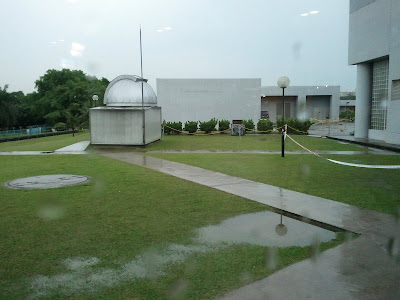

The observatory and stage area was literally flooded. No stars or meteors visible on this occasion. However, it was decided that the show must go on, as all the outdoor festivities, performances and movie screenings were moved to the indoor auditorium at the Annexe Hall 1, the Science Centre Exhibitions were also opened for all.


At the SCOB, things remained rather quiet, with just a handful of families remaining to participate in the arts and crafts activities. Only thing left for scobbers to do was to regrettably inform new arrivals of the wet weather and usher them to the galleries and annexe auditorium. We also put up a temporary sign to help guide visitors along and reduce the amount of times we had to repeat the information.


Now dare I say that there is another meteor shower coming this December, in fact its happening this very weekend. The Geminids Meteor Shower peaks around December 12th & 13th every year. This year is supposed to be a pretty good one as the Geminid Meteors are expected to be brigther and more numerous than meteor showers in previous months.

Having said that, its best not to get your hopes up. Remember, watching any meteor shower in an urban environment like Singapore will yield a relatively low number of shooting stars. Whereas the expected number of Geminids is supposed to be 40-60 meteors per hour, you are more likely to see one or two per hour, somemore its rainy season so expect more rain than meteors.

SCOB we will not be organising any event for the Geminids. For those who wish to view it from home, it is best seen on the evening of 12th December between 12am and 5am (which technically is early on 13th Dec). Meteors will originate from the North-East direction and can travel in any direction (up, left, right).

If you do manage to see any meteors let us know how many and where from. This Friday 10th Dec on Friday Night Stargazing we'll also be giving a talk at 8:15pm, giving more information on the Geminids and other meteor showers.

Merry Christmas Ho Ho Ho!!!