Sticky Post

We are currently not maintaining our blog here. Please go to our Facebook Page for latest updates!

Wednesday, August 1, 2012

Photos of Stars and Planets - July 2012


Things at SCOB have been a bit quiet this month in comparison to a very active June holiday period. Weatherwise, the first two weeks of July were full of cloud and rain and we didn't get to see much during Friday night stargazing.
However, hot weather did return and with it, clear skies. The last two stargazing sessions were very fruitful as we got to see several of those bright star clusters that I was talking so much about in an earlier post.
Open Star Cluster NGC 6231 located in the constellation Scorpius - as seen through a 6-inch refractor telescope.
Unfortunately we didn't see any of those fainter globular cluster but clear skies meant that we could also see a rather nice display of planets. In the early evening Saturn, Mars and a star called Spica formed a bright triangle in the western part of the sky. This triangle will gradually get smaller over the next weeks as Mars gets closer to Saturn.

Last week I also managed to wake up early in the morning at 6am, to go outside and take some photos of another bright trio of objects. After a few failed attempts, due to clouds, my sleepy eyes were suddenly revived by the sight of Venus, shining brilliantly white, along with Jupiter and a star called Aldebaran (in the constellation Taurus) along with a bunch of other familiar stars, including the constellation Orion. 

Venus (brightest and lowest), Jupiter (top left) Aldebaran (star, right of Jupiter) as seen from Singapore - 6:30am, before sunrise in late July.
Whilst at home, I also took advantage of the clear skies and ventured outside on a few nights after dinner to catch another glimpse of some bright constellations. Once the moon had gone, many bright stars stood out, including the constellations Scorpius & Sagittarius.

The teapot shape of constellation Sagittarius (left) and hook-shaped constellation Scorpius (right) - as seen in a light polluted area of Singapore.

I find it very enjoyable to look at constellations with just my eyes or a pair of binoculars, especially with clear skies.  After a while though, it was time to leave the stars and the mosquitos behind and head back inside, where I joined my wife to watch some indoor stars, i.e. watching Korean drama.......An-nyeong-ha-se-yo!

Thursday, July 5, 2012

This month's sky - July 2012

Oh no! Its raining! That's how this first week of July has been almost every day. However, the cooler weather is a welcome break from the hot sunny days of June. Unfortunately, July is a great time for stargazing, with a number of bright constellations, star clusters and other deep sky objects. I only wish the sky remains as clear as it did last month. Let's hope this thick cloud clears come Friday evenings.

Planets in July
On 1st July, Mercury was at its highest point in the sky for the year as reached its "greatest elongation east" of the Sun (i.e. at the extreme edge of its orbit as seen from Earth). As Mercury moves further around the Sun, towards the Earth, it will become lost in the Sun's bright glare.
By 10th July, Mercury may be too low to see, which makes this Friday (6th July) the last opportunity we'll get to observe Mercury before it comes back for a brief visit in October.

The brightest and best planet on view at the moment is still Saturn:
Photo of Saturn (May 2012) - Taken through Science Centre Observatory's main telescope (16" Cassegrain reflector) using Nikon D70 DSLR Camera.
Similar to last month, Saturn remains relatively high in the sky next to the bright star Spica (alpha Virginis) part of the constellation Virgo. We've been getting some amazing clear views of Saturn and its rings and moons at SCOB over the last few Fridays.

Moving closer to Saturn, the planet Mars looks like an orange star, similar to the bright orange Arcturus (alpha bootis). When it first appeared, Mars was in front of the stars of Leo. In June, it moved into Virgo. By making some casual observations throughout July, you should begin to notice Mars gradually moving closer to Saturn and Spica.
Diagram highlighting the position of Mars and Saturn during July 2012.


By end July, the three objects form a triangle that slowly breaks apart during August.
On 25th July, look out for the almost half moon, positioned just South of the Saturn-Mars-Spica trianlge.

A good time for planet watching is in the early morning. Around 6am-7am Jupiter and Venus appear very bright towards the east before sunrise, gradually moving in front of the constellation Taurus.


Moon Phases
July starts midway in the 5th month of the Chinese Lunar Calendar with Full Moon occurring on 3rd July. The New Moon does not occur until 19th July, which signifies the start of the 6th Lunar Month of the Year of the Dragon (Chinese Calender).
Dates for the four main lunar phases in July 2012. Moon phases from 1st Quarter to Full Moon are best observed in the early evening. Phases from Full Moon to Last Quarter are best observed after midnight or during early morning. Phases occurring one or two days before/after New Moon cannot  be seen.

While looking up the chinese lunar calendar month, I also found that the 6th day of 6th lunar month is known as Xi Shai Jie  (洗晒节)  bathing/basking festival, a day for hanging out and airing your bedding, books etc . I'm guessing this is because of the hot, sunny weather in China at this time. However, as its always hot in Singapore, we can air our bedding everyday.... if you want to. This year, Xi Shai Jie occurs on 24th July, just before 1st Quarter Half Moon.

Anyways, if you want to see the Moon at SCOB, the best Friday to come will be 27th July.

Constellations
In addition to some of the bright stars of June, such as Crux, Alpha and Beta Centauri, Arcturus and Spica, one of the brightest constellations in July is Scorpius, rising high in the south-east direction.
The most obvious part is the bright red supergiant star Antares, followed by the collection of stars that make up the tail. 
Red Supergiant Star Antares (alpha scorpii) - As seen through Science Centre Observatory's main telescope (16inch cassegrain reflector)


As the stars of Scorpius are in front of one of the brightest parts of the Milky Way (our Galaxy), there are lots of amazing deep sky objects such as star clusters located within the constellation. However, our Singapore sky is much too bright to see many of them clearly but some of the brighter objects are listed in the diagram below:

1) M6 (Butterfly Cluster) – beautiful open star cluster arranged in curved chains like the wings of a butterfly. Visible in binoculars, best in telescope using low magnification.


2) M7 – large open cluster of about 70 stars. Triangular pattern. Close to M6 and other star clusters.
3) Zeta Scorpii – Double star, orange and blue/white colour, unrelated (do not orbit each other). More visible in telescope.
4) NGC6231 – a bright open star cluster of 100 stars. Located near to Zeti Scorpii. Binoculars may reveal more star clusters in the surrounding area.
5) M4 – large globular cluster containing thousands of stars. Difficult to spot may appear fuzzy in binoculars.
6) M80 – small, distant globular cluster. Faint, requires low magnification.
7) Omega Scorpii  – unrelated double star. Easy to spot in Binoculars.


Using a pair of good binoculars or telescope at low power may reveal some of the closest globular clusters for example M4 or M80 (NGC6093). Globular clusters are large collections of stars orbiting around the centre of the Milky Way and contain some of the oldest stars in the Galaxy.
Its unlikely that you'll see the individual stars, but each cluster will appear as a faint hazy patch, like a tiny round cloud. M4 is located nearby Antares and the star Sigma Scorpii. M80 is higher up, halfway between Sigma and Beta  Scorpii.
Diagram highlighting the position of Globular Clusters M4 & M80, near to the stars of Antares and Sigma Scorpii .

Some very nice open clusters are also located near the Scorpius' tail, for example M6 the butterfly cluster.
I wonder how many we'll get to see over this month.

Wednesday, June 27, 2012

Observing Satellites

Orbiting around our planet are thousands of electronic satellites that make great targets for urban astronomers like ourselves. And, there are a number of useful tools and apps that will help you locate them.

A common misconception is that the easiest satellites to spot are those in geosynchronous orbit (GSO) which  stay positioned above the same place on Earth. This is not true, as these satellites orbit at a distance of 35,786km, from which they cannot be seen as they have no light of their own.
The easiest satellittes to spot are those closest to us in low earth orbit (LEO), orbitting between 200km-2000km above the Earth. Such low orbits cause them to travel around the Earth 10 or 15 times every day, occassional travelling above Singapore.


A good website to find dates and timings of visible satellittes is Heavens-Above.
Once there, the first thing you must do is set your location. This is done under the "Configuration" menu: click "from database" and type in and select your city .i.e. Singapore.


You can be more precise by manually inputting your longitude and latitude or selecting from the map, however I often found these options give you the timings in UT (universal time/GMT) which is minus 8 hours from Singapore time,which is a be a bit confusing. Selecting your city from the database gives the local timings.

Once your location is set, just click on a satellite name. The brightest satellites are usually the International Space Station (ISS), Hubble Space Telescope (HST), Iridium Satellites (very bright communication satellites) or maybe China's Tiangong 1 space station.

After making a selection you will be presented with a table of information for all the visible passes for that particular time period.
This information includes the brightness or magnitude. The lower the number the brighter the object will be. Negative numbers indicates that the satellite will be brighter than most stars.
Satellites with magnitudes greater than 2 or 3 maybe difficult to spot in a light polluted environment.
The timings are given in 24hour format (HH:MM:SS) along with the altitude (height) and azimuth (direction) of the satellite at that particular time. Some satellites are visible for several minutes, so their start and end timings/positions are stated separately.
The highest possible altitude is 90 degree (directly overhead). Altitudes below 30 degrees may not be visible from some locations due to trees or tall buildings.

Iridium Satellites (http://en.wikipedia.org/wiki/Iridium_satellite_constellation) are only visible for a few seconds so usually only one time period is stated. Because of the shape of their solar panels, they only reflect the sunlight for short period of time but the reflection is very intense and quickly fades from view, this is known as an Iridium Flare. 
Iridium satellite 
Apps for Satellite Tracking

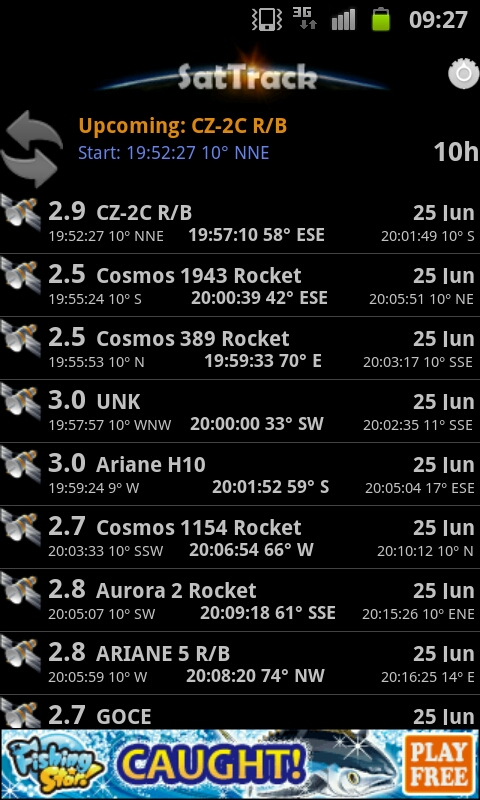
One of the most useful ways to find satellites is using a smartphone app. I've only tried one so far called SatTrack for Android phones from Goggle Play Store:
Again, the first thing is to set your location using your GPS, once that's done you'll get a list of all visible satellites passing over your location. This even includes various rockets and other space junk left behind in orbit. Its best to use the settings to filter the most visible ones. Basically, anything brighter (lower) than magnitude 2.5 and higher than 30 degrees in altitude should be easy to find.


Once you select a satellite, you'll be presented with the magnitude, timings, altitude and azimuth as well as a handy compass which indicates the location and direction in which the satellite will travel across the sky (the purple line).

The app sometimes sends you notifications, when a satellite pass is due to start but you can also select an extra alarm/vibrate setting for those satellites you do not want to miss.

SatTrack app is free and there's also a paid version (without ads) but there many other satellite apps on the android market. There are also some on iTunes for iPhone users, this include: GoSatWatch and Satellites although they're not free,

Look out for those bright Iridium Flares and ISS sightings over the coming week.

Wednesday, June 20, 2012

June Solstice in Singapore

This week is June Solstice week, where the Sun reaches its most northerly point in the sky. Of course, this event is not due to the Sun's actual movement but instead the movement and tilt of Earth. Every year around 21st June, Earth's north pole points more towards the Sun than at any other time of year. This causes a number of significant effects here on Earth.

June Solstice signifies the start of summer in the northern parts of the Earth as well as the longest daylight hours for the whole year. At the same time, it also marks the start of winter and the shortest daylight hours in the southern hemisphere.
There's often a great deal of excitement and sometimes celebelation associated with solstice particularly in places like stonehenge in the UK, where crowds gather from sunrise (around 5am) to sunset (around 9:30pm). The stones themselves also mark the Sun's position at solstice.
Stonehenge - Credit: Pete Strasser - NASA.gov
In Singapore, the effects of solstice are a little harder to spot as near the equator the Sun's position varies only slightly throughout the year.
However, here are some of the signs to look out for in order to notice the solstice from 1 degree north of the equator:

1. Longest daylight hours and shortest night. As Singapore is technically in the northern hemisphere by 1 degree, we also experience the longest number of daylight hours for the year. How long? Exactly 12hours 11minutes 48seconds, from sunrise to sunset. Compare this to the shortest daylight hours of 12hours 3minutes 2seconds in December, the difference is only 8 minutes. Not much to celebrate about, but it is noticeable particularly if, like me, you find yourself reaching home around 7pm. Whilst walking home from the MRT station, bus stop or waiting for a ride, look up at the sky and see if it looks any brighter than usual. A slightly later sunset at 7:16pm should make the sky look brighter than at other times of the year.
Sunset/dusk in June - Longer daytime, later sunset, slightly brighter sky.

Sunset/dusk in April - slightly darker than in June.
2. Sunrise, Sunset and Northern Sun
If you're heading out to work or school around 7:30am or 8am, you may notice that the morning Sun is positioned slightly more to the left (i.e. North) than usual.

June morning Sun to the left (north) of the Science Centre entrance - After June 21st the morning Sun will gradually make its way south (towards the right)
After 21st June, take a look at the Sun every now and then over the next few months around 8am. You should find the Sun gradually moving more towards the right (i.e. south) every week, until it reaches the December solstice position on 21st December.
Similarly at sunset, the afternoon/evening Sun should be located more towards the right than usual. This can be a bit annoying if you happen to own a house, flat or condo with north-facing windows, thinking that you'll escape the brightness and heat of the afternoon/western Sun. Around June Solstice, you'll start to find what was once a nice shady spot is now lit by bright sunlight, as that north facing window is now tilted slightly towards the Sun for most of the day. Those with south-facing windows will experience the same thing in December.

3. Noontime Shadows
Between 12:30pm and 1:30pm, the Sun is at its highest point in the sky but as the June Sun is at its most northern point, midday shadows on the ground will be at their longest as compared to other times of year.
June Solstice Shadows - Longest noontime shadows. Shadows point South

Morning Shadows in June - Sun rises from north-east, shadows point south-west 
If you compare your shadow at midday over the next few months you should find it becoming gradually shorter and shorter until finally its directly below your feet around late September, when the Sun is directly overhead (Autumnal Equinox). Also, as the Sun is located towards the North, all the June shadows should point in the opposite direction towards the South.


All parts of the world, will experience the effects of solstice in one way or another, the most obvious being  in those parts furthest from the equator.In Singapore, the changes may be small, but the clues to spot them are all around us, we need only stop for a while and look around at the environment we live in.


There are a number of other times in year in which the Earth's tilt causes other seasonal effects, such as the the position of the Sun, daylight hours, sunrise, sunset, planet growth, animal migration and seasonal weather patterns. Some of these changes have even influenced the dates of well know holidays and celebrations such as May Day, Halloween, Mid-Autumn Festival, Christmas and Chinese New Year as the movement of objects like the Sun and Moon, have formed the basis of many calenders for thousands of years.
The world may be full of different cultures, but we all share the same sky.
Happy Solstice everyone!

Friday, June 15, 2012

Transit of Venus - Pictures

Its been over a week since the Transit of Venus event. There wasn't alot of time to stop and reflect as we immediately had to move on and prepare for other events and programmes going on during this busy June holiday period.
However, the event went well despite a disappointing start due to bad weather. Around 3000 people turned up at Science Centre that day. When we arrived to set up the telescopes around 7:30am there was already a  queue of 10-15 people eagerly waiting to catch a glimpse of this rare event.


Around 8am the sky was still cloudy and there was no sign of the Sun. After informing the growing number of visitors about the delayed start, we began to standby around the viewing area and wait for the Sun to appear. It was also an ideal time for some group photos.


Anticipation started to turn to disappointment as the time approached 9am and it started to rain with light drizzle.
As the crowd was growing every minute, we were starting to question whether the transit will be visible at all and at what time should announce to  visitors that viewing may have to be cancelled. During the wait, I managed to access and display a live webcast from an observatory on Hawaii's Mauna Loa, whilst other scobbers and volunteers tried to entertain visitors in the queue with some of our gallery activities sets.
By 10am, all we could see were "cloud transits" as the Sun remained covered. So it was time for a talk, two talks in fact. The first, by myself, explained some things about what was happening in the live webcast and some basic information on what else is visible in the sky this month. The second talk featuring more detailed info about the transit was by Mr Albert Ho from TASOS, who regularly helps out at the observatory.
One of the problems about conducting a talk was that not everybody could see it. The ideal location for the talk was the open terrace area in front of the observatory classroom, however the queue line was set up to run down the linkway corridor in order not to cause too much obstruction. Many visitors had to decide weather the would remain in queue for the telescope viewing area or attend the talk. Most people chose to remain hopeful about viewing the transit and kept their place in the queue. However, there were speaker set up along the linkway so that visitors could at least hear what was being said even if there couldn't see it.
After the talks there was a glimmer of hope as sunlight started to appear behind the clouds, a sign that the cloud layer was becoming thinner. Soon after, those that purchased the handheld solar filters were able to see a faint outline of the sun but it was still too faint to see Venus.

By around 11:15am or so we started to see the first glimpse of Venus through the telescopes. Once it became clear enough in most of the telescopes, the doors we opened and we were ready for ACTION:


Small clusters of visitors were led out towards the various telescopes at gradual intervals to prevent overcrowding. There were around 12 telescopes, from both Science Centre and TASOS as well as a few from other volunteers like the Aljunied Astronomy Club, each equipped with strong solar filters to protect our eyes.

In addition to the telescopes, we also set up a number of large solar filters and projection boxes beside snow city and of course the Milo Van and an Old Chang Kee Stall over there as well.


After one and a half hours of hot sunshine and viewing the Venus transit, we were reaching the end of the queue line. Just in time, as around 12:40pm, Venus was almost reaching the end it's transit.
Just prior to the end we managed to take a few photos of the Transit through the telescope to at least have our own record of this historic event. I took the first image with my phone camera, which involves holding the phone at the correct point in front of the telescope lens.
 The below image was taken by our volunteer Eric Lim, who used a DSLR with a special telescope adaptor known as a T-Mount, which allows the camera to attached directly to the telescope.
At the end of the day we were all very hot and tired but it was a thrilling experience to have witnessed this event that won't happen again for another 105.5years. as I mentioned in an earlier post, its not every day we get to see something moving in front of the Sun, besides clouds that it.