Sticky Post

We are currently not maintaining our blog here. Please go to our Facebook Page for latest updates!

Thursday, March 7, 2013

First week of March 2013

Last Friday 1st March, the sky cleared for our first stargazing session of the month.
At first it was mostly cloudy with lightning in the distance so we delayed our start time to allow the weather to improve. Whilst waiting we had time to watch the dramatic sunset.

Sunset 1st March 2013 - Science Centre Singapore Observatory.

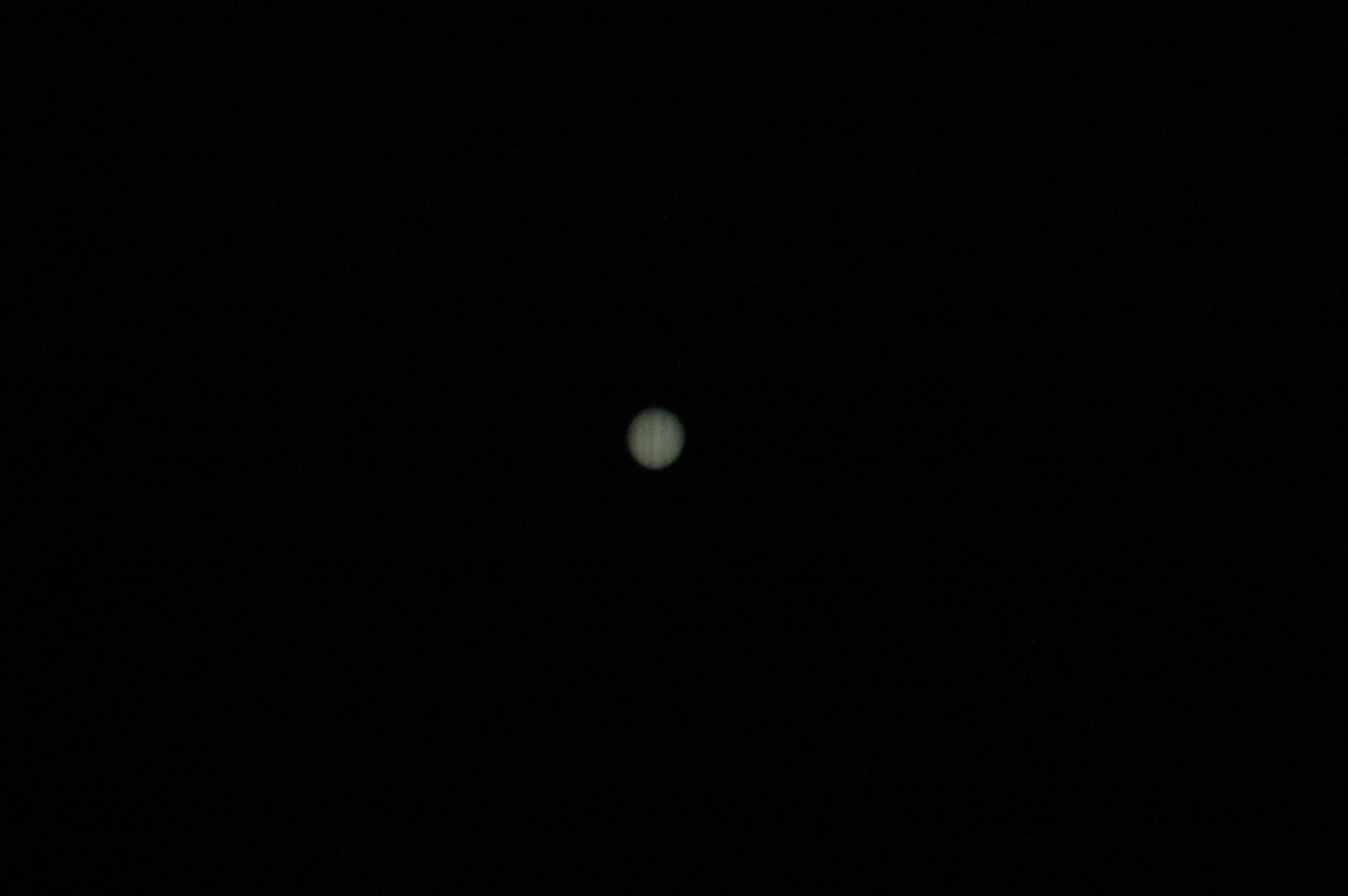
After 8pm the sky was clear. As usual, Jupiter was the main target for most of the first hour. Just like the previous week, the Great Red Spot (a giant storm) was faintly visible amidst one of the equatorial cloud belts.
Jupiter - Taken on 22nd Feb 2013 - from Science centre Singapore, through a 16 inch Cassegrain using a Nikon D70s. The great red spot is just visble on the left, beside the southern equatorial belt (lower dark band).

Jupiter - taken on 22nd Feb 2013 - through a 6 inch refractor. Sidewise orientation due to position of Jupiter in the sky (towards the west) and the position of the camera.

Later in the evening we turned are attention to the bright stars and constellations of Taurus, Orion and Canis Major. The great Orion Nebula (M42) was particularly stunning in the main 16-inch telescope, especially as there was no moonlight around.

After closing time, a few of us stayed back to take some photos of constellations:
Orion (top) and Jupiter (brightest, below) next to bright star of Aldebaran (in Taurus) - taken facing west - 1st March 2013.

Rectangular constellation of Gemini - bright stars Pollux (on top) and Castor (below). Facing North.


Close up of Orion

Close up of Canis Major - brightest star Sirius (top right).

Canis Major & Sirius (top right) with Carina & Canopus (below) - facing South

Waning Gibbous Moon rising from the East - 1st Mar 2013 10:45pm

Back at home, on Sunday evening (3rd Mar) there was was a bright flyby of the International Space Station (ISS) over Singapore. It would have made a nice photo as the ISS passed  right next to Jupiter and through Orion. However, 10 minutes before the flyby, a big patch of cloud blocked that part of thesky. ISS was visible for a few seconds through gaps in the clouds but all I got on camera was a faint streak as it approached Jupiter:
Faint trail of ISS passing by Jupiter on a cloudy night - 3rd March 2013 - Singapore 


Finally, the Moon is currently going through its waning phases as it moves around the morning side of the Earth. I've seen it every morning this week as I walked to the MRT to get to work. Every day getting closer and closer to the Sun as it approaches New Moon, resulting in its phase changing from a Large bright Gibbous to a half and then just this morning a thin crescent Moon.
Waning Gibbous Moon - 28th Feb 2013 - 7:30am - Singapore

Last Quarter Half Moon - 4th March 2013 - 7:40am - Singapore


Waning Crescent Moon - 7th March 2013 - 7:45am - Singapore

New Moon occurs on Monday 11th of March, which means it will not be visible this weekend as it will be too close to the Sun to see. By the end of next week it will return to the evening sky as a crescent Moon around 13th-15th March.

To see the Moon at SCOB this month I would recommend either Friday 15th March or Friday 22nd March.
____
Also we've seen no sign of Comet PANSTARRS C/2011 L4, which is at its brightest this week. However, its extremely low in the sky between 7pm and 7:30pm, almost exactly west after sunset. So far, its been cloudy every day in that direction so it will be challenging to spot it.

Thursday, February 28, 2013

Galaxy Forum 2013 - 9th March


On Saturday 9th March, Science Centre Singapore is hosting the first Galaxy Forum in South East Asia.

Organised by the International Lunar Observatory Association (ILOA) the forum features a series of space-related presentations and discussions on the theme of Galaxy Education, Exploration and Enterprise.

More details here: http://galaxyforum.org/future-galaxy-forums/#sea13
Register via:http://www.science.edu.sg/events/Pages/GalaxyForum.aspx
Enquiries: enquiries-tnc@science.edu.sg

Friday, February 1, 2013

February 2013

ISS
February starts with a bright International Space Station (ISS) pass over Singapore on Sun 3rd Feb 7:38pm-7:45pm.

During this time the ISS will pass almost directly overhead, from south-west to north-east between the bright stars of Orion and the planet Jupiter.
The only things that will interfere with its visibility will be clouds or the bright evening sky at this time of year.
Star map showing the path and timings of ISS pass on 3rd Feb in Singapore.

Sunrise-Sunset
You may have noticed that mornings remain darker for longer and early evening (ard 7pm) is brighter than usual.
Every year in February, Earth is halfway between its Solstice(21st Dec) and Equinox(21st Mar) position, resulting in the latest sunrise and sunset of the year in equatorial regions like Singapore.
Around 10th Feb the Sun rises at 7:17am and sets at 7:21pm.
Therefore the late sunset may impede ISS visibility.

Chinese New Year!
Its no coincidence that CNY also occurs on 10th Feb this year.
The date of Chinese Lunar New Year is also related to the position of the Sun at this time of year.
In China, the Sun's position around 3rd-4th Feb traditionally signifies the start of spring or Lichun 立春.
The New Moon closest to Lichun, is the start of the lunar new year.

Moon dates for Feb 2013


Obviously, during new moon, the moon is facing towards the Sun and is obscured from view. You can expect to see the Moon in the evening from 14th Feb to 26th Feb.
Position of the Moon in the early evening sky during Feb 2013


Jupiter's Moon
Jupiter remains the brightest planet in the night sky. During Friday's at SCOB we'll be able to see the following arrangement of its four biggest moons:

Mercury
The closest planet to the Sun, reaches its maximum elongation (18deg) east  of the Sun, meaning Mercury is at is highest position, towards the West direction shortly after sunset on 14th Feb (around 7:30pm). Ideal weather conditions (clear sky) are required to see it, but it is just visible to the naked eye.

Constellations
Finally, at least 8 of the brightest stars in the sky are visible in February. This includes Sirius, Canopus, Procyon.
One of our most common targets is of course Orion, reaching his highest point in the sky in the early evening this month, which should give us some pretty good views of the Orion Nebula.
Diagram of the brightest stars in the constellation Orion

Thursday, January 17, 2013

Astronomy talk 25th January

UPDATE! - **VENUE CHANGE** -  THIS TALK WILL NOW BE HELD AT MAXWELL AUDITORIUM IN SCIENCE CENTRE'S MAIN BUILDING.
Due to larger than expected response. Same time: 8pm-9pm
Thanks for your support!!

----------------------------

Next week (25th Jan) we are hosting a free talk by A*STAR scholar and Harvard PhD student in astronomy, Mr Eddie Chua:

25th Jan 8pm-9pm at SCOB, in addition to our regular Friday night Stargazing.

Seats are limited, pre-register via upstream@science.edu.sg

Programme:
7:45pm – Registration
8:00pm – Talk: “What is the universe made of?...” by Eddie Chua
8:45pm – Q&A and interaction with the speaker
9:00pm – Friday night stargazing – Jupiter and the Moon (weather permitting)
10:00pm – Observatory closed

“What is the universe made of? .... a walk through the dark side of the universe”
The talk  “What is the universe made of? .... a walk through the dark side of the universe” gives  an overview of the origins of the universe (big bang), the discovery of the accelerating expansion of the universe (Nobel Prize in Physics 2011),  constituents of the universe (dark energy, dark matter + ordinary matter),  large scale structure of the universe (cosmic web) as well as a simulation of the evolution of the universe and the formation of galaxies such as our Milky Way. These are not ordinarily encountered in school classes but serve as a stepping stone to get more interested in the science which aids in our understanding of the universe.

Eddie Chua
...is a second year PhD student in Astronomy at Harvard. He works with Professor Lars Hernquist, using computer simulations to understand the formation of large-scale structure in the universe as well as the properties of galaxies such as the Milky Way.

Tuesday, January 8, 2013

January 2013 - Happy New Perihelion!

Our first stargazing session of the new year turned out to be very cloudy indeed, not a single thing to see. The same was also true during our attempts to see ISS fly over Singapore on 2nd & 3rd Jan.
However, as the weather is much clearer and hotter this week, I put a solar filter on our 6-inch refractor attached to the main telescope and took a look at our parent star, the Sun.
Photo of Sun ans sunspot 7th Jan 2013 4:15pm - taken through 6 inch refractor with Samsung SII phone camera. Image is rotated 90deg counter-clockwise, north is on the left, south on the right.
Image of the Sun from NASA satellite SDO (Solar Dynamic Observatory) showing the numbers/names of the sunspots on 6th Jan. The highlight area produce a M-class Solar flare on 5th Jan. This image is in the correct orientation with north at the top.

January is the month when the Earth reaches its closest position to the Sun, (perihelion), which was actually on 2nd Jan.  The difference between Earth's perihelion (closest) and aphelion (furthest) distance is only 3% so it doesn't look any different than usual. There were several sunspots visible on the Sun's surface, areas of magnetic instability and high activity, usually associated with solar flares. 2013 is expected to be the year in which the Sun reaches its solar maximum, the peak of its  11 year natural activity cycle.

For the remainder of January here's what we can expect to see:

Constellations
Most of the brightest stars in the sky are visible during the first part of the year. This includes Orion, Taurus and Canis Major, with the brightest star in the night sky Sirius, lower towards the south-east.

Planets
We've been observing Jupiter for over a month now and its still shining brighter than all the stars. This month its alot higher in the sky, so we should get some nice clear views of its bands of clouds and its 4 Galilean Moons.  64 moons have been discovered around Jupiter, but only its four biggest moons, Io, Europa Ganymede and Callisto are visible through most telescopes.
Position of Jupiter's four biggest moons during Friday night stargazing at SCOB (8pm-10pm).

As a planet orbiting around the Sun, Jupiter appears to move in front of the constellations. Currently, its making its way through Taurus. Since October 2012, Jupiter has been in apparent retrograde motion, meaning its moving backwards in the opposite direction of its original path (prograde)
This apparent retrograde is due to the position of the Earth.

As Earth is closer to the Sun, it travels faster than Jupiter. Both planets are travelling in the same direction but as Earth comes closer to Jupiter and eventually overtakes it, the giant planet appears to move backwards. This current retrograde will last from Oct 2012 until 30th January 2013.

Moon
The Moon moves close to Jupiter on 21st Jan and 22nd Jan. Look out for the bright planet next to the Gibbous moon on these two evenings.
On Friday nights at SCOB, we'll be observing the Moon on 18th Jan (crescent/half moon) and 25th Jan (gibbous moon).
The other significant Moon dates are as follows:

 Happy skywatching!