Sticky Post

We are currently not maintaining our blog here. Please go to our Facebook Page for latest updates!

Tuesday, September 18, 2012

Scobbers go to Jakarta - Kalbe Junior Science Fair

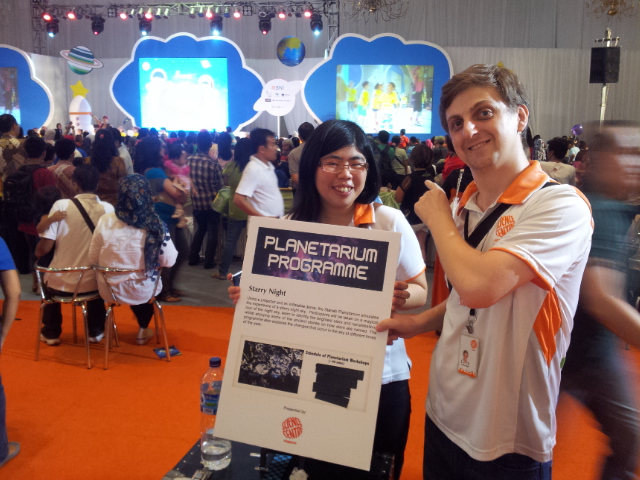
Last week, from 7th-10th Sept, scobbers Murni and Andrew (i.e. myself) journeyed to Jakarta, Indonesia to conduct our first overseas planetarium shows with our trusty STARLAB inflatable planetarium.
It was all part of the annual Kalbe Junior Science Fair, held at Jakarta Convention Center (JCC). Actually, we were more of a small part, as the fair was huge! Occupying the about two large convention halls, with a mixture of sponsor's booths, activities stations, playgrounds, workshops and stage performances. The atmosphere was an amazing bustle of activity and excitement, more popular than the large IT fairs we get here in Singapore.

Here are some highlights:
Checking in for the flight, just within baggage allowance.


Entrance banners


Setting up the dome

In anticipation of the large crowd, we made a temporary barrier of chairs and rope.

Which was further enhanced by a human barrier.

Here they come! Over 30,000 visitors on day one.

Our large dome of stars was very attractive. Was challenging to manage the crowd sometimes but people were always friendly and patient. We increased the number of sessions from 6 to 13 sessions on the first day.

First time someone brought a dog inside the planetarium.

We were right next to the main stage, sometimes it was so loud we couldn't hear ourselves talk, visitors still enjoyed seeing the stars and constellations though. On the stage, there were performances by Indonesian singers and student dance groups as well as talks by Japanese scientist and astronaut Dr Mamoru Mohri.

We issued out stickers/tickets for each session (30 pax per session) by midday, we were out of tickets, all sessions full.
End of day two, all packed up after 2pm session, to make way for the closing ceremony performances.


Other exhibits and attractions:


Tuesday, September 4, 2012

Moon Photos

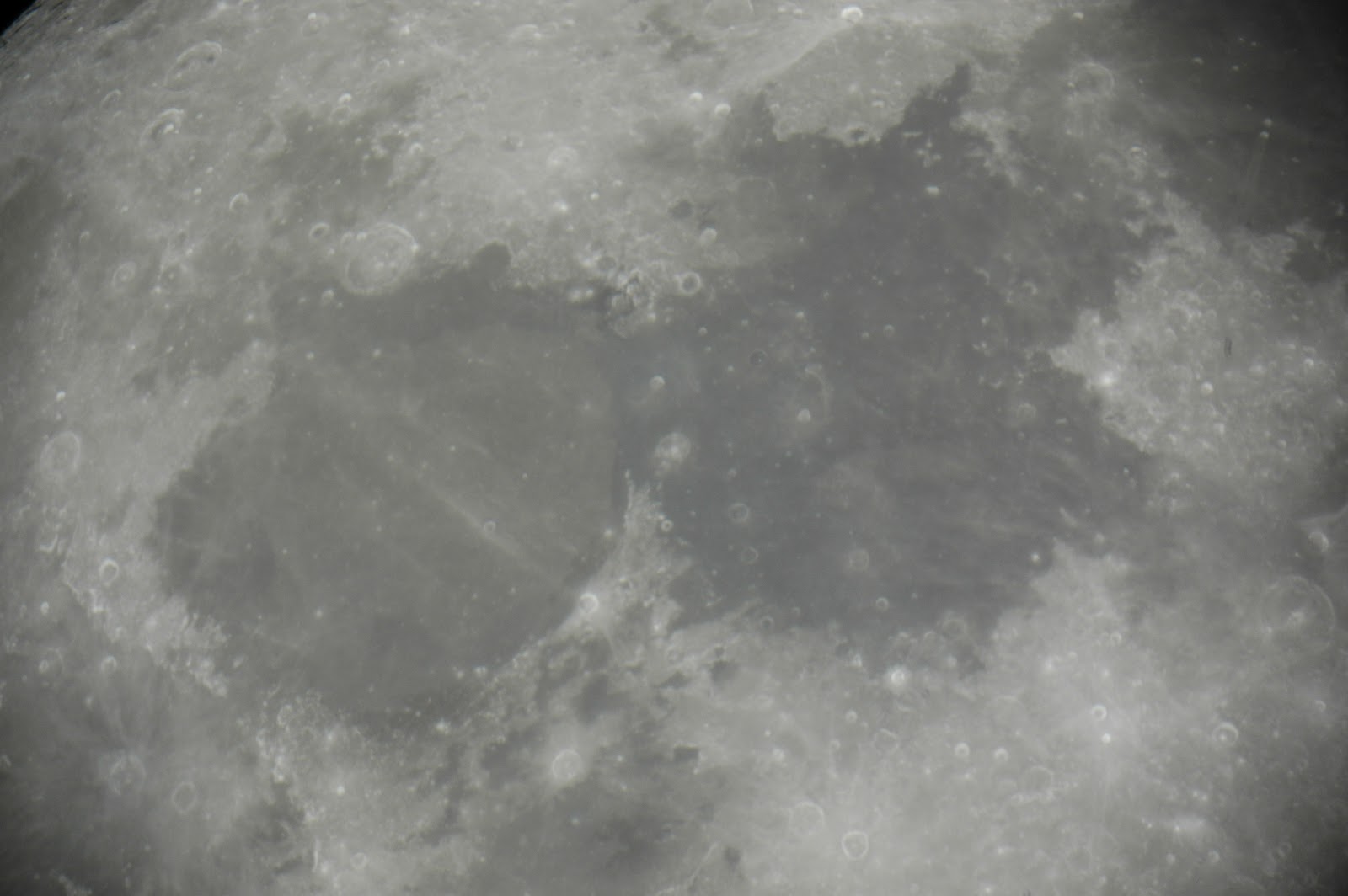
Just a quick post to share some photos which we took last Saturday Night (1st Sept) whilst conducting a stargazing session for a group of students and parents from Pasir Ris Primary School.

It was one day after the Full Moon, therefore hardly any shadow on the surface. Craters stand out best with  some shadow to create an outline and give depth.
Full Moons are good for observing the large dark areas known as seas or "maria" (latin for seas) as well as a few craters with bright rays of dust which spread out across the surface after the original impact.
Crater Tycho - one of the brightest dust ray systems on the Moon

Mare Fecunditatis (Sea of Fecundity) - with crater Langrenus (centre). Also crater Humboldt on the right side edge standing out near the lunar shadow.

Mare Crisium (Sea of Crises) on the top right, along with crater Gauss along the Moon's edge.

Mare Serenitatis (left) and Mare Tranquillitatis (right) - Seas of Serenity and Tranquillity. The far right of Tranquillity is the location of the Apollo 11 landing site, where the late Neil Armstrong took his first steps.

Crater Copernicus (centre) and crater Kepler (bottom centre) - in an area known as Oceanus Procellarum (Ocean of Storms)
The sky was clear enough to see a number of other stars and planets. At the end of the evening I asked our guests what was the best object they saw, almost all replied "The Moon".
Its by far the biggest and brightest object in the night sky and with so many interesting features, I guess its hard not like the Moon.

In honour of Neil Armstrong
Landing site of Apollo 11 (Tranquillity Base) - Taken by NASA's Lunar Reconnaissance Orbiter (LRO). The horizontal tracks from the LM (lunar module) to the crater (Little West) were made by Neil Armstrong as he walked to observe the crater that he narrowly missed when landing the LM for first time back in 1969.

Monday, September 3, 2012

September Sky 2012

September is here and change is abound.

Stars and Constellations of September
For months we've been concentrating on the bright southern constellations like Crux, Centaurus, Scorpius and Sagittarius.
Stars of Sagittarius as seen from Singapore


Scorpius and Sagittarius are still around but now its time for these constellations to gradually move aside for some of the brightest stars in the northern part of the sky like those of Aqulia Cygnus and Lyra, which include the Summer Triangle.

1) Delphinus – a small constellation representing a Dolphin. Visible to the naked eye and binoculars.
2) Coathanger Asterism (Brocchi’s Cluster) – A small group of 10 stars in the shape of a coathanger. Requires binoculars or small telescopes. Located in the faint constellation of Vulpecula.
3) Dumbbell Nebula (M27) – a Planetary Nebula, gas cloud formed from the other layers of a dying star.
Appears as a faint misty ellipse using low magnification.
4) Albireo (Beta Cygni) – a colourful double star, yellow and blue in colour. Requires telescope.
5) Ring Nebula (M57) – A faint planetary nebula in the shape of a ring or halo. Appears misty in small telescopes.
6) Double-Double (Epsilon Lyrae) – Four stars arranged in pairs, very close together. Larger telescopes and high magnifications are need to separate each pair to see all four stars. 600 light-years away.


Some my favourite targets within these constellations are double stars like the colourful Albireo (beta cygni) and the Double Double (epsilon lyrae), as well as a faint collection of stars known as the coathanger asterism (among other names). Visible in binoculars or a finderscope its located near the centre of the Summer Triangle (constellation Vulpecula) and looks like a coathanger.


Double Star "Albireo" - Beta Cygni as seen through the observatory's 16 inch cassegrain reflector telescope
In the unlikely event of extremely clear skies and no moon we may feel ambitious and aim for the faint glows of the Ring Nebula(M57) and Dumbbell Nebula (M27).


Planets
This year, September also sees the disappearance of Saturn, but it can still be seen for a few weeks in the early evening around 8pm.
Mars hangs around for a another month or two, although it now appears very tiny in telescopes. Gradually making its way across the constellation Libra, Mars will eventually end up in front of Scorpius, next to the bright red star Antares.
Antares gets its name from Mars, as "Ares" is Greek for Mars, therefore Antares literally means "Anti-Mars" as they both appear similar in colour (red/orange).


Neptune and Uranus are at their closest position to Earth right now. Neptune was at opposition (in direct alignment with Earth) on 24th Aug and Uranus will reach opposition on 29th Sept.


This means that they'll be visible during the later part of the evening but even at their closest they are still billions of kilometres away so in a telescope they kinda look like this:


The Moon

The best time to view the Moon during our Friday Night Stargazing session will be 21st Sept (Crescent Moon) and 28th Sept (Gibbous Moon).
A good time for moon watching, at home will be on the evenings 19th & 20th Sept, when the crescent Moon moves past the red planet Mars and then between Mars and the red star Antares:


Finally 30th September is Mid Autumn Festival  中 秋 節 - Full Moon/15th day of 8th lunar month (Chinese Lunar Calendar), a time for family celebrations, lanterns and mooncakes.

What's special about this Full Moon is that it's the closest Full Moon to the Autumnal Equinox (22nd Sept, where night and day are equal length).
A common assumption about mid-autumn is that the Full Moon is at its biggest or brightest, which is not the case. Lunar festivals usually have some seasonal significance. For mid-autumn, its harvest time in the northern hemisphere.
The orientation of the Earth during Equinox causes the Moon to rise at a smaller angle and stay in the sky slightly longer (roughly12-13hours) than in previous months. Therefore, warm autumnal temperatures and long moonlight hours make this full moon the ideal time for night harvesting, before the cold winter weather arrives. In Europe, the autumnal Full Moons are called Harvest Moon and Hunter Moon for similar reasons.

Of course, here in Singapore, near the equator, its warm all year round and there is little or no change in the Full Moon's timing in the sky but we still in get to enjoy the festivities.

Friday, August 31, 2012

Not so Blue Moon!

I recently encountered a number of questions about this month's double full moon. The first full moon occurred on 2nd August (2012) and the second is tonight (Friday 31st August).
Its a common misconception that the second full moon in a month is called a "blue moon". I also made this assumption previously, however this is not the case. Having two full moons in one month does not result in a Blue Moon.
Throughout several conversations this week, I have attempted to explain why and this is the best explanation I can come up with:

The rather long background information
Our 12 month Gregorian Calendar is partially based on the 12 Lunar Cycle that often (but not always) occur in one year but individual calendars months (like August) are no longer in sync with the (approximately) 29-day lunar month (i.e. the time between two New Moons).
This results in some months (e.g those with 31 days) having two Full Moons or two New Moons.

The term "once in a Blue Moon" is not related to the number of Full Moons in one month but instead, the number of Full Moons or lunar cycles between two seasons.

Most calendars around the world have significant dates that represent the start of seasons. These dates are based on the Sun's position in the sky.

For example, in European calendars, the "Start of Spring" was usually celebrated on the 20th Mar (or 21st Mar), when the Sun is exactly level with the Earth's equator. This is referred to as Vernal Equinox where day and night are equal in length (Equi -"equal"; Nox -"night").
Likewise, the "start of summer" is usually 21st Jun or Solstice, when the Sun reaches its highest position in the sky, resulting in the longest daylight hours.


In Asian calendars, the "start of spring" (Lichun, 立春) is actually marked by the halfway point between the December Solstice and Vernal Equinox, i.e. when the Sun is 45 degrees behind (or 315 degrees in front of) its Vernal Equinox position.

The actual answer
How does the Blue Moon fit in to all of this?
Most of the time, there are three Full Moons between Equinox and Solstice (i.e. between seasons). But occasionally when a Full Moon occurs on or near the Equinox or Solstice, there will four Full Moons between the seasons. The third moon of a four moon season is called the "Blue Moon" (It will take another essay to explain why).


Consequences and Complications
Having an extra Full (Blue) Moon between seasons makes things a little bit messy, because cultural and religious festivals like Easter and Chinese New Year are based on lunar and seasonal dates.
For example, Chinese New Year is always celebrated on the New Moon closest to Lichun (the start of spring based on the Sun's position).
When there is a Blue Moon between seasons (like in 2013) it can result in the date of next Chinese New Year moving back (e.g from February to January) by almost half a month. Over several years, this gradual shift can result in Chinese New Year moving into winter months like December or November.

To accommodate this, extra/double months have to be added into the Chinese Lunar Calendar during certain years in order to push forward significant festivals, e.g. so that Chinese New Year stays close to spring/LiChun.

Phew ... that explanation was a little bit more complicated and longer than I thought!

Tuesday, August 21, 2012

7 useful astronomy resources

Finding out what's happening up in the sky often involves using a variety of resources, such as books, star charts, astronomy software, apps, etc. Some may present you with a bunch of number or unfamiliar terminology. Here's some of my favourite online resources, which are relatively easy to use and interpret as well as some new ones which I just recently discovered.

This popular astronomy magazine has many useful features on its website. The Sky Chart provides a relatively simple view of which stars and planets you can expect to see at any time of day or year.


After registering your details on the site and opening the sky chart, you first have to set your location/hometown and timezone (i.e. Singapore, GMT+8). Once that's done, you can alter the time and date on the side panel and watch which objects appear during that particular time.

This website provides a static but more detailed starmap for each month, in an easily printable pdf format. The important part is to pick the right map for your part of the world, i.e in Singapore, you'll need the Equatorial Edition.

Enter your desired date and time, and receive a simple image of the moon phase on that particular date.

View any object in the solar system as they would appear from any other object. For example, look at the rings of Saturn as seen from its largest moon Titan or how the Sun and other planets look like from Pluto.
I often use it to get an overall view of the whole solar system, to see the arrangement of planets during significant alignments or the position of current space probes, like New Horizon, which is on its way to Pluto.

On the menu page, you need to select the object you wish to view and  where you want to view it from, as well as the size of the field of view.

NASA Solar System  Simulator -  field of view 45 degrees - wide enough to see Pluto, but too far to see inner planets
NASA Solar System - field of view 5 degrees - only wide enough to see up to Jupiter. but can show position of inner planets.


I recently remembered this rather nice-looking solar system model. Although the size and distances of the planets is not to scale, their positions are accurate.
Just drag the arrow indicating the date around the outer edge or select the running speed on the control bar in the top left corner and watch the planets dance around each other.


The two options at the bottom right corner (Copernican and Tychonian) give two slightly different views: Copernican shows the more realistic view with the Sun at the centre, whereas Tychonian puts Earth at the centre, allowing you to see the position of planets as seen from Earth.

Very similar to dynamic diagrams, except with more options that allow you to adjust the size and scale of the planets. 


Both Planets Today and Dynamic Diagrams appear to be used for astrology, as they provide information regarding the position of the planet's with respect to zodiac star signs (Leo, Gemini, etc). Whilst the zodiac does represents actual constellations, the position of the astrological star signs given in these two sites is scientifically inaccurate and out of date. However, you have to option to remove the zodiac star signs from each diagram.

Finally, for a bit of solar system exploring fun try Ace of Space and pilot your space ship around the solar in the fastest possible time.