Sticky Post

We are currently not maintaining our blog here. Please go to our Facebook Page for latest updates!

Monday, December 9, 2013

Look, a shooting star! (and what happened to Comet ISON?)

Our Solar System is an amazing place. There are a bunch of objects whizzing around the Sun including planets, asteroids and comets. Comets, often called "shooting stars", are very interesting. They are strikingly beautiful, relatively rare and worth studying.

Comet ISON, called the "Comet of the Century" on various media, has been a popular topic since its discovery on 21 September 2012. Below we explain some basic features of comets, illustrated with the example of Comet ISON.

What is a comet?

Great Comet of 1882.
In simple term, a comet is a dirty ice ball moving around the Sun. When passing close to the Sun, it evaporates and displays a thin cloud and sometimes a tail. In scientific terms, the ball is called nucleus and the cloud coma.

Originated from Kuiper belt or Oort cloud, a comet mainly consists of rock, dust, ice, and solid gases such as carbon dioxide and methane. Its dimensions are from few hundreds metres to few kilometres. 

Comet ISON: It is around 2 kilometres long according to Hubble Telescope observation. 

How do we name a comet?

Many naming systems have been used to name comets, therefore many comets have more than one name. 

Comets are named after the year of discovery...

Great Comet of 1680. Isaac Newton used it to verify Kepler's Laws.
Or after the names of discoverer...

Halley's Comet. Discovered and predicted by Edmond Halley, it can be seen every 76 years.
Or according to IAU (International Astronomical Union) system. Comets are designated by the year of the discovery, followed by a letter indicating the half-month, and a number indicating the order of discovery. Prefixes are used to describe the nature of the comet as well.

Comet ISON: Comet ISON was discovered in Russia by International Scientific Optical Network (ISON). Its formal name is C/2012 S1:
  • C/ means that it is non-periodic. It is not likely to revisit the Solar System. Even if it comes back to the Sun next time, it will be another 400,000 years at least!
  • 2012 denotes the year of discovery.
  • S denotes the second half-month of September.
  • 1 indicates it is the first comet discovered in that period.

What is the fate of a comet?

A comet can end up in very drastically different outcomes. The possible fates are:
  • It comes back regularly, for example Halley's comet (period of 76 years).
The orbit of Halley's comet. The next visit is in 2024.
  • The nucleus evaporates by the Sun's immense heat and radiation. The comet is said to fade or extinct. 
3552 Don Quixote.
  • The nucleus may break up under the Sun's gravity or radiation. The remnants are still spectacular.
Breaking up of 73P/Schwassmann-Wachmann in 1995. This animation covers three days.
  • It may fall into the Sun or smash into another planet. Comet Shoemaker-Levy broke up and collided with Jupiter in July 1994.
The brown spots indicate the crash sites of Comet Shoemaker-Levy on Jupiter in 1994.

Comet ISON: According to NASA Comet ISON Observing Campaign, it is very likely that Comet ISON does not survive the trip. Most of the nucleus has been disintegrated by the Sun's gravity pull and intense radiation. All hopes are not lost yet, as a very diffused remnant emerged after the passage. The following short clip shows the time-lapsed images on the NASA STEREO spacecraft. 

(Big animated gif, please be patient... it is worth it!)


We may have been denied the opportunity to observe a bright comet in the night sky, but the scientific data collected is highly valuable. Scientists will know more about the behaviour of comets when they are very near to the Sun, and are able to predict such comets (called Sungrazing comets) better in the future. 

Reference:

Wednesday, October 30, 2013

Halloween Special: Spirits in Space

It's a spooky halloween! Pictured above is an eerie nebula (SH2-136) that is
located about 1,200 light years away from us.
Photo credit: Adam Block, NOAO, AURA, NSF

If you have watched the recent sci-fi space movie, ‘Gravity’ (starring George Clooney and Sandra Bullock), you would have realised the extremely risky nature of space expeditions. When things go seriously wrong up there, death is almost inevitable.

For the Celtic people who lived 2000 years ago, Halloween falls on the eve of their new year, which happens on 1 November. On Halloween (31 October), it is believed that the boundary between this world and the next becomes unclear. This is when the ghosts of the dead start to return to earth.  As we prepare to dress up in our spookiest costumes this Halloween night, let us take the time to remember the heroes who have sacrificed their lives up in space...

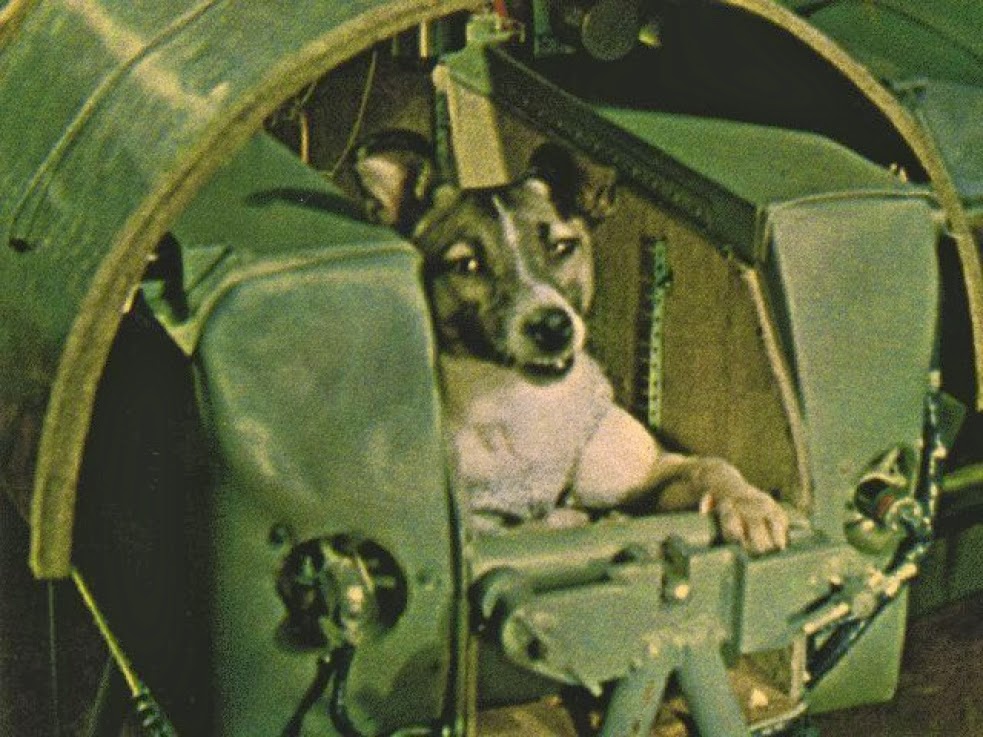
Before Neil Armstrong became the first human to conquer the moon, there had been hundreds of animals that were sacrificed in the name of space exploration. Animals such as monkeys, chimpanzees, dogs, mice and other animals were used as test subjects in space to analyse the effects of space environment such as microgravity and radiation exposure on human during spaceflight.
Laika, the space dog, was the first animal in space. Unfortunately,
she never return as a re-entry plan had not been worked out.
Photo credit: NASA
Unfortunately, the earlier designs for spacecraft construction were still in the experimental phase. As a result, many animals that were sent for spaceflights died from starvation or dehydration during flight and in explosions while on board the shuttle. In some cases, the spacecraft in which the animals flew in were never recovered. This has led to speculations of abandoned ships that might be drifting in orbit together with their animal astronauts.
It is not just animal deaths that happened during space travels. In 1971, three Soviet crew members of the Soyuz 11 spacecraft, Georgi Dobrovolski, Viktor Patsayev and Vladislav had died in space as a result of space decompression during preparations for re-entry. Technically speaking, these are the only human fatalities that occurred in space (100km above sea level) so far.

The unfortunate crew members (from left to right: Georgi Dobrovolski, Viktor Patsayev and Vladislav Volko)
of Soyuz 11 were the first men to occupy the world's first space station.
Photo credit: Joachim Becker/ SpaceFacts

Thanks to the sacrifices of these animals, astronomers are now able to better understand the requirements of bringing a living being into space and also what lies in the universe out there. So the next time you wish upon a shooting star or wonder what that mysterious looking object in the night sky may be, remember that there is more than meets the eye...


Tuesday, October 1, 2013

Happy Belated Mid Autumn Festival!

Scobbers were so busy that we forgot that Mid Autumn Festival has past! Other than filling ourselves with mooncakes and playing with sparklers, we found out some amazing facts about the Moon that you might not know.

1. The Moon was created in a huge impact event by a Mars-like object

Artist's Impression of Giant Impact event (Source: Wikipedia)

Termed as "Giant Impact Hypothesis", most scientists think that the Moon was formed after a great collision between the Earth and a Mars-sized object 4.5 billion years ago. It explains why the Earth and the Moon spin in similar ways. Scientists also did some calculations to show that if the post-impact Earth revolves in a 2-hour period, i.e. a day is 2 hours instead of 24 hours, we can explain some of the observations.

After the direct impact, the cores of the Mars-sized object and the young Earth fused. The collision made the post-impact Earth spin so fast that a significant portion of the Earth's mass was ejected to form the Moon. By the conservation of angular momentum (a quantity to describe an object's rotation), the Earth-Moon system has similar spin directions.

Also, if the Moon was created from the Earth's material we can explain the fact that the Earth and the Moon have similar chemical compositions. For example the isotopes of oxygen and titanium were found to have identical ratios in both lunar and terrestrial rocks.

The Mars-like object is commonly known as Theia. In Greek myth, Theia is a titan who gave birth to Selene the Moon, Helios the Sun and Eos the Dawn. That's why we use Selen- (or lunar) and Helio- to describe stuff related to the Moon and the Sun respectively.

2. We are always looking at the same side of the Moon

Near side of the Moon (Source: Wikipedia)
Far side of the Moon (Source: Wikipedia)
Readers may have known this fact a long time ago. The "dark" side of the Moon has also been depicted in movie as well. Of course, there are neither giant robots nor military bases located at the far side of the Moon, as shown in the NASA Astronomy Picture of the Day on 16 September 2013. (Direct YouTube link)

There is nothing hidden behind the Moon as shown in photos taken by lunar probes. There are only craters at the far side of the Moon (the side that is not facing us). On the other hand, the near side of the Moon (the side that is facing us) has more interesting features. Apart from the craters there are valleys, mountains and maria (meaning Sea in Latin). Maria appear dark as they mainly contain iron compounds that are less reflective. People in ancient times made up stories for the observed patterns, such as the Moon rabbit legend in Chinese culture. Do you see it in the following picture?

Did you see the Moon Rabbit? (Source: Wikipedia)
Regarding why the Moon always faces with the same side, we need to know how gravity works. Every massive object in the universe attracts each other with a force called gravity. For instance, an apple drops to the ground due to the Earth's gravity (the apple also attracts the Earth, but the effect is very negligible due to the Earth's much larger mass). The strength of the gravity depends on the distance between two objects, so in this case the near side is more attracted than the far side is, making the Moon face towards the Earth with only one side. This effect is called "Tidal Locking".

3. One day, we will lose the Moon

The Moon exerts a gravitational force on the Earth (and vice versa), pulling the water nearer to itself and causing high tide on the Earth. As the Earth rotates underneath the water (we can imagine Earth being a solid rocky ball covered by water), it tugs the tides and loses some of the rotational energy. As a result, the Moon picks up some of the energy and then speeds up, ascending from its orbit. On average, the distance between the Earth and the Moon increases by around 4 cm every year.

It has an interesting side effect: as the Earth loses rotational energy it will rotate slower and slower. The length of a day will increase as a result, amounting to 2 millisecond per century. Wish to have 48 hours per day? Perhaps if you're still around after 4 billion years!

Reference:
  1. Wikipedia. Moon. Retrieved 20 September 2013, from http://en.wikipedia.org/wiki/Moon
  2. Geology 5835 - The Moon - Fall 2006. University of Colorado Boulder. Retrieved 20 September 2013, from http://lasp.colorado.edu/life/GEOL5835/Moon_presentation_19Sept.pdf
  3. A New Model for the Origin of the Moon. Harvard University. Retrieved 24 September 2013, from http://www.fas.harvard.edu/~planets/sstewart/Moon.html
  4. M. Ćuk, S.T. Stewart (2012). Making the Moon from a Fast-Spinning Earth: A Giant Impact Followed by Resonant Despinning. Science Vol. 338 no. 6110 pp. 1047-1052.

Friday, September 13, 2013

A small upgrade at SCOB


We have recently upgraded our observatory step by step! (pun intended) We have placed anti-slip strips on every step of the stairway to the Observatory. Scobbers Chua, Li Fei and Joanna have been busy under the hot weather :)


Now the steps will not become as slippery as before when it rains. Still, please go up the stairway one step at a time carefully :)

Friday, August 30, 2013

Venus: A Hostile Planet

It has been over one year since we witnessed Venus travelling in front of the Sun. We had an event last year to observe this rare phenomenon. Did you come?

Venus spotted in front of Science Centre's entrance.

Venus spotted in Johor Bahru, Malaysia.

In these few months we can observe Venus when we look towards the western sky. Often mistaken for a star, Venus appears as a very bright speck in the sky. It is so bright that it can actually cast shadows on Earth. 

Here are some short facts about Venus:
  • It is Earth's Twin Sister. It is the closest planet to Earth, and similar to Earth in terms of size and mass.
  • It is the only planet in the Solar System that is named after a female figure.
  • On Venus, a day is longer than a year. One Venusian day is 243 Earth days, and one Venusian year is 224.7 Earth days.
  • It is the hottest planet in the Solar System. The average surface temperature on Venus is 462 °C.
The last statement comes from the fact that Venus is shrouded by a thick atmosphere which consists of carbon dioxide and sulfuric acid. These gases form highly reflective clouds, preventing us from observing the Venus surface directly. In other words, the pictures we see are actually the Venusian atmosphere instead of the surface. Active volcanic activities happen on the surface of Venus, as evident in the radar image below. These make Venus an extremely hostile place for us to go!

Venus. The surface is obscured by thick clouds. (Wikipedia)

Craters on the surface of Venus. (Wikipedia)

Fortunately for us Earthlings, we can observe Venus from a safe distance (1.7 x 10^8 kilometres, or 17 followed by 7 zeros). Around 7pm to 9pm, we can observe Venus now until end of November. Look towards the Western sky and say hello to Venus! Science Centre Observatory opens every Friday from 7:45pm to 10pm, come and join us!